

Winnipeg is one of those cities that reveals itself slowly. At first glance, it is a prairie capital on a flat horizon, known for long winters and big skies. Spend some time here, though, and a more complex identity emerges: a meeting place with deep Indigenous roots, a crucible of labour and civil rights history, and a contemporary hub where Franco-Manitoban, Métis, Filipino, Ukrainian, and many other communities shape daily life. This guide explores the culture, history, and defining experiences that give Manitoba’s capital its distinct personality today.
A Meeting Place at the Forks of Two Rivers
To understand Winnipeg’s culture, it helps to start at the waters that first drew people here. Long before Canada existed as a country, the junction of the Red and Assiniboine rivers was a vital gathering place for Indigenous nations, including Anishinaabe, Cree, Dakota, and later the Red River Métis. Families camped, traded, told stories, and negotiated alliances on this riverside plain, using the waterways as travel corridors across the prairie. That heritage survives in the way many local residents still describe Winnipeg as a meeting place rather than simply a city.
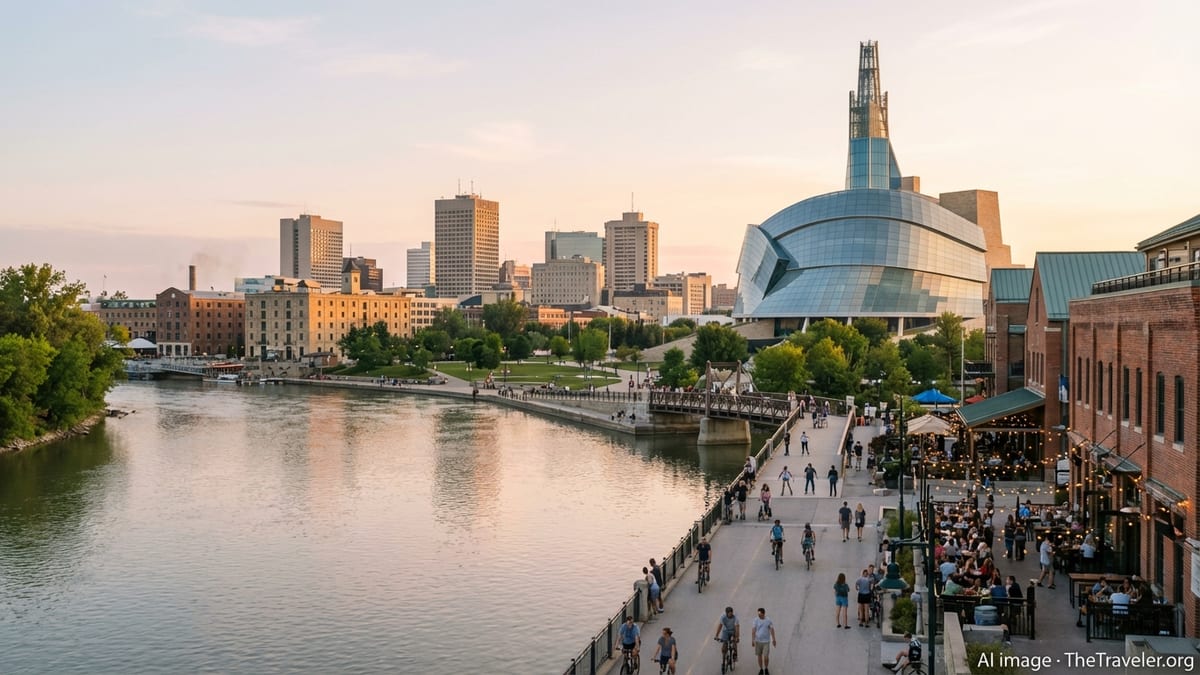
Today, The Forks remains one of Winnipeg’s most symbolic spaces. The former railway yards have been reimagined as a public market, riverfront promenade, skate park, and gathering ground where festivals, outdoor concerts, and winter events unfold through the year. In summer, patios face the water and buskers play to families and cyclists; in winter, the site becomes a launch point for skating trails and snow sculptures. Throughout, interpretive panels and Indigenous public art acknowledge the layered history underfoot, from ancient campsites to the beginnings of the fur trade era.
Just steps away, the Canadian Museum for Human Rights anchors the skyline with an angular glass tower inspired in part by prairie ice formations and the idea of a beacon. Inside, exhibits trace global and Canadian struggles for human rights, including the histories of Indigenous peoples, women, migrants, and 2SLGBTQ+ communities. The museum’s presence beside this long-standing meeting place underlines a theme that runs through Winnipeg’s story: the city is not only shaped by cultural diversity, but also by ongoing conversations about justice, memory, and reconciliation.
Riverwalks, guided tours, and seasonal boat rides all help visitors connect the contemporary city back to this geography. Whether you are watching northern lights dance over the river ice or listening to live music from the outdoor stage on a summer night, the Forks area continues to function much as it did centuries ago, as a space where people gather, share experiences, and decide what kind of community they want Winnipeg to be.
Indigenous and Métis Roots That Still Shape the City
Indigenous and Métis cultures are not just part of Winnipeg’s past; they are integral to its present identity. Manitoba’s capital sits within Treaty 1 territory and the National Homeland of the Red River Métis, a fact increasingly acknowledged in public events, classroom curricula, and civic institutions. Powwows, round dances, and cultural workshops are held across the city, and Indigenous leaders play prominent roles in politics, arts, education, and social advocacy. For travelers, this means multiple opportunities to learn from community voices, often directly rather than through filtered interpretation.
The Manito Ahbee Festival, typically held in May, exemplifies this living culture. Centered around one of the largest powwows in North America, it brings together dancers, drummers, artists, and families from across the continent for several days of competition, ceremony, and celebration. The festival also includes music showcases and market spaces where artisans sell beadwork, moccasins, prints, and contemporary fashion influenced by traditional designs. Visitors are welcome, provided they follow guidance on protocol and show respect for the spiritual elements of what they are witnessing.
Institutions such as the Manitoba Museum, the Canadian Museum for Human Rights, and community-based cultural centers present exhibitions co-created with Indigenous curators and knowledge keepers. These displays explore histories of the fur trade, residential schools, and resistance movements, but also highlight resilience, language revitalization, and contemporary art. Murals across downtown and in neighbourhoods such as the North End feature imagery of bison, beadwork patterns, and Indigenous leaders, transforming ordinary walls into public storytelling spaces.
Travelers interested in more structured learning can join Indigenous-led walking tours, which interpret sites from an Anishinaabe or Métis perspective and frame the city’s architecture within much longer histories of land use and governance. The result is a more nuanced understanding of Winnipeg, not as an isolated modern city, but as one chapter in a much older story about this prairie river junction and the peoples who have cared for it over generations.
From Fur Trade Post to Prairie Metropolis
Winnipeg’s transformation from a riverside trading post into a regional capital has left an imprint on its streetscapes and civic character. In the 19th century, Hudson’s Bay Company posts and Red River settlements evolved into a commercial hub once the railway arrived. For a time, the city marketed itself as the “Gateway to the West,” a place through which newcomers, goods, and grain flowed toward the vast prairies. The boom years of the late 1800s and early 1900s filled the downtown with warehouses, banks, and theatres, many of which survive in remarkably intact form.
The Exchange District, a 20-block historic area north of Portage and Main, preserves this era particularly vividly. Rows of brick and stone warehouses feature ornate cornices, arched windows, and cast-iron details that speak to an age when investors expected Winnipeg to rival Chicago. Today, the district is protected as a National Historic Site and has become one of the city’s main cultural quarters, filled with galleries, design studios, cafes, and performance venues. It is also a compact, walkable neighbourhood, where most destinations are within a few minutes of one another.
Winnipeg’s history is not only one of commercial ambition but also of social movements. The 1919 Winnipeg General Strike, one of the most significant labour actions in Canadian history, saw more than 30,000 workers walk off the job for six weeks to demand better wages and working conditions. Interpretive displays and guided tours around City Hall and the Exchange District recount the strike’s events, from massive street rallies to the eventual crackdown. This history of collective action and dissent continues to inform how many locals think about fairness, community organizing, and the importance of strong public institutions.
As the 20th century progressed, Winnipeg’s growth slowed compared to western cities such as Calgary and Vancouver. Yet that relative pause helped preserve older buildings that might otherwise have been demolished. The result is a downtown where Edwardian warehouses, modernist office blocks, and contemporary condos coexist, creating visual evidence of shifting economic fortunes and urban planning philosophies. For visitors, wandering these streets is a way to read Winnipeg’s layered history in brick, glass, and stone.
Neighbourhoods That Tell Stories: Saint-Boniface, the North End, and Beyond
Winnipeg’s culture becomes most tangible at the neighbourhood level, where distinct histories and communities shape daily life. Saint-Boniface, directly across the Red River from downtown, is the historic heart of Franco-Manitoban life and home to the largest Francophone community in Western Canada. Bilingual storefronts, patisseries, and cafés line Provencher Boulevard, and you are as likely to hear French as English on the sidewalks. The neighbourhood’s character blends European influences with Métis heritage and contemporary Prairie sensibilities.
Le Musée de Saint-Boniface, housed in a former Grey Nuns’ convent built with a distinctive Red River frame construction technique, explores local Franco-Manitoban and Métis stories. Exhibits cover the early mission era, the rise of Louis Riel and the Red River Resistance, and the ways language and culture have been sustained through schools, churches, and community organizations. Nearby, the remains of the Saint-Boniface Cathedral and the adjacent cemetery offer a quiet, reflective counterpoint to the nearby cafés, with headstones that trace generations of local families.
North of downtown, the North End has long served as a landing place for newcomers. In the early 20th century, it was shaped by Ukrainian, Jewish, Polish, and other Eastern European immigrants, many of whom worked in rail yards and factories. Over time, the demographic mix has shifted to include strong Indigenous, Filipino, and other communities. The result is a neighbourhood where perogy shops, Filipino bakeries, and Indigenous community centers can exist within a few blocks of one another. Murals, community gardens, and social enterprises reflect a strong grassroots ethos.
Other districts add their own notes to Winnipeg’s cultural chorus. Osborne Village, just south of downtown, mixes vintage shops, music venues, and bars popular with students and young professionals. Corydon Avenue offers a dense strip of Italian-influenced restaurants, patios, and gelato spots that come alive on warm evenings. Even suburban areas often host cultural centers, temples, and churches that serve specific communities, from Sikh gurdwaras to Portuguese and Greek halls that double as festival spaces.
Festivals, Theatre, and the City’s Creative Energy
For a city of its size, Winnipeg supports an unusually dense calendar of festivals and performances. Much of the city’s cultural life is seasonal, responding to the extremes of prairie weather. In summer, open-air events and late sunsets draw people outdoors; in winter, festivals embrace the snow and ice rather than simply enduring them. This rhythm shapes how Winnipeggers socialize and how visitors experience the city across the year.
Folklorama, held for two weeks each August, is among the city’s signature events. Billed as one of the world’s largest and longest-running multicultural festivals, it features dozens of pavilions hosted by cultural communities across Winnipeg. Each pavilion presents live performances, displays, and food that highlight traditions from regions such as the British Isles, Ghana, Latin America, Hungary, Greece, and French Canada, among many others. Recent editions have drawn hundreds of thousands of visits and involved tens of thousands of volunteer hours, illustrating the scale of community involvement.
The Winnipeg Folk Festival, staged over four days in early July at Birds Hill Provincial Park just outside the city, is another cultural touchstone. Founded in the 1970s, it has grown into a major music gathering, attracting tens of thousands of attendees with a lineup that blends international acts, Canadian headliners, and local artists. The festival is as much about the relaxed, community-focused atmosphere and campground culture as it is about the main stage, reinforcing Winnipeg’s reputation for grassroots arts scenes and volunteer-driven events.
Within the city itself, the Winnipeg Fringe Theatre Festival turns the Exchange District into a hub of experimental and independent theatre each July. Dozens of venues host hundreds of performances ranging from solo storytelling to physical theatre and comedy, while Market Square fills with buskers, food vendors, and casual crowds. Year-round, institutions such as the Royal Manitoba Theatre Centre, Prairie Theatre Exchange, the Winnipeg Symphony Orchestra, and the Royal Winnipeg Ballet contribute to a performing arts scene that punches above the city’s population size.
Winter City Spirit and Outdoor Culture
Winnipeg’s climate is legendary, with cold, dry winters that have become part of the city’s identity. Rather than hiding from the season, many residents lean into it, cultivating a winter culture that visitors can experience in everything from architecture to everyday habits. Double vestibule doors, heated bus shelters, and extensive skywalk systems are practical adaptations, but the emotional response to winter is shaped just as much by festivals and outdoor activities.
At The Forks, the Red and Assiniboine rivers often freeze solid enough to support one of the world’s longest natural skating trails, connecting downtown to residential areas upstream. Warming huts designed by architects and artists from around the world line the route, offering shelter and visual interest. Some years, the trail extends for several kilometers, lit by soft string lights and the occasional fire pit, making evening skates a local ritual. Rental shops and cafes make it easy for short-term visitors to join in.
Events such as outdoor art installations, ice sculpture competitions, and winter markets add to the seasonal atmosphere. Neighbourhoods across the city host toboggan slides, community rinks, and snowshoe trails. The surrounding prairie and nearby parks provide opportunities for cross-country skiing and wildlife viewing, with crisp air and clear skies that can be ideal for photography. For those unused to such conditions, local advice on layering clothing and protecting against wind chill is as much a part of the cultural experience as any museum visit.
Even indoors, winter shapes the city’s rhythms. Cozy cafes, independent cinemas, and live music bars become refuges where people linger over conversations, readings, and performances. Many cultural institutions schedule major exhibitions and concert series through the colder months, giving residents and visitors reasons to venture out despite the temperature. This seasonal resilience, and the sense of humour that often accompanies it, is a defining part of what it means to belong to Winnipeg.
Food, Everyday Life, and What Defines Winnipeg Today
Food is one of the clearest ways to taste Winnipeg’s diversity and understand how migrations have shaped the city. Ukrainian perogies and cabbage rolls, Filipino pancit and halo-halo, Vietnamese pho, Ethiopian injera, and South Asian curries can all be found within relatively short distances of one another. Locally owned restaurants serve everything from classic diner fare to experimental tasting menus that feature prairie ingredients such as bison, pickerel, wild mushrooms, and Saskatoon berries.
Neighbourhood festivals and social halls often double as culinary destinations. At Folklorama and other cultural events, volunteers prepare recipes passed down through generations, offering visitors the chance to sample dishes that might not appear on standard restaurant menus. Community centres, churches, and cultural organizations host periodic dinners, bake sales, and holiday markets where food becomes a vehicle for storytelling and fundraising alike.
Everyday life in Winnipeg is also shaped by a sense of scale. The city is large enough to sustain major cultural institutions, universities, and professional sports teams, yet small enough that people frequently describe it as a “big small town.” It is common for artists, activists, and entrepreneurs from different scenes to know one another, leading to collaborations that might be less likely in more anonymous megacities. This interconnectedness can make it easier for visitors to have meaningful conversations and access insider perspectives, especially if they attend community events rather than only major attractions.
While Winnipeg faces challenges familiar to many North American cities, including economic inequality and debates over urban development, there is a strong current of civic engagement. Residents organize around issues such as housing, transit, and reconciliation, and local media give significant attention to community initiatives. Taken together, these elements help explain what defines Manitoba’s capital today: a place where deep histories meet contemporary creativity, where winters are cold but social networks are warm, and where cultures from around the world continue to reshape life at the junction of two rivers.
The Takeaway
Winnipeg is not a city that fits neatly into a single narrative. Its culture is rooted in Indigenous and Métis homelands, layered with Franco-Manitoban and immigrant histories, and continually refreshed by new arrivals and emerging artists. The Forks, the Exchange District, Saint-Boniface, and the North End each reveal different facets of the city’s identity, from labour struggles and human rights advocacy to culinary traditions and grassroots festivals.
For travelers, this means that the most rewarding experiences often come from slowing down and engaging with local communities. Attend a powwow or a Folklorama pavilion, take a walking tour with an Indigenous or Franco-Manitoban guide, or spend an evening following live music from a small venue to a late-night diner. Visit in winter to experience the river skating trails and warming huts, or in summer to wander outdoor markets and patios long after sunset. Either way, Winnipeg offers a chance to encounter a prairie capital defined less by tourist spectacle and more by the everyday creativity, resilience, and hospitality of the people who call it home.
FAQ
Q1. What is the best time of year to experience Winnipeg’s culture?
Many visitors choose summer, when festivals like Folklorama, the Winnipeg Folk Festival, and the Fringe Theatre Festival animate parks and historic districts. Winter, however, offers its own cultural experiences, including river skating, outdoor art installations, and cozy indoor performances. The best season depends on whether you prefer warm-weather events or snow-filled adventures.
Q2. How many days should I plan for a first visit to Winnipeg?
A stay of three to four days allows enough time to explore The Forks and the Canadian Museum for Human Rights, wander the Exchange District, visit Saint-Boniface, and sample a few neighbourhoods and restaurants. If you want to attend a major festival or add day trips to nearby parks, five to six days will feel more relaxed.
Q3. Is Winnipeg a walkable city for visitors?
Several central areas are very walkable, especially The Forks, downtown, the Exchange District, Saint-Boniface, and Osborne Village. Distances between neighbourhoods can be significant, so most visitors combine walking with public transit or rideshares. In winter, sidewalks are generally maintained, but good footwear and layered clothing are important.
Q4. How can I respectfully engage with Indigenous culture while in Winnipeg?
Look for Indigenous-led tours, galleries, and cultural events, and follow the guidance of organizers about photography and protocol, especially at powwows and ceremonies. Choosing to support Indigenous-owned businesses and artists, listening more than speaking, and learning basic context about Treaty 1 territory before you arrive are all respectful steps.
Q5. What neighbourhoods are most interesting for food and nightlife?
The Exchange District, Osborne Village, Corydon Avenue, and parts of downtown offer strong concentrations of restaurants, cafes, and bars. Saint-Boniface adds Francophone bakeries and bistros, while the North End and nearby areas are good places to seek out Ukrainian, Filipino, and other community-focused eateries. Nightlife tends to be relaxed and concentrated in a few main strips rather than spread evenly across the city.
Q6. Are there family-friendly cultural activities in Winnipeg?
Yes. The Forks is particularly popular with families, with open spaces, playgrounds, a market, and seasonal programming for children. Museums often offer interactive exhibits, and festivals such as Folklorama and the Winnipeg Folk Festival include family areas and daytime shows. In winter, community rinks and toboggan hills are an essential part of local family life.
Q7. How cold does Winnipeg get in winter, and how should I prepare?
Winnipeg winters are typically very cold, with temperatures often well below freezing and wind chill that can make it feel significantly colder. Visitors should bring insulated boots, a warm parka, hat, mittens, and layers of clothing. With proper gear, you can comfortably enjoy outdoor activities such as skating and walking tours, then warm up in cafes, galleries, and museums.
Q8. What defines Winnipeg’s identity compared with other Canadian cities?
Winnipeg combines a strong sense of local community with a deep awareness of history and social issues. Its position as a meeting place for Indigenous nations, its role in the labour and human rights movements, and its dense calendar of grassroots festivals give it a distinctive character. Many visitors notice the city’s blend of big-city arts institutions with the feel of a close-knit prairie town.
Q9. Can I experience Francophone culture without speaking French?
Absolutely. In Saint-Boniface, many residents and staff at museums, cafes, and restaurants are bilingual, and signage is typically in both French and English. Even without fluency, you can enjoy Francophone food, music, and architecture, and you may find that locals appreciate any effort to use simple French greetings.
Q10. Is Winnipeg safe for travelers exploring on their own?
Like any city, Winnipeg has areas where it is wise to be cautious, especially late at night, but most visitors find that central neighbourhoods and major attractions feel comfortable when using common-sense precautions. Sticking to well-lit streets, being aware of your surroundings, and asking locals or hotel staff for up-to-date advice on where to go and how to get around are practical ways to stay safe.