

More news on this day
Bargain-hunters in northwest England are eyeing Krakow as one of Europe’s standout city breaks, as ultra-competitive fares from Liverpool combine with the Polish city’s reputation for value, culture and character.
Get the latest news straight to your inbox!
Low Fares Now, Cost Pressures on the Horizon
Low-cost carriers across Europe are still advertising attention-grabbing prices on short-haul routes, and departures from Liverpool John Lennon Airport to Polish hubs are part of that trend. Industry analysis shows that some leading budget airlines have cut average economy fares, with publicly available data indicating drops of more than 40 percent in some cases, even as demand for leisure travel remains robust.
At the same time, broader aviation forecasts suggest that today’s deals may not last indefinitely. International airline bodies expect passenger revenues to rise in 2026, while highlighting growing labor and sustainability costs that are beginning to filter into ticket pricing. Analysts point to new fuel-blending requirements in the European Union and rising expenditure on sustainable aviation fuels as medium-term pressures that could push fares higher across the continent.
Geopolitical tensions are also feeding into uncertainty over fuel costs. Coverage of the energy market notes that disruptions in the Middle East have driven up jet fuel prices as the 2026 summer season approaches, prompting some carriers on longer routes to add surcharges and warn of higher prices ahead. While intra-European hops such as UK to Poland remain relatively shielded compared with long-haul flights, overall volatility in operating costs is one reason many travel-watchers advise locking in attractive fares early.
Market studies of global air travel in 2026 underline that competition among low-cost carriers is still intense, keeping many advertised fares keen in the short term. However, with travel demand stabilising after the post-pandemic surge rather than collapsing, the current window of unusually cheap tickets from regional UK airports may narrow as airlines test higher prices on popular leisure routes.
Krakow’s Status as Europe’s Best-Value City Break
If cheap flights are the trigger, Krakow’s on-the-ground value is what turns a weekend away into a compelling proposition. Repeated consumer surveys in the United Kingdom have ranked Krakow at or near the top of European city-break charts, praising its combination of historic centre, compact layout and strong value for money in accommodation, dining and local transport.
Recent tourism statistics from the city highlight just how firmly Krakow has re-established itself on the European short-break map. Municipal reporting for 2025 shows visitor numbers surging back, with millions of overnight stays and international guests drawn by curated cultural events, major festivals and a growing selection of hotels and serviced apartments across different price brackets.
Independent budget breakdowns for 2026 describe Krakow as a destination where travellers can still assemble a full day of sightseeing, café stops and hearty meals at prices noticeably below those in many Western European capitals. Mid-range restaurant dinners, museum tickets and public transport passes remain competitively priced, and even premium experiences such as tasting menus at Michelin-recognised venues often undercut equivalents in London, Paris or Rome.
This perception of affordability is being reinforced by city and regional initiatives promoting “value without overtourism,” with tourism strategies centred on spreading visitors beyond the Old Town and encouraging longer, more immersive stays. For short-break travellers flying in from Liverpool, that translates into a sense that their money stretches further, without sacrificing comfort or cultural depth.
Atmospheric Old Town, Living History and Emerging Food Scene
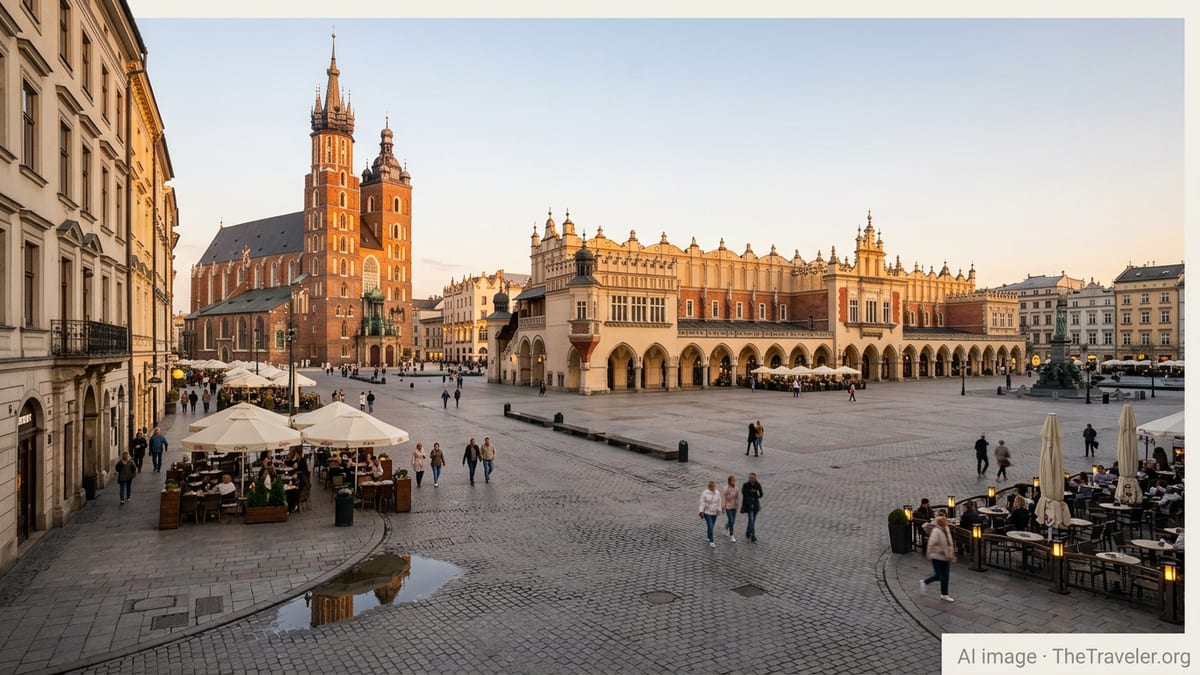
Once on the ground, visitors find a city whose physical fabric lives up to the hype. Krakow’s Old Town, encircled by the green belt of the Planty Park, is one of Europe’s most intact medieval cores. The vast Main Market Square, flanked by townhouses, churches and the Cloth Hall, is the backdrop to street musicians, flower stalls and café terraces that stay busy from morning to late evening.
Just beyond the Old Town, Wawel Hill and its royal castle complex provide a sweeping introduction to Poland’s royal and religious history. Across the river, the former Jewish district of Kazimierz mixes synagogues and small museums with galleries, cafés and bars that have turned it into one of the city’s most characterful neighbourhoods. Contemporary guides for 2026 point to both areas as anchors for first-time itineraries, with most of the key sights reachable on foot from centrally located hotels and apartments.
The city’s food and drink scene has been evolving just as fast as its visitor numbers. Local and international coverage notes that more than 20 venues in Krakow now feature in the Michelin Guide, including Poland’s only two-star restaurant. At the same time, budget-friendly options remain abundant, from pierogi and zapiekanka vendors to modern bistros pushing creative versions of Central European comfort food, ensuring that travellers on low-cost flights are not priced out of dining well.
Nightlife and culture add further layers. Long-established festivals, contemporary art spaces and concert venues mean that weekends often coincide with major events, while the city’s academic population keeps bars and clubs busy during term time. For many Liverpool-based visitors, that mix of youthful energy and historic setting is central to Krakow’s appeal as a short break that feels bigger than its modest size.
Timing, Crowds and Why Booking Early Matters
Krakow’s success brings challenges, and timing a visit is becoming more important. City and European research projects focused on tourism management describe Krakow as one of the continent’s major urban destinations, with peak summer months now characterised by packed squares and busy museum queues. Local tourism bodies have responded with strategies to promote shoulder-season travel, and 2026 campaigns are placing particular emphasis on spring and autumn as optimal windows.
Spring 2026 illustrates that logic. Recent rankings of Easter getaways placed Krakow among Europe’s best-value options for the holiday period, based on analysis of thousands of package deals. With Easter falling early in April, airlines and tour operators have loaded extra capacity into late March and early April, but reports indicate that central hotels and popular tours can still sell out weeks ahead, particularly at the most competitive price points.
There is also a broader structural reason to move quickly. Studies of global airfare trends for 2026 suggest that, while prices may not spike dramatically, airlines are unlikely to keep discounting indefinitely on routes that consistently fill. In a climate of higher wage bills, environmental compliance costs and uncertain fuel markets, travel economists expect carriers to continue testing the upper limits of what leisure passengers will pay for well-loved city-break destinations.
For would-be visitors from Liverpool, that makes the current crop of low fares an opportunity with a timer attached. Booking flights and accommodation several months in advance, particularly for school holidays or major events, remains the most reliable way to secure the kind of deal that has helped Krakow earn its reputation as Europe’s standout value city break.
A Polish City Break That Still Punches Above Its Weight
Beyond prices and forecasts, Krakow’s enduring draw lies in how much it offers over a two or three-night stay. Travel data services and search trends for 2025 and 2026 show the city climbing global rankings as more international travellers discover, or rediscover, its blend of walkable heritage districts, green spaces and contemporary culture.
From Liverpool, flight times of around two and a half hours put Krakow within easy reach for a long weekend, yet the shift in setting feels pronounced. Gothic churches, Renaissance courtyards and 19th-century townhouses form the daily backdrop, while excursions to sites such as the Wieliczka Salt Mine or the former concentration and extermination camp at Auschwitz-Birkenau give the trip historical and emotional weight for those who choose to include them.
For many travellers, that balance of leisure and learning, café culture and reflection, explains why Krakow has become a repeat-visit destination rather than a one-off tick on a list. Combined with today’s unusually competitive airfares from regional UK airports, it is turning the Polish city into one of 2026’s most compelling short-break choices, and a trip that many budget-conscious travellers will be keen to book before prices inevitably edge higher.