

More news on this day
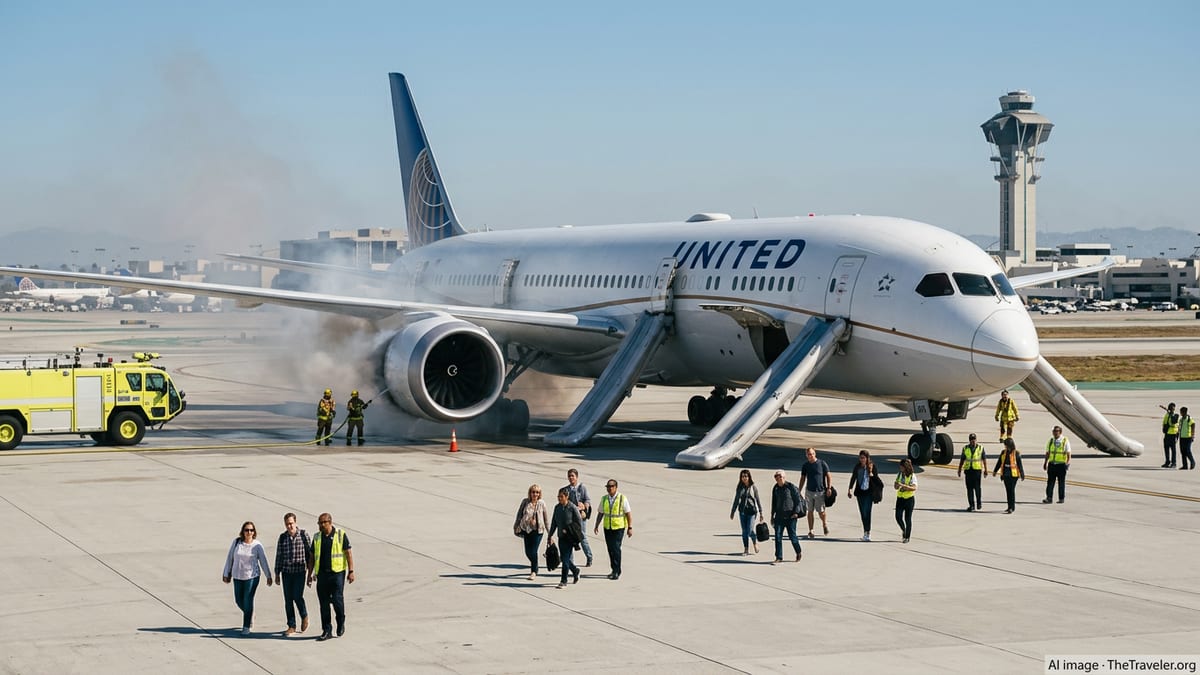
A United Airlines Boeing 787-9 Dreamliner bound for Newark made a safe emergency return to Los Angeles International Airport on Monday after a reported issue with its left engine, prompting a dramatic full evacuation on the taxiway but no serious injuries.
Newark-Bound Flight Turns Back After Midair Engine Alert
The incident involved United Airlines Flight 2127, which departed Los Angeles late Monday morning for Newark Liberty International Airport with more than 250 passengers on board. According to officials, the widebody jet took off at approximately 10:40 a.m. local time before the flight crew reported a problem with the aircraft’s left engine less than an hour into the journey.
Flight-tracking data and federal aviation officials indicate the crew requested an immediate return to LAX, where the Boeing 787-9 landed safely around 11:20 a.m. The aircraft taxied to a remote area of the airfield, where emergency crews were already positioned in anticipation of a possible fire or mechanical failure.
Video from the airfield showed smoke coming from the Dreamliner’s left engine nacelle as fire crews approached the aircraft. Authorities later described the situation as a possible engine fire, though the precise nature of the malfunction has not yet been determined.
Rapid Evacuation on Taxiway, No Serious Injuries Reported
Once the jet came to a stop on the taxiway, the pilots ordered an evacuation. Slides were deployed from multiple exits, and passengers and crew began leaving the aircraft within minutes. Some passengers opted to descend via stairs brought to the aircraft, while others slid directly to the tarmac before being guided away from the plane by firefighters and ground staff.
Officials said approximately 256 passengers and 12 crew members were on board the Dreamliner. Medical teams at the scene evaluated travelers, but authorities reported no serious injuries. One minor injury, described as a small cut to a passenger’s finger, was noted by local responders, though it did not require hospital transport.
United said customers were transported by bus back to the terminal, where the airline began arranging alternative flights to get travelers to their final destinations. The carrier praised its crew and emergency responders for their quick coordination during the evacuation and emphasized that safety remained its top priority.
Ground Stop at LAX and Ripple Effects for Travelers
The emergency return briefly disrupted operations at one of the world’s busiest airports. The Federal Aviation Administration issued a ground stop for flights destined for LAX while the Dreamliner was on approach and during the subsequent evacuation, halting some arrivals from major Western hubs.
The ground stop, which lasted about 30 to 60 minutes depending on the source, was lifted once the aircraft was secured and fire crews confirmed the situation was under control. Even after the restriction ended, passengers elsewhere in the terminal reported modest delays as airport staff worked through the resulting backlog of arrivals and departures.
For travelers already on board Flight 2127, the disruption was far more immediate. Evacuated passengers were escorted to the terminal, where United staff worked to rebook connections and arrange meal and hotel vouchers where required. Some customers were accommodated on a replacement aircraft to Newark later in the day, while others were re-routed through alternate hubs in the United network.
Focus on Boeing 787-9 and Engine Safety
The aircraft involved was a Boeing 787-9, a long-haul variant of the Dreamliner family commonly used on transcontinental and international routes. The twin-aisle jet is known for its fuel efficiency and advanced composite structure, and is a cornerstone of United’s widebody fleet.
Engine reliability remains a central focus for regulators and airlines alike, particularly on long-range jets that routinely conduct flights of eight hours or more over water. Modern engines are designed with multiple safety systems, including sensors and onboard fire suppression, to detect and address anomalies midflight and to protect the aircraft’s structure.
In this case, emergency systems and crew procedures functioned as intended, aviation analysts noted, with the pilots returning to the departure airport, requesting priority handling, and overseeing a prompt evacuation once the aircraft stopped on the taxiway. Images from the scene show firefighters dousing the affected engine area and inspecting the nacelle for signs of heat damage or fuel leaks.
FAA Investigation and Reassurances for Passengers
The Federal Aviation Administration has opened a formal investigation into the engine issue, a standard procedure following emergency landings involving potential fire or mechanical failure. Investigators are expected to review cockpit recordings, maintenance logs, and data from the aircraft’s onboard monitoring systems to determine the root cause.
United Airlines said it is cooperating fully with regulators and that the Dreamliner will remain out of service while technical teams carry out detailed inspections. Depending on the findings, the probe could extend to inspections of similar engines in the fleet, although officials have not announced any broader checks beyond the affected aircraft.
For passengers planning upcoming travel, industry experts stressed that such incidents, while dramatic, are statistically rare and that modern airliners are engineered to withstand the loss or degradation of an engine and still land safely. The safe return of Flight 2127 and the absence of serious injuries highlight the multiple layers of redundancy built into both aircraft design and airport emergency response at major hubs like LAX.