

More news on this day
United Airlines is moving into a new phase of growth, pairing one of the industry’s most aggressive fleet expansion programs with upgraded premium cabins and onboard services aimed at reshaping how customers experience long‑haul and domestic travel.
Get the latest news straight to your inbox!
Ambitious Fleet Expansion Underpins Growth Strategy
Publicly available financial filings and industry analysis show that United Airlines has committed to one of the largest aircraft order books in commercial aviation, with plans to take delivery of more than 800 new aircraft by the early 2030s. The mix centers on Boeing 737 Max models, Boeing 787 Dreamliners and Airbus A321neo narrowbodies, reflecting a dual strategy of reinforcing its domestic network and deepening long‑haul connectivity.
Data compiled from airline disclosures and consulting reports indicates that United expects triple‑digit annual deliveries in the second half of the decade, even after accounting for recent adjustments to manufacturer production schedules. Updated guidance points to reduced deliveries in the near term compared with earlier projections, but still leaves the carrier on track to grow capacity and refresh older jets at a faster pace than most U.S. competitors.
Industry coverage highlights that the airline is taking advantage of its order book flexibility to rebalance between Boeing and Airbus as program timelines evolve. Additional commitments for the Airbus A321neo, coupled with the airline’s long‑standing widebody focus on the Boeing 787 family, are designed to improve fuel efficiency, reduce maintenance costs and increase range options for new point‑to‑point routes.
The expansion is also closely tied to United’s premium strategy. New aircraft are being delivered with higher counts of business class, premium economy and extra‑legroom seats than previous generations, reflecting strong demand for paid upgrades and corporate travel on key domestic and international routes.
United Next and the Push for Consistent, Premium Cabins
United’s multi‑year cabin renewal initiative, widely referred to in public materials as United Next, is reshaping the onboard layout of both new deliveries and retrofitted existing aircraft. Official fleet information indicates that mainline narrowbodies are being standardized around interiors with larger overhead bins, seatback entertainment, in‑seat power and significantly expanded extra‑legroom seating in economy.
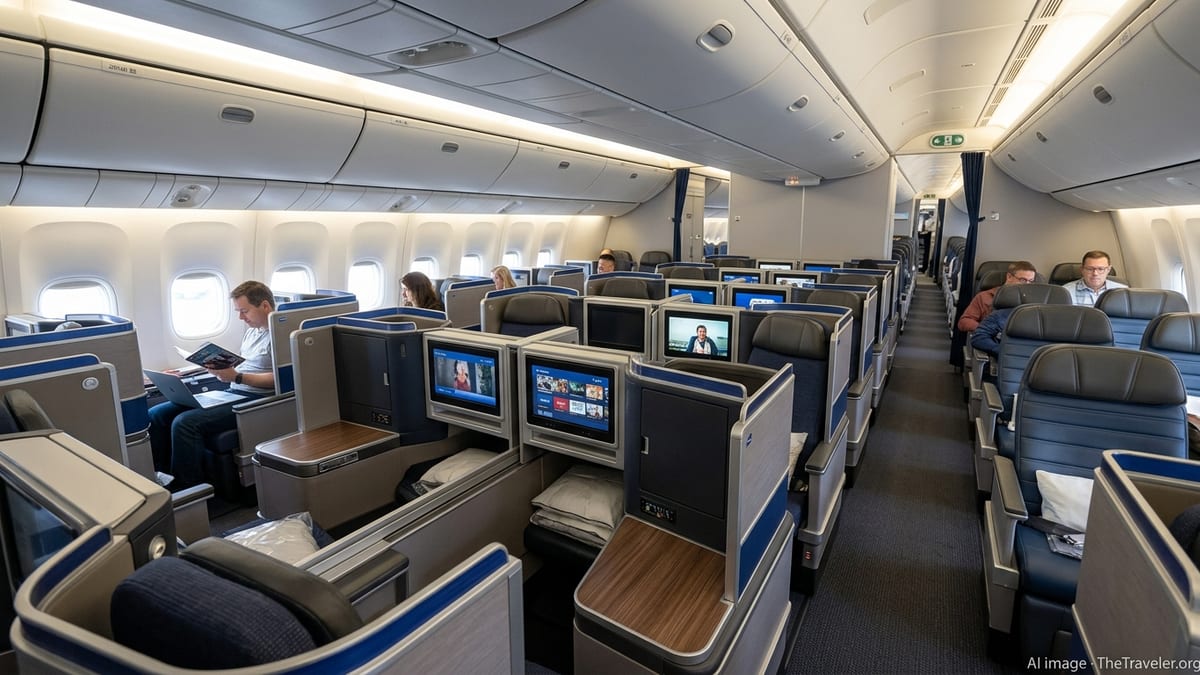
On widebody aircraft, the program builds around the Polaris business class concept, which features direct aisle access at every seat, enhanced privacy and upgraded bedding and amenity products. Aviation industry reports note that the airline is introducing an updated 787‑9 layout with a higher number of Polaris suites and a greater share of total capacity allocated to premium cabins compared with previous designs.
Cabin plans described in trade press coverage show that future long‑haul jets will dedicate a substantial proportion of seats to business, premium economy and extra‑legroom offerings. This configuration approach is intended to capture more high‑yield traffic on transatlantic and transpacific routes, while also allowing for greater segmentation of leisure demand seeking more comfort without paying full business class fares.
United has signaled through public comments and filings that it views a consistent premium experience as critical to loyalty. As more aircraft are delivered or reconfigured under the United Next blueprint, passengers are expected to encounter fewer product variations across the network, whether they are flying a newly delivered narrowbody on a domestic trunk route or a 787 on an ultra‑long‑haul sector.
Polaris, Premium Plus and New Onboard Amenities
Beyond cabin layouts, United is layering in new services and amenities targeted at premium travelers. Recent product updates described in airline and supplier announcements include refreshed Polaris bedding, amenity kits and upgraded inflight dining on long‑haul international flights. These changes build on the core Polaris model, which already features lie‑flat seats, direct aisle access and a focus on rest and privacy.
The carrier is also expanding its Premium Plus premium economy cabin across more of the widebody fleet. Industry observers note that this intermediate product, positioned between economy and Polaris, has become an important revenue driver as travelers increasingly seek more space and enhanced service without the cost of full business class. Publicly available information suggests that Premium Plus has seen strong load factors on routes where it is offered.
Connectivity and entertainment are central to the new premium blueprint. Technology coverage has highlighted the roll‑out of next‑generation onboard Wi‑Fi on selected aircraft, including systems designed to deliver faster, more reliable connections capable of supporting video streaming and real‑time collaboration tools. Paired with high‑resolution seatback screens, Bluetooth audio connectivity and expanded content libraries, the airline aims to make time spent in flight feel closer to the ground‑based digital experience.
These upgrades are being introduced in phases but are expected to reach a growing share of the fleet as new aircraft arrive and existing jets are retrofitted. Taken together, the cabin enhancements are intended to differentiate United on long‑haul routes where competition for premium passengers is particularly intense.
Rebalancing the Widebody Fleet for Long‑Haul Growth
United’s long‑haul strategy is underpinned by an extensive commitment to the Boeing 787 Dreamliner family. Public data on orders and deliveries shows that the airline holds one of the largest global 787 order books, positioning it to replace older widebodies and expand services across the Atlantic and Pacific over the next decade.
At the same time, the carrier is reassessing its long‑standing order for Airbus A350 widebodies. According to aviation news coverage of executive interviews, a final decision on whether to proceed with the A350 or pursue alternative replacement options for older Boeing 777 aircraft is expected around the middle of the decade. That decision will have significant implications for the composition and capabilities of United’s long‑haul fleet into the 2030s.
In the interim, timetable and route announcements show the airline continuing to deploy 787s and updated 777s on strategic long‑haul markets, often pairing aircraft with the latest Polaris and Premium Plus cabins. This approach allows United to grow capacity in high‑demand regions while gradually phasing out less efficient aircraft types.
Analysts note that the combination of new widebodies and increasingly premium‑heavy configurations could give United additional flexibility to open secondary long‑haul city pairs, particularly from hub airports with strong local demand and connecting traffic. That, in turn, would support the airline’s broader ambition to position itself as a leading global carrier out of North America.
Competitive Pressures and Passenger Expectations
United’s fleet expansion and premium upgrades are unfolding against a backdrop of rising competition in global aviation. Peer carriers in North America, Europe and the Middle East are also investing heavily in new aircraft, improved business class suites and enhanced inflight technology. Industry analysts suggest that this environment leaves little room for stagnation among large network airlines.
Passenger expectations are shifting as well. Surveys and booking trends described in airline investor materials point to growing willingness among travelers to pay more for extra space, connectivity and comfort, particularly on flights longer than a few hours. United’s decision to allocate a larger share of cabin real estate to premium products aligns with those trends and is intended to capture a greater portion of high‑spend demand.
Operational challenges remain, from manufacturer delivery delays to the complexity of retrofitting existing aircraft at scale. However, public statements and planning documents indicate that United continues to frame its aircraft investments and cabin upgrades as central to its long‑term strategy. If the airline can execute its fleet plan and maintain service standards, analysts say its combination of scale, network breadth and premium focus could reshape its competitive position in the coming years.
For travelers, the changes will be most visible in the seats they occupy, the space around them and the level of digital convenience available onboard. As more of United’s renewed fleet enters service, the airline is betting that a more consistent, premium‑tilted product will be a key differentiator across its domestic and international networks.