

More news on this day
Passengers across the United States faced hours of disruption as United Airlines canceled 44 flights and delayed at least 835 more, stranding travelers at major hubs in Chicago, Newark, Los Angeles and other cities and compounding an already strained spring travel season.
Get the latest news straight to your inbox!
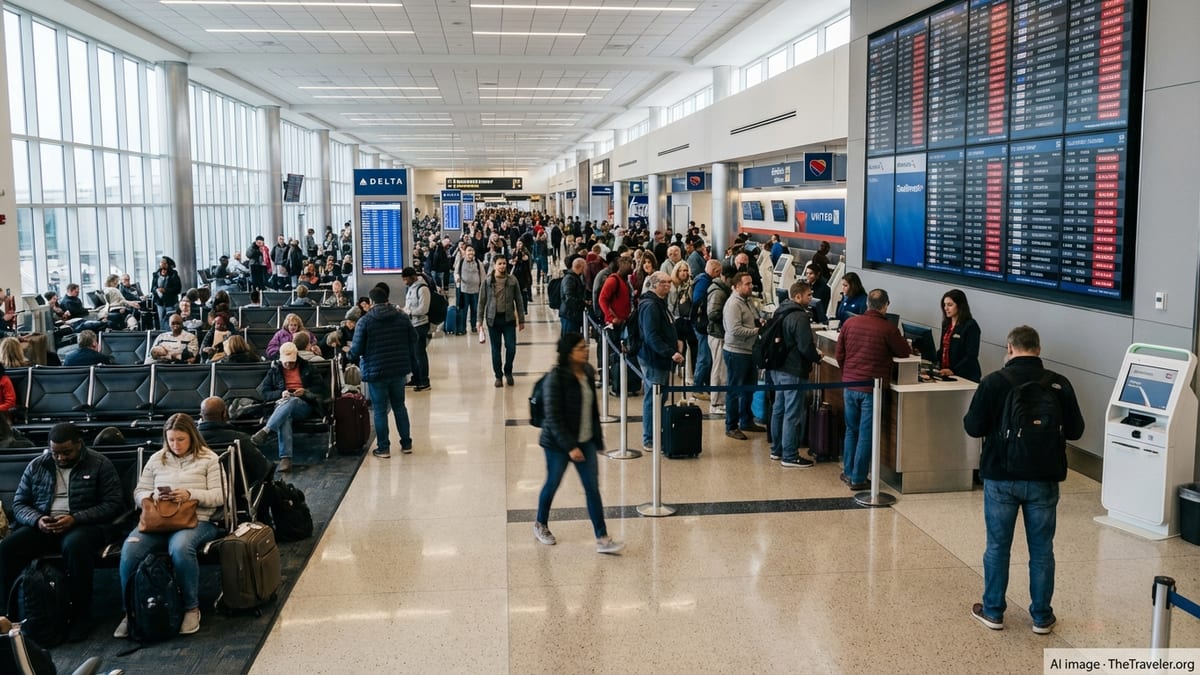
Widespread Disruptions Hit United’s Largest Hubs
Publicly available flight-tracking data shows United’s latest wave of cancellations and delays spread across its network, with the brunt of the impact concentrated at hub airports such as Chicago O’Hare, Newark Liberty and Los Angeles International. The 44 cancellations, while a fraction of United’s daily schedule, translated into thousands of disrupted itineraries once missed connections and misaligned crew schedules were taken into account.
Chicago O’Hare saw a cascade of schedule changes as early delays rippled into the afternoon, forcing some flights to depart hours behind schedule or be scrubbed altogether. Similar patterns were reported at Newark, where congested airspace and earlier operational constraints have made the airport particularly vulnerable when disruptions begin to build. At Los Angeles International, rolling delays left many passengers waiting in crowded gate areas as departure times repeatedly shifted.
Secondary airports in United’s network also felt the effects. Travelers passing through Denver, Houston and San Francisco encountered backed-up departure boards, with some regional connections canceled to preserve long-haul and hub-to-hub services. In several cases, passengers reported being rebooked through alternative hubs or routed onto red-eye flights as the carrier attempted to re-stitch its schedule.
The disruption hit during a period of elevated demand, with spring travel volumes climbing and aircraft operating closer to capacity. Under those conditions, even a few dozen cancellations can quickly consume remaining seat availability, leaving stranded travelers with limited same-day options.
Operational Strains and Weather Complications
Recent coverage of airline performance has highlighted an array of pressures facing major US carriers, and United is no exception. Weather systems moving across the Midwest and Northeast have periodically triggered air traffic control initiatives that slow arrivals and departures. When paired with already dense schedules at airports like Chicago and Newark, those constraints leave little room to recover once delays start to mount.
In addition to weather related challenges, industry reports have pointed to ongoing staffing and infrastructure strains within the air traffic control system that periodically reduce the flow of flights into key metropolitan areas. When capacity is cut for even a few hours, airlines must decide which flights to delay and which to cancel outright in order to keep aircraft and crews in position for later operations.
Higher jet fuel prices and tight aircraft utilization have also pushed airlines to run more complex and finely tuned schedules. That efficiency leaves carriers more exposed when something goes wrong, since spare aircraft and additional crew are less readily available to absorb shocks. Analysts have noted that as carriers attempt to meet strong travel demand while containing costs, the recovery from a disruption can stretch longer than passengers might expect.
Airline industry observers suggest that the pattern seen in United’s latest disruption reflects a broader environment in which weather, airspace constraints and operational complexity intersect. The result for travelers is a heightened risk that a local problem at one hub can quickly snowball into a nationwide issue.
Stranded Passengers Face Long Lines and Limited Options
As cancellations accumulated, social media posts and local news segments documented long customer service lines at United counters in Chicago, Newark and Los Angeles. Travelers described spending hours waiting to speak with an agent, only to learn that the next available seat on their route might not depart until the following day or later, especially on heavily booked transcontinental and international flights.
Hotel availability near major airports tightened as stranded passengers sought last minute rooms. Some travelers reported turning to nearby suburbs or city centers to find accommodation, particularly around Chicago and Newark, where properties near the terminals can fill quickly during irregular operations. Others opted to sleep in terminal seating or on the floor rather than leave the airport and risk missing an early morning rebooked flight.
Families with young children and those traveling for time sensitive events such as cruises, medical appointments or connecting international itineraries faced particularly difficult choices. With limited seats, changing routings or even shifting airports became a common strategy, as passengers asked to be rerouted through alternative hubs or to different destination airports within the same region.
Travel advocates note that these situations highlight the importance of contingency planning. Booking earlier flights in the day, building in longer connection times and having a backup plan for lodging and ground transportation can help reduce the personal impact when airline operations unravel.
What United Passengers Are Entitled To When Flights Disrupt
According to publicly available information from consumer advocates and government agencies, US airlines are generally required to provide a refund if a flight is canceled and a passenger chooses not to travel. That applies even to nonrefundable tickets when the airline is the party canceling the trip. For those who still wish to travel, carriers typically offer rebooking on the next available flight on their own network, subject to seat availability.
Unlike in parts of Europe, there is no overarching US regulation mandating fixed cash compensation for most delays and cancellations. Instead, each airline publishes its own customer service commitments. These policies often distinguish between disruptions deemed within the airline’s control, such as crew or maintenance issues, and those outside its control, such as severe weather or air traffic control restrictions.
In events categorized as controllable, United and other major carriers may provide meal vouchers, hotel accommodations and ground transportation for passengers who are stranded overnight, especially when the disruption occurs away from a traveler’s home airport. When weather or other uncontrollable factors are cited, assistance can be more limited, although airlines sometimes make exceptions on a case by case basis.
Travel experts recommend that affected passengers keep documentation of expenses, monitor the airline’s mobile app or website for rebooking options, and review the terms of any travel insurance or credit card protections. Some premium cards and third party policies reimburse meals, hotels and alternative transportation after significant delays, adding an extra layer of protection when airline assistance falls short.
Preparing for a Volatile Spring and Summer Travel Season
The latest round of United disruptions arrives as analysts warn of another challenging year for air travel reliability in the United States. Strong passenger demand, evolving weather patterns and ongoing constraints in air traffic control capacity are expected to strain schedules at major hubs through the spring and summer months.
Airlines, including United, have pledged to make targeted schedule adjustments and infrastructure investments intended to improve resilience. These efforts range from trimming peak hour operations at congested airports to deploying additional tools in operations centers that can more rapidly reoptimize schedules when disruption strikes.
For travelers, the practical implications are clear. Booking nonstop flights where possible, allowing ample connection time at busy hubs like Chicago, Newark and Los Angeles, and closely monitoring flight status in the 24 hours leading up to departure can all reduce the likelihood of becoming stranded. Having essential items such as medications, chargers and a change of clothes in carry on bags can also make extended delays more manageable.
As the industry navigates rising costs and complex operating conditions, episodes such as United’s cancellation of 44 flights and delays to more than 800 others underline how quickly a routine travel day can unravel. For now, passengers across the United States are left juggling rebooked itineraries and reset plans as the airline works to restore its schedule.