

More news on this day
United Airlines is introducing a new Relax Row product on select long-haul routes, turning standard economy seats into a shared couch-style space aimed at travelers who want more room to stretch out without paying business or premium economy prices.
Get the latest news straight to your inbox!
What the New Relax Row Actually Is
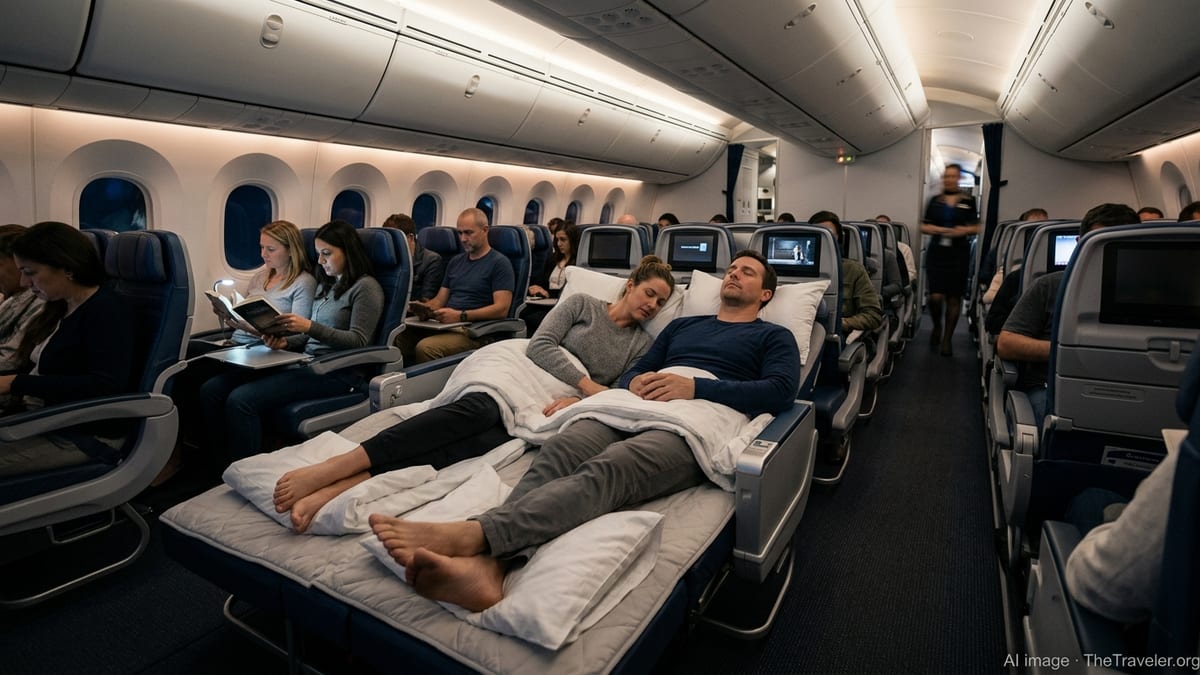
According to publicly available details and industry coverage, United's Relax Row is a dedicated block of three adjacent seats in the standard economy cabin that can be converted into a flat, mattress-like surface after takeoff. The concept closely resembles the "sky couch" idea seen at a few international carriers, but this is the first major rollout of such a product by a large U.S. airline on long-haul routes.
Relax Row is designed for customers who are willing to pay for extra space but do not need the separate cabin, larger seat, and upgraded meal service associated with United Premium Plus or Polaris business class. The three-seat row is sold as a single product, with special leg rests and extensions that rise to fill the gaps between the seats once the aircraft is in the air, creating a more continuous surface for lounging or sleeping.
Reports indicate that the airline will provide a custom-fitted mattress pad, extra pillows, and blankets to help make the surface more comfortable. For families, there is a focus on creating a play-or-sleep space for young children, and for solo travelers or couples it offers a way to lie down fully in economy without relying on an empty row by chance.
How Pricing and Booking Are Expected to Work
Public information so far suggests that Relax Row will be offered as an optional add-on rather than a separate fare class, similar in principle to how extra-legroom economy seats are currently sold. Customers book a standard economy ticket and then pay a supplemental fee to secure a Relax Row for their flight, subject to availability on specific aircraft and routes.
Because the product occupies three seats that otherwise might be sold individually, early commentary from aviation analysts indicates that pricing will likely sit above most economy seat selection fees but well below a typical upgrade to Premium Plus or Polaris on the same long-haul route. Travelers weighing the option will want to compare the Relax Row cost with paid upgrades, using their specific itinerary, as differences can be substantial depending on demand and season.
Relax Row is expected to be capacity-controlled, with only a small number of rows per aircraft configured with the necessary leg rests and structural components. As with other seat products, the add-on is likely to appear during the booking process on United's website or app, and potentially in the "manage reservation" section for customers who decide to upgrade after purchasing their ticket.
Where and When Relax Row Will Be Available
Industry coverage indicates that Relax Row is targeted at long-haul international flights where overnight travel and extended flight times make lie-flat or semi-flat options particularly valuable. This aligns with United's wider strategy of enhancing the comfort of its widebody fleet, alongside the previously announced "Elevated" interior for new Boeing 787-9 Dreamliners that will debut from San Francisco to Singapore and London in 2026.
While exact route maps for Relax Row have not yet been broadly detailed, observers expect the product to be deployed first on popular transoceanic services where United already emphasizes premium demand, such as transatlantic and transpacific routes. The airline has been steadily increasing the proportion of higher-yield seating across its network, and Relax Row fits into that pattern by monetizing space that previously depended on chance empty seats in economy.
Rollout timing is expected to be phased. Travelers may first see Relax Row appear on select aircraft types and specific long-haul routes before any wider expansion. As with other cabin innovations, early feedback from passengers and operational performance will likely influence how quickly and how widely United chooses to scale the concept.
How Relax Row Compares With Other Cabin Options
Relax Row sits between standard economy and true premium cabins. Unlike Polaris business class, it does not offer individual lie-flat suites, privacy doors, or the extensive dining and amenity upgrades that have been showcased as part of United's new Dreamliner interiors. It also lacks some of the dedicated service and larger individual seating found in United Premium Plus, which functions as a classic premium economy product with wider seats and increased pitch.
For many travelers, the key difference will be the type of comfort they value. Premium Plus caters to those who want more personal space, upgraded meals, and a more exclusive cabin that feels separate from economy. Relax Row, by contrast, focuses on horizontal space and the ability to lie down, which can be particularly attractive for overnight flights, families with children, or couples who are comfortable sharing one large surface instead of two individual seats.
Observers note that Relax Row also formalizes a behavior that already exists: travelers hoping for an empty row in economy to stretch out. Instead of relying on luck or lightly loaded flights, the new product packages that extra space into a predictable, bookable option, with additional bedding and structural support to make it more practical for resting.
What Travelers Should Consider Before Booking
Travelers evaluating Relax Row will want to think carefully about who is in their party and how they plan to use the space. A solo traveler effectively pays for three seats in exchange for the ability to lie down fully, something that may be most compelling on very long overnight flights. Couples or a parent with a small child might see more value, since the cost can be mentally divided across more people while still securing a shared couch-style area.
The physical dimensions also matter. Published seat width figures for standard United economy on long-haul aircraft suggest that three adjacent seats are not as wide as a full-size bed, so taller or broader passengers may still need to curl or bend their legs when lying down. Passengers will also need to be aware of safety rules that require all customers to use their own seat belts during taxi, takeoff, and landing, meaning the couch configuration is only available in cruise.
As with any new product, early reports and reviews from frequent flyers are likely to provide practical insight on comfort, value, and any quirks of the setup, such as storage space once the leg rests are in place or how easy it is to transition between seated and couch modes. For now, the introduction of Relax Row signals an ongoing shift in how major airlines think about economy cabins on long-haul flights, offering travelers one more way to customize their balance of cost and comfort at 35,000 feet.