

More news on this day
United Airlines is doubling down on premium travel, accelerating fleet growth while rolling out upgraded cabins, lounges and digital tools in a bid to capture high-spending customers across key long-haul and domestic routes.
Get the latest news straight to your inbox!
Fleet Expansion Underpins United Next Strategy
United Airlines is using rapid fleet growth as the backbone of its strategy to reshape the onboard experience. Public filings for full-year 2025 show that the carrier added more than 80 new aircraft and retrofitted over 100 jets with its latest "Signature" interior, part of the multiyear United Next program that aims to refresh cabins and increase overall capacity. The plan calls for the airline to keep inducting new aircraft at a pace of roughly one every few days, giving United one of the youngest and most consistently configured fleets among major U.S. carriers.
The global network strategy is closely tied to this fleet buildout. Additional widebody deliveries, particularly Boeing 787-9 Dreamliners, are being steered toward long-haul routes where demand for higher-yield cabins remains robust. Industry data indicates that premium seats are growing faster than economy capacity across the Atlantic and Pacific, and United is positioning its new aircraft to capture that trend on routes linking hubs such as San Francisco, Newark and Chicago with key business centers in Europe and Asia.
Regional operations are part of the equation as well. United Express operators continue to phase in modern regional jets configured with more comfortable cabins, enabling the airline to market a more consistent experience for passengers connecting from smaller cities into the long-haul network. The goal is to create a smoother transition from regional to mainline aircraft, particularly for frequent flyers purchasing or upgrading into premium cabins for intercontinental segments.
Analysts note that this fleet strategy gives United flexibility to adjust capacity by cabin type, allowing it to add more business-class and premium-economy seats on long routes while maintaining dense, higher-capacity layouts on domestic trunk flights. That balance is becoming increasingly important as corporate travel patterns shift and leisure travelers show a growing willingness to pay extra for comfort on longer journeys.
Premium-Heavy Cabins and New Polaris Studio Suites
Central to United’s redefined travel experience is a decisive shift toward premium-heavy cabins. Company disclosures for 2025 highlight a record 27 million premium seats flown in a single year, representing a growing share of total capacity. A significant portion of that growth is tied to a new configuration of the Boeing 787-9 that carries 99 premium seats in total, the highest percentage of premium seating in the airline’s fleet and one of the highest among U.S. carriers.
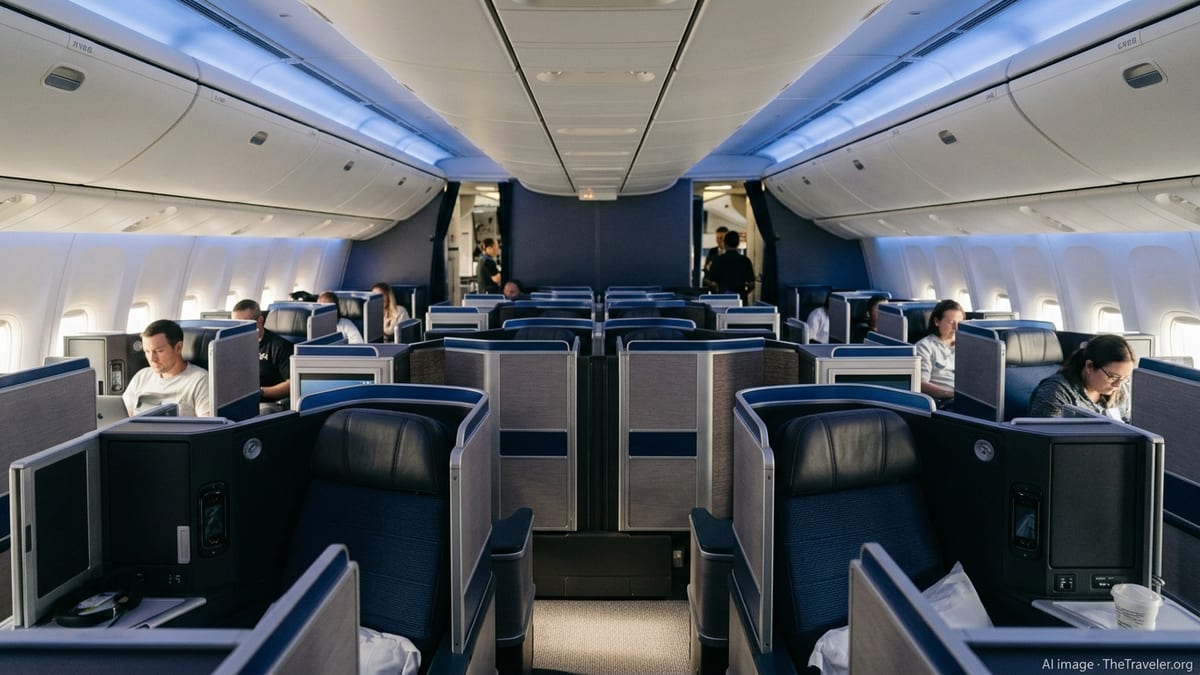
The flagship of this effort is the introduction of Polaris Studio suites at the front of the long-haul cabin. These new spaces supplement the existing Polaris business class with a small number of enclosed suites that offer additional privacy, an expanded seating footprint and space for a guest. Industry coverage describes the suites in a 1-2-1 configuration alongside a redesigned Polaris cabin that includes sliding doors, larger high-resolution entertainment screens and enhanced storage. The airline has indicated that the first aircraft featuring this layout will initially serve long-range routes such as San Francisco to Singapore and London from 2026.
United is also in the process of upgrading existing Polaris seats into fully enclosed suites across parts of the widebody fleet. Reports indicate that the refreshed business-class product will feature 4K screens, improved bedding and a greater emphasis on personal space, addressing long-standing passenger concerns about privacy and in-flight rest on overnight sectors. The airline is targeting completion of these interior projects on dozens of aircraft over the next several years, with a target of having a significant share of the long-haul fleet converted by the end of the decade.
Alongside physical seat changes, United is enhancing the soft product in premium cabins. Coverage of the new Polaris Studio concept points to elevated dining service, expanded beverage offerings and upgraded amenity kits, including items such as noise-cancelling headphones and sleepwear on select flights. These touches are aimed at differentiating the product from both domestic competitors and international carriers that have also been investing heavily in premium cabins.
Lounges, Wi-Fi and Ground Experience Get a Tech-Forward Refresh
United’s premium push extends well beyond the aircraft. The airline has been expanding and upgrading its lounge network, most notably with what has been described as its largest-ever United Club at Denver International Airport. Opened in mid-2025, the club showcases design elements that are starting to appear across the broader lounge portfolio, including expansive seating zones, numerous power outlets and tech-heavy amenities tailored to business travelers.
The Denver lounge introduction highlights a shift toward more automated and self-service elements in the ground experience. Reports describe e-gates that allow guests to self-scan boarding passes or membership credentials for entry, reducing queues and freeing staff to handle more complex customer issues. Similar technology is expected to roll out to additional locations as United moves to standardize its premium ground offering.
Onboard, connectivity is another pillar of the new experience. The airline is continuing the deployment of Starlink-powered Wi-Fi on portions of its fleet, aiming to deliver faster, more reliable internet access that can support video calls, streaming and real-time collaboration tools. For premium travelers, consistent high-speed connectivity has become a core expectation, particularly on daytime transcontinental and transatlantic flights where passengers often work throughout the journey.
United’s lounge strategy is not without challenges. In some markets, existing facilities are undergoing renovation or operating near capacity, reflecting broader crowding issues in premium spaces across the industry. However, the pipeline of larger clubs in hubs such as Houston and San Francisco signals that the airline is betting on lounge quality and availability as key differentiators in the competition for high-value customers.
Digital Tools and Service Model Aim to Personalize Premium Travel
Technology is increasingly shaping how United delivers its premium service. An update to the airline’s mobile app rolled out in late 2025 introduced more granular flight information, interactive wayfinding and guidance for lounge access, aiming to give travelers more control over their journey. Public reports on the upgrade emphasize features designed to surface context-aware notifications at the right moment, such as reminders about boarding times, gate changes and access rules for premium spaces.
The app improvements build on earlier initiatives that integrated tracking tools for checked baggage, including the ability for customers using certain Bluetooth trackers to share location data with the airline’s customer service teams when a bag is mishandled. For premium passengers paying higher fares, these forms of transparency and rapid resolution are increasingly central to the value proposition, especially on complex itineraries involving tight connections or multiple checked bags.
United is also reshaping how upgrades and premium fares are packaged. Industry coverage has noted experiments with a potential "basic business" fare that would provide the core Polaris seat but scale back certain extras, echoing trends in unbundled products already seen in economy cabins. At the same time, changes to upgrade hierarchies and the use of mileage or points-based instruments are altering how elite travelers access premium seats, prompting close attention from frequent-flyer communities.
Observers suggest that these moves reflect a broader shift toward personalization, where customers can pay for exactly the mix of comfort, flexibility and service they value. For United, the challenge will be to maintain the aspirational feel of its top-tier products while offering lower entry points that maximize revenue from a wide spectrum of travelers.
Competitive Positioning in a Premium-Focused Market
United’s fleet expansion and premium investments are unfolding against a backdrop of intensifying competition among global carriers. Rivals in North America and Europe are also adding doors to business-class suites, refreshing soft products and expanding premium-economy cabins. Market research indicates that demand for luxury and upper-premium travel has outpaced overall passenger growth since the pandemic, with both corporate clients and affluent leisure travelers driving higher yields on long-haul routes.
By increasing the share of premium seats across its fleet, United is aligning itself with this structural shift. The new 787-9 configuration, with its unusually high concentration of Polaris and Polaris Studio seating, illustrates a willingness to allocate significant real estate on valuable aircraft to higher-revenue cabins. For investors and industry analysts, the key question will be whether sustained demand can absorb that capacity through economic cycles.
Network developments are another piece of the puzzle. United is preparing to return to New York’s John F. Kennedy International Airport through a slot-sharing arrangement with JetBlue in 2027, a move that will give the airline access to one of the world’s most competitive premium markets. Combined with its strong position at Newark and a growing long-haul presence from San Francisco and Chicago, the carrier is building a platform aimed squarely at travelers who prioritize schedule breadth and premium comfort.
As the United Next program advances, the airline’s strategy increasingly revolves around the belief that passengers will pay more for a seamless, upgraded experience from curb to cabin. With new aircraft arriving, lounge projects underway and Polaris enhancements rolling out, United is positioning its brand at the higher end of the market, seeking to redefine what travelers can expect from a U.S. network carrier in the premium segment.