

More news on this day
United Airlines passengers across the United States are facing significant disruption after a major technology outage triggered ground stops at key hubs, rippling into more than 1,200 delays and thousands of cancellations across the carrier’s network.
Get the latest news straight to your inbox!
What Triggered United’s Latest Ground Stop
Recent coverage of United Airlines operations describes a severe technology failure affecting core flight-planning systems, including tools used for weight and balance calculations and aircraft dispatch. When these systems fail, airlines are unable to safely release flights, prompting a halt to departures until manual workarounds or system resets are in place.
Publicly available information about a nationwide United disruption in August 2025 indicates that a system used to manage flight data suffered a massive failure, forcing the airline to request ground stops at major hubs such as Chicago O’Hare, Denver, Houston, Newark, and San Francisco. Similar reporting notes that United’s internal technology has long been central to how it schedules aircraft and crews, which means any outage can cascade quickly through the network.
Industry analysis comparing the 2025 failure with newer disruptions in 2026 suggests that even short outages now translate into large numbers of delayed and canceled flights. With aircraft schedules running close to maximum utilization, a pause of only an hour or two at multiple hubs can produce 1,200 or more delays in a single operating day and push total cancellations into the thousands once missed connections and crew time limits are factored in.
Experts in aviation operations also point out that technology glitches often collide with challenging weather or air traffic constraints. In early 2026, for example, severe winter storms and subsequent thunderstorms across major U.S. markets already had airlines operating with little spare capacity, making the system more vulnerable to a shock such as a United technology outage.
How Widespread Are the Delays and Cancellations
Data from flight-tracking services and operational roundups show that when United experiences a major disruption, it often accounts for a disproportionate share of national flight delays. On some recent high-disruption days in March 2026, reports indicate that United has led all U.S. carriers in delays, with more than 200 late departures attributed to the airline on a single day and hundreds more affected indirectly through missed connections.
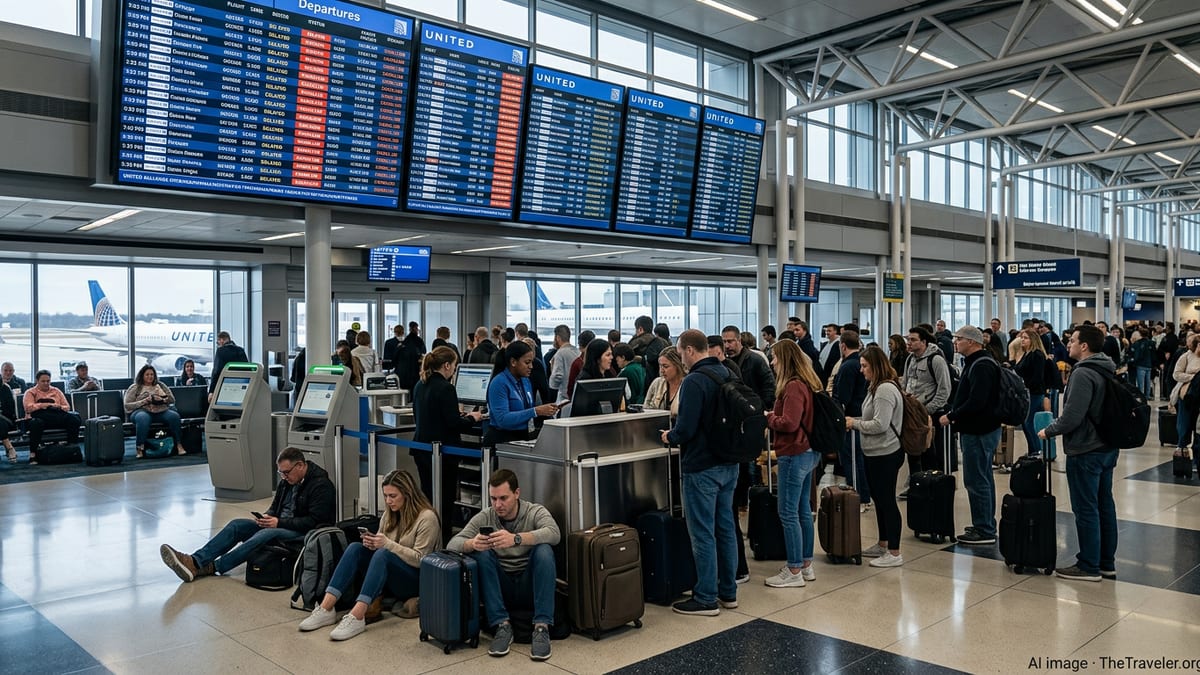
In large-scale events involving ground stops, the visible impact at airports can be stark. Departure boards at hub airports typically show long columns of flights marked delayed, with departure times pushed back in rolling increments as crews and aircraft fall out of position. Even after the immediate ground stop is lifted, residual disruptions can continue well into the following day, driving total delay counts above 1,200 and cumulative cancellations into the thousands as United trims its schedule to restore order.
The networked nature of United’s operation amplifies these effects. A ground stop centered on a major hub like Chicago or Newark does not just affect local departures; it also disrupts inbound aircraft that are needed to operate later flights elsewhere in the country. This domino effect is particularly severe on days already pressured by high passenger volumes, storm systems, or airspace constraints.
Reports summarizing recent U.S. aviation performance also highlight that United’s disruptions do not occur in isolation. Nationwide, some days in March 2026 have seen more than 4,000 total delays across all airlines, with weather-driven issues at cities such as Atlanta, Houston, and Dallas compounding technology and staffing challenges. In this environment, a single carrier’s ground stop can be the tipping point that turns a difficult travel day into full-scale chaos for passengers.
What United Is Offering Impacted Travelers
Publicly available policy documents and consumer guides explain that United differentiates between disruptions it defines as controllable, such as many technology-related outages, and those it attributes to weather or air traffic control. In events described as preventable or controllable, coverage from previous incidents indicates that United has offered hotel accommodations, meal vouchers, and assistance with rebooking on the next available flight when passengers are forced to overnight away from home.
In contrast, when cancellations are linked to severe weather or external factors, travelers are generally entitled to rebooking or a refund if their flight is canceled, but not to automatic cash compensation for delays. However, United often issues travel waivers that allow customers to change flights without incurring change fees or additional fare differences within specified date and routing windows, especially during storms, industrial action overseas, or geopolitical disruptions affecting certain regions.
Recent waiver notices for March 2026, including those tied to thunderstorms in Chicago, unrest in parts of the Middle East, and labor actions in Brussels, show how United attempts to create flexibility for travelers likely to be affected. These waivers can be especially valuable on days when a technology issue coincides with bad weather, as they give passengers more options to rebook before large numbers of flights are formally delayed or canceled.
Consumer advocates often remind travelers to keep careful records of expenses such as meals, hotels, and ground transportation during a major disruption. While United is not required under U.S. law to provide cash compensation for delays, it may reimburse certain reasonable costs in controllable events, and clear documentation can make it easier to seek goodwill gestures or expense coverage after the fact.
What Stranded Passengers Can Do Right Now
When a ground stop or technology outage hits, the most important step for travelers is to stay ahead of official notifications. Aviation experts recommend using multiple tools at once, including United’s app, airport departure boards, and independent flight-tracking services, to monitor real-time status. In some cases, third-party trackers reflect gate or routing changes before they appear on terminal displays.
Rebooking quickly is critical on days when hundreds of flights are disrupted. Travel specialists advise that passengers should use digital self-service tools while also joining customer service lines, effectively working two channels in parallel. If an itinerary involves connections through a heavily impacted hub, it may be worth asking about alternative routing, even if it involves a longer flight time, in order to avoid airports experiencing the worst delays.
Travel insurance can also play a role. Policies that include trip interruption or travel delay benefits may cover hotel stays, meals, or replacement transportation when flights are significantly delayed or canceled. Passengers are encouraged to check policy terms carefully, as coverage often depends on whether the disruption is caused by weather, mechanical issues, or broader operational failures.
Finally, experts emphasize the value of proactive planning in a period of heightened volatility for U.S. air travel. When possible, travelers can build longer connection times into itineraries, book earlier flights in the day that are less exposed to rolling delays, and avoid tight same-day commitments at their destination during seasons known for major storms. For those flying United in the coming weeks, monitoring travel waivers and operational updates closely may offer the best chance to adjust plans before a bad travel day becomes a personal crisis.