

More news on this day
United Airlines has quietly rewritten its rulebook to give staff the power to remove, suspend or even permanently ban passengers who play audio out loud without headphones, igniting a fierce debate over cabin etiquette and how far airlines should go to enforce it.
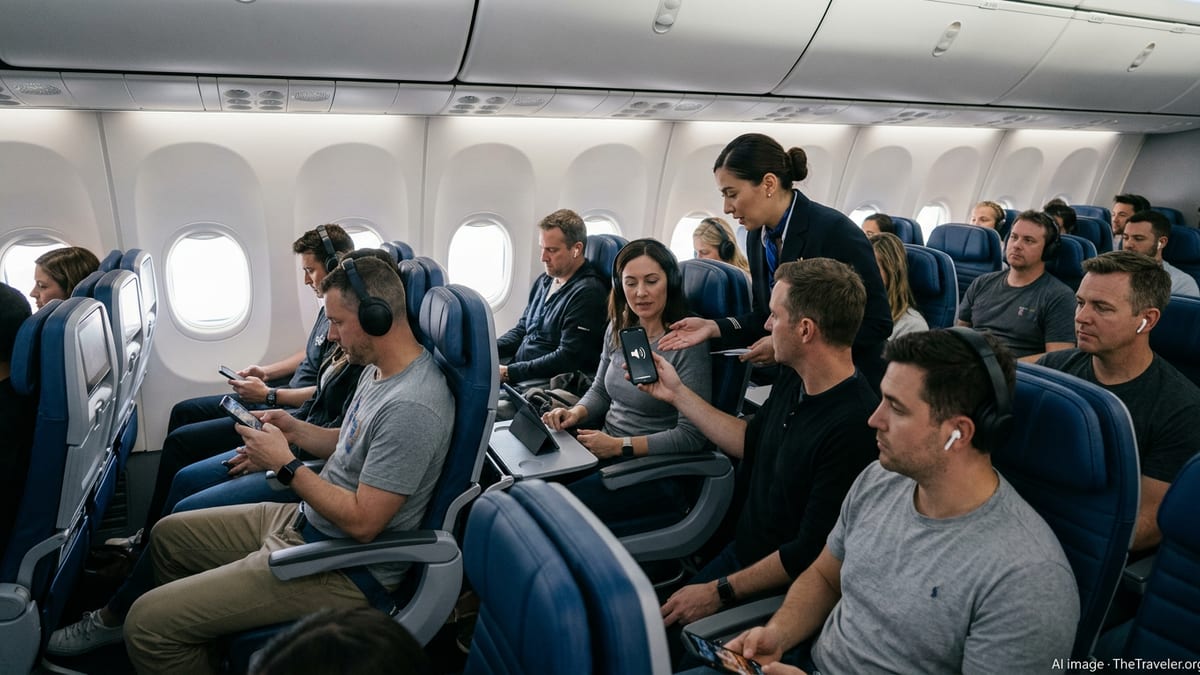
What United’s New Headphone Rule Actually Says
The controversy stems from a late February update to United’s Contract of Carriage, the legal document that governs the relationship between the airline and its customers. In the revamped “Refusal of Transport” section, United now explicitly lists passengers who “fail to use headphones while listening to audio or video content” as potential grounds for denial of service.
The clause gives United “the right to refuse transport on a permanent or temporary basis” to anyone who violates the contract, including the headphone rule. In practice, that means travelers who insist on blasting videos, music or social media clips through their phone or tablet speakers could be removed from a flight, barred from boarding, or flagged for further action by the airline.
The update effectively elevates what many travelers considered common courtesy into enforceable policy. While flight attendants have long asked customers to use headphones, this is the first time a major U.S. carrier has embedded a headphone requirement in language that explicitly allows for suspensions or lifetime bans.
United has framed the change as a clarification rather than a radical shift. Company representatives note that its onboard Wi-Fi rules already told customers to use headphones with streaming content, and that the new wording simply aligns the contract with what has been standard practice in the cabin.
Could You Really Be Banned for Life Over Headphones?
The idea that a forgotten pair of earbuds could cost a traveler their ability to fly United ever again has driven much of the viral reaction to the policy. Technically, the airline’s contract does allow for permanent bans for anyone who violates its terms, including the new audio rule. That language, however, has typically been reserved for serious misconduct such as assaulting crew, threatening safety or repeatedly refusing to follow instructions.
Aviation and legal experts point out that while the clause gives United broad discretion, permanent bans for headphone issues alone are likely to be extremely rare. A more realistic scenario is that a passenger who refuses repeated crew requests to lower their volume or plug in headphones could be removed from the flight and possibly flagged for a temporary suspension, especially if the incident escalates into abusive or disruptive behavior.
The bar for a lifetime ban would almost certainly involve a pattern of noncompliance or a single incident that spirals into something far more serious than loud audio. Still, consumer advocates warn that the new language broadens the toolkit available to airlines, and that travelers should be aware that ignoring a headphone request is no longer just rude, it is a clear rules violation.
United has tried to soften the message by emphasizing that affected customers can request a refund if they are removed or refused transport solely because of the headphone rule. For many passengers, though, the bigger concern is not the money but the possibility of ending up on an internal “do not fly” list over what feels like a minor etiquette lapse.
Why United Is Cracking Down on Inflight Noise
United’s move comes amid growing frustration among travelers over noisy cabins and a general decline in inflight manners. Viral posts about children watching cartoons without headphones, adults on speakerphone in cramped rows and travelers blasting TikTok videos have become a staple of social media travel rants.
Cabin crew say they are on the front lines of that tension. Flight attendants have long relied on polite announcements and quiet conversations to persuade passengers to plug in earbuds or mute devices, often with mixed success. By codifying the expectation in its contract, United is effectively giving crews more authority and clearer backing when they ask someone to use headphones.
The rule also reflects a broader push inside the industry to reduce disturbances that can escalate into conflicts. Loud audio may seem trivial compared with disruptive drunkenness or aggressive behavior, but in a tightly packed cabin at cruising altitude, small irritations can quickly snowball. Airlines and regulators have spent the past several years grappling with a spike in unruly passenger incidents, and any measure that promises a calmer cabin is likely to get serious consideration.
United has also highlighted the growth of its high-speed inflight connectivity as a factor. As more passengers stream video and scroll endlessly through short-form clips, the potential for cabins filled with competing audio sources has increased dramatically. Requiring headphones is, in the airline’s view, a straightforward way to keep that digital entertainment from turning into analog chaos at 35,000 feet.
Passenger Reaction: Relief, Alarm and Plenty of Jokes
Online, reaction to the new policy has been sharply divided but undeniably intense. Many frequent flyers have welcomed the move, arguing that it is long overdue. Social media threads are filled with variations of “thank you” from travelers who say they are tired of enduring loud games, YouTube videos and video calls on otherwise quiet flights.
On the other side are customers who worry that the airline now holds too much power over relatively minor behavior. Some fear that the open-ended language about “failing to use headphones” and “refusal of transport” could be applied inconsistently, depending on the mood of the crew or the interpretation of a single incident. Others argue that a lifetime ban, even if unlikely, is a disproportionate theoretical penalty for something that might be an honest mistake or a forgotten accessory.
The headline-friendly idea that “no headphones” could mean “banned for life” has also invited humor. Memes about packing four pairs of backup earbuds, or travelers offering to carry spares for their entire row, have spread quickly. In more serious discussions, travelers with hearing impairments or sensory sensitivities have asked how the rule will account for disability accommodations, raising questions that United will likely need to address clearly in its staff guidance and customer-facing communication.
For now, United has stressed that crew members are trained to use discretion and de-escalation. That suggests most interactions will begin with polite reminders and only escalate if a passenger flatly refuses to cooperate, especially after multiple warnings.
What Travelers Should Know Before Their Next United Flight
For passengers, the practical takeaway is simple: if you plan to watch or listen to anything with sound on a United flight, pack headphones or earbuds and be prepared to use them. United says that travelers who forget can request a complimentary pair from cabin crew, though these are generally designed for the airline’s own inflight entertainment systems and may not fit every personal device without an adapter.
It is also worth remembering that the policy is aimed specifically at audio played out loud, not at silent screen use. Scrolling through emails, reading downloaded articles or watching muted video without sound remains acceptable. Voice and video calls are prohibited after the aircraft doors close and while in the air, a restriction that predates the new headphone rule but now sits alongside it in United’s conduct guidelines.
Travel experts advise passengers to think of the headphone requirement as part of a broader etiquette shift in the skies. Alongside rules about remaining seated when the seatbelt sign is on and respecting crew instructions, keeping your audio private is now firmly in the category of “not optional.” If a flight attendant asks you to plug in earbuds or lower your volume, complying quickly is the safest way to avoid being labeled disruptive.
Whether other carriers will follow United’s lead remains to be seen. Several U.S. airlines already encourage or informally require headphones, but have stopped short of baking the rule into their official refusal-of-transport language. If United’s stricter stance leads to quieter cabins without a surge in contentious confrontations, it may set a new industry standard for how airlines handle the sounds of the modern, always-connected traveler.