

More news on this day
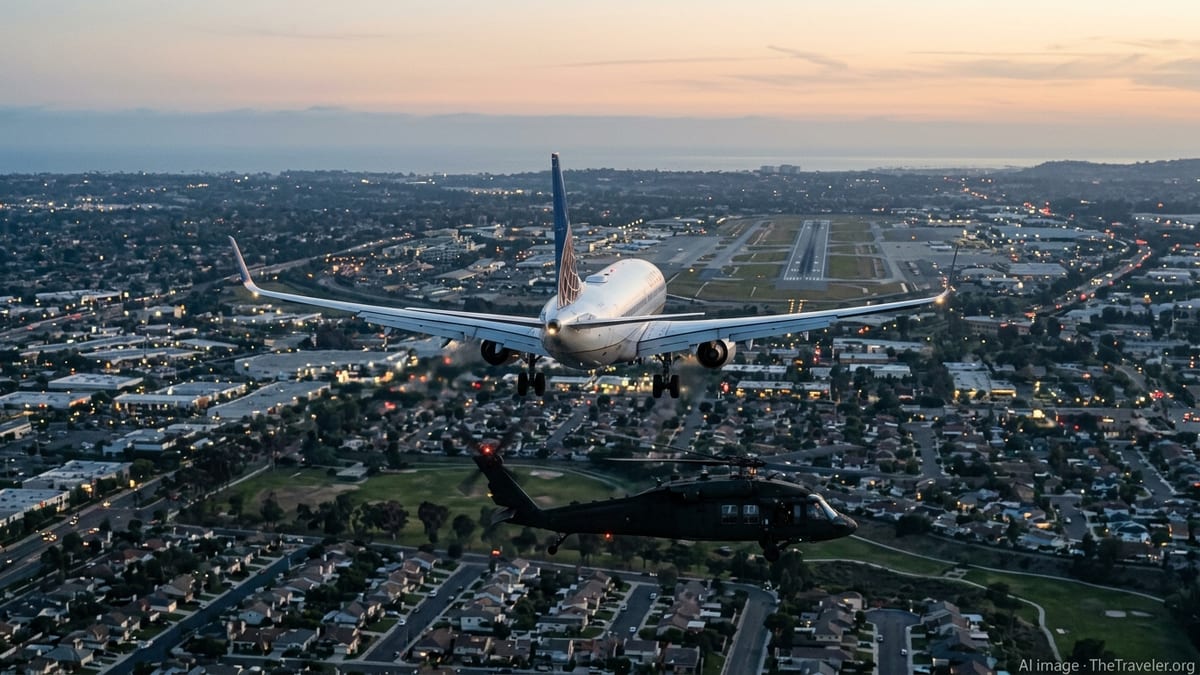
A United Airlines flight on approach to John Wayne Airport in Southern California narrowly avoided a collision with a U.S. military Black Hawk helicopter earlier this week, in a near miss that aviation records describe as among the most serious types of close call.
Get the latest news straight to your inbox!
Close Call Over Orange County Skies
According to publicly available flight data and media reports, the incident occurred around 8:40 p.m. local time on Tuesday near John Wayne Airport in Orange County. The United Airlines jet, carrying 162 passengers and six crew members, was descending toward the airport when a Black Hawk helicopter returning from a training mission crossed its projected flight path.
Onboard safety systems detected the developing conflict, triggering a resolution advisory that directed the airline crew to stop their descent and level off. The pilots followed the instruction and the two aircraft passed within what has been described as a few hundred feet vertically, close enough to be classified as a serious loss of separation but short of a collision.
No injuries were reported on either aircraft, and the United flight landed safely after the evasive maneuver. Passengers on board were not initially informed of the full extent of the incident, but tracking data and subsequent reporting have highlighted how narrowly the aircraft avoided impact.
The military helicopter, identified as a Black Hawk variant, was operating under separate flight procedures as it returned to base from a local training exercise. Its crew continued the mission and landed safely following the encounter.
FAA Launches Investigation Into Near Collision
The Federal Aviation Administration has opened an investigation into how the two aircraft came into such close proximity in controlled airspace around a major commercial airport. Preliminary information indicates that the helicopter crossed into the United jet’s path as the airliner was on approach, raising questions about coordination between civilian air traffic control and military flight operations in the area.
Investigators are expected to review radar recordings, cockpit voice and flight data recorders from the United aircraft, and communications between air traffic controllers, the airline crew, and the helicopter pilots. The review will focus on whether established separation standards were breached, whether any instructions were misunderstood, and how quickly onboard warning systems alerted the United crew.
Publicly available information shows that the event has been categorized as a serious close call, a classification that typically triggers detailed internal safety reviews at both the aviation regulator and the operators involved. The results may lead to updated procedures for mixed civilian and military traffic near busy airports, particularly where helicopter training routes intersect with commercial approaches.
United Airlines has not publicly detailed the internal steps it is taking in response but is expected to participate in the fact-gathering process. Military aviation units operating the Black Hawk type typically conduct their own parallel safety reviews following such incidents.
Aviation Community on Edge After Earlier Deadly Crash
The California near miss comes just over a year after a catastrophic midair collision between an American Airlines regional jet and a U.S. Army Black Hawk helicopter over the Potomac River near Washington, D.C., which killed 67 people. That crash, involving American Airlines Flight 5342 near Ronald Reagan Washington National Airport, was the deadliest U.S. aviation disaster in more than two decades and remains under intense scrutiny.
Investigations into the Washington collision have highlighted long-standing concerns about dense traffic patterns and the mix of civilian and military aircraft near major hubs. Reports from the National Transportation Safety Board and other reviews have pointed to years of warnings about helicopter routes, reliance on visual separation, and airspace designs that left little room for error.
In the wake of the Potomac crash, federal regulators and the military began altering some helicopter procedures and equipment requirements, including greater use of location-broadcast systems that make aircraft more visible on radar and in cockpit displays. The recent near miss involving United in Southern California is likely to intensify debate over whether those changes have gone far enough and whether similar risks exist at other airports.
Safety advocates note that while fatal airline crashes remain rare in the United States, a series of nonfatal close calls in recent years has revealed vulnerabilities that can only be addressed through changes in air traffic management, technology, and training across both civilian and military fleets.
Scrutiny on Mixed Civilian and Military Airspace
The latest incident underscores the complexity of managing airspace that must accommodate commercial airliners, general aviation, and military aircraft with very different performance characteristics and mission profiles. Around John Wayne Airport, helicopters often operate at lower altitudes and along river or coastline routes, while jets follow structured arrival paths, creating multiple potential crossing points.
Analysts note that coordination between military units and civilian controllers is generally governed by established letters of agreement and standard operating procedures. However, real-world variables such as training requirements, weather, and traffic surges can test those arrangements. The California near miss will likely prompt a renewed review of local helicopter corridors, altitude assignments, and communication protocols to reduce the chance of conflicting trajectories.
Experts also point to the role of onboard collision avoidance technology in preventing disaster. Systems that monitor transponder signals and provide automated climb or descent commands to flight crews have been credited with averting numerous midair collisions globally. In the Orange County case, those systems appear to have functioned as designed, giving the United pilots clear instructions in time to avoid impact.
At the same time, the encounter illustrates the limits of relying on last-line electronic safeguards. Aviation safety specialists tend to emphasize that airspace design, controller procedures, and adherence to rules of the air remain the first layers of protection, with technology intended as a backup rather than a primary tool for routine separation.
Passengers and Public Reassured but Watchful
For travelers, the near collision is another reminder that even with statistically safe air travel, risk management depends on multiple layers of defense. The fact that the United Airlines flight landed without injuries or damage may reassure many passengers that systems and training work as intended when problems emerge late in a flight.
At the same time, the proximity of this incident to the fatal Potomac crash has sparked renewed public attention to close-call data, which often remains technical and opaque. Aviation observers argue that greater transparency around where and how near misses occur can help focus safety improvements where they are most needed.
Travelers passing through John Wayne Airport in coming days are unlikely to see visible changes, at least initially. Any adjustments to routes, altitude profiles, or helicopter operations would typically be implemented gradually after the investigation identifies contributing factors.
For now, the event over Orange County stands as a stark illustration of how quickly routine approaches can become high-stakes emergencies, particularly in busy corridors where commercial jets and military helicopters share the same airspace.