

More news on this day
United Airlines has formally written inflight etiquette into its rulebook, updating its contract of carriage to require passengers to use headphones for any audio or video played on personal devices or risk being removed from a flight and potentially banned from future travel.
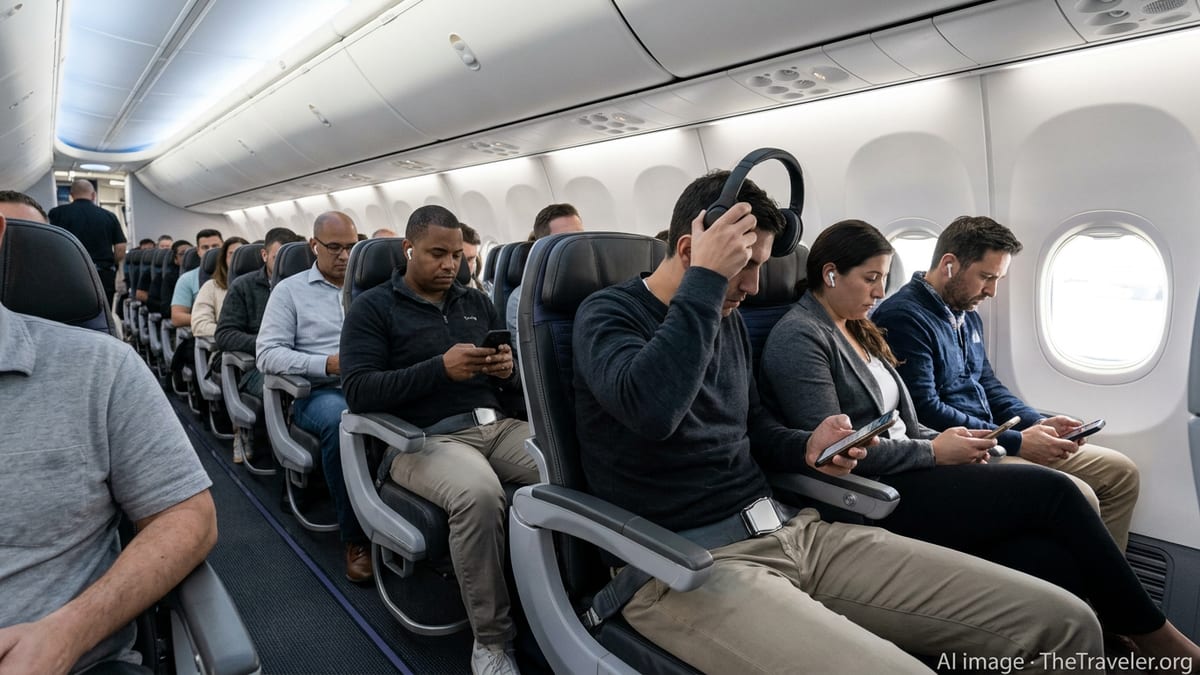
What United’s New Headphone Rule Actually Says
The revised policy, which took effect on February 27, 2026, adds a new category to United’s contract of carriage, the legal agreement every traveler accepts when buying a ticket. Under the change, passengers who fail to use headphones while listening to audio or video content on their own devices can be denied boarding, removed from an aircraft or refused transport on a temporary or even permanent basis.
The language was added under the airline’s “Refusal of Transport” provisions, grouping noisy personal-device use with behaviors such as refusing to follow crew instructions, smoking on board or wearing lewd or offensive clothing. United’s position is that unchecked audio from phones, tablets and laptops is more than a nuisance; it can become a safety and security concern if passengers ignore crew directions to turn the sound off or plug in headphones.
United has stressed that the rule is not designed to police quiet screen use. Passengers remain free to scroll social media, play games or watch muted videos, provided no sound escapes their device speakers. The focus is on audible content, whether it is a movie, music playlist, podcast, game effects or a video call.
The rule also sits alongside existing prohibitions on voice and video calls when aircraft doors are closed or the plane is taxiing or in flight. Those restrictions are aimed at preventing both noise and potential disruptions to cabin safety briefings and crew communications.
From Courtesy to Enforceable Rule
For years, United flight attendants have reminded customers to use headphones as a matter of courtesy, often including the request in predeparture announcements. Until now, though, the expectation lived mostly in informal guidance and onboard etiquette rather than in the hard text of the carrier’s core legal document.
United spokespersons say the wording change reflects how passengers actually use technology in 2026. With more travelers relying on their own devices instead of seatback screens, and with inflight Wi-Fi fast enough for streaming and live video, the potential for cabin noise has multiplied. By placing the rule in the contract of carriage, United gives crews clearer authority to step in early when a problem arises.
The airline notes that its Wi-Fi terms have already referenced headphone use, and that many passengers assumed it was a firm rule. Making the requirement explicit in the central policy document closes that gap and signals that the carrier is prepared to back up flight attendants who ask a customer to plug in or turn the sound off.
Travel experts say the move also sends a message to a small but noticeable group of passengers who have resisted repeated requests to use headphones, arguing that the lack of a written rule meant they were within their rights. The updated contract language removes that ambiguity.
How the Policy Will Be Enforced Onboard
In practice, most travelers are unlikely to see a dramatic change in how crews handle noisy devices. Flight attendants are expected to start by issuing polite verbal reminders, just as they do today, asking passengers to use headphones or mute their audio. Only if a customer refuses to comply, or becomes confrontational, does the situation escalate toward removal or a potential ban.
United emphasizes that any decision to take a passenger off a flight will hinge on behavior after a warning, not on a single accidental burst of sound when a video autoplays or a Bluetooth connection drops. The rule is aimed at those who knowingly continue playing audio out loud, even after crew instructions.
While the airline has the option to deny transport permanently, industry observers expect that outcome to remain rare, reserved for severe or repeated offenses. More typical consequences could include being rebooked on a later flight after cooling-off time, or being placed under review by United’s security and customer-relations teams.
The policy applies across cabins, from basic economy to premium cabins and international long-haul. It covers personal smartphones, tablets, laptops, handheld gaming devices and any other personal electronics capable of producing sound, regardless of whether the inflight entertainment system is in use.
What Passengers Should Do Before Their Next United Flight
For most travelers, complying with the new rule will be straightforward: pack headphones and make sure they connect properly to the devices you plan to use. With many newer phones lacking traditional headphone jacks, that may mean carrying wireless earbuds along with a backup wired headset or adapter that works with your laptop or tablet.
Passengers who forget headphones will typically have options on board. United has long stocked wired headsets for purchase or complimentary distribution on many routes, especially in premium cabins and on long-haul flights. Availability can vary by aircraft and route, however, so etiquette experts advise flyers not to rely on the airline as their only source.
Families traveling with children should be particularly mindful of the change. Games and cartoons played at full volume on tablets have been a common source of cabin friction, and United’s rule applies equally to young flyers and adults. Kid-friendly headphones or volume-limited headsets can help keep children entertained without drawing unwanted attention from fellow passengers or crew.
Travelers concerned about cabin noise in general may want to combine the policy with their own strategies, such as noise-canceling headphones, earplugs or white-noise apps played at a level audible only to them. While the new rule targets the loudest offenders, it does not eliminate other environmental sounds, from engine hum to chatty seatmates.
Part of a Broader Push for Quieter, More Connected Cabins
United’s move comes as airlines race to upgrade onboard connectivity and entertainment, adding high-speed satellite Wi-Fi that makes streaming, gaming and real-time communication more practical at 35,000 feet. With that connectivity has come a surge in speakerphone calls, social media videos and viral clips played out loud, prompting widespread complaints across the industry.
Industry analysts note that several major U.S. carriers already urge passengers to use headphones for personal audio, but typically phrase it as a request rather than an enforceable rule. United appears to be among the first to tie headphone use directly to the right to travel, giving crews a sharper tool to preserve a calm cabin as connectivity improves.
The headphone requirement also dovetails with investments in higher-quality audio experiences in premium cabins, where airlines have introduced upgraded, noise-reducing headsets and redesigned soundscapes to make cabins feel more restful. By clamping down on competing noise from personal devices, United is betting it can deliver a more consistent environment throughout the aircraft.
For travelers, the message is clear. As streaming and always-on connectivity become standard parts of the inflight experience, the social contract in the sky is being rewritten, with headphones now a nonnegotiable part of carry-on essentials for anyone planning to watch or listen while they fly.