

More news on this day
United Airlines is rolling out a new product called Relax Row, an economy-cabin seating option that converts a block of standard seats into a shared bed-style couch on long-haul international flights, aiming to close the comfort gap between regular economy and premium cabins.
Get the latest news straight to your inbox!
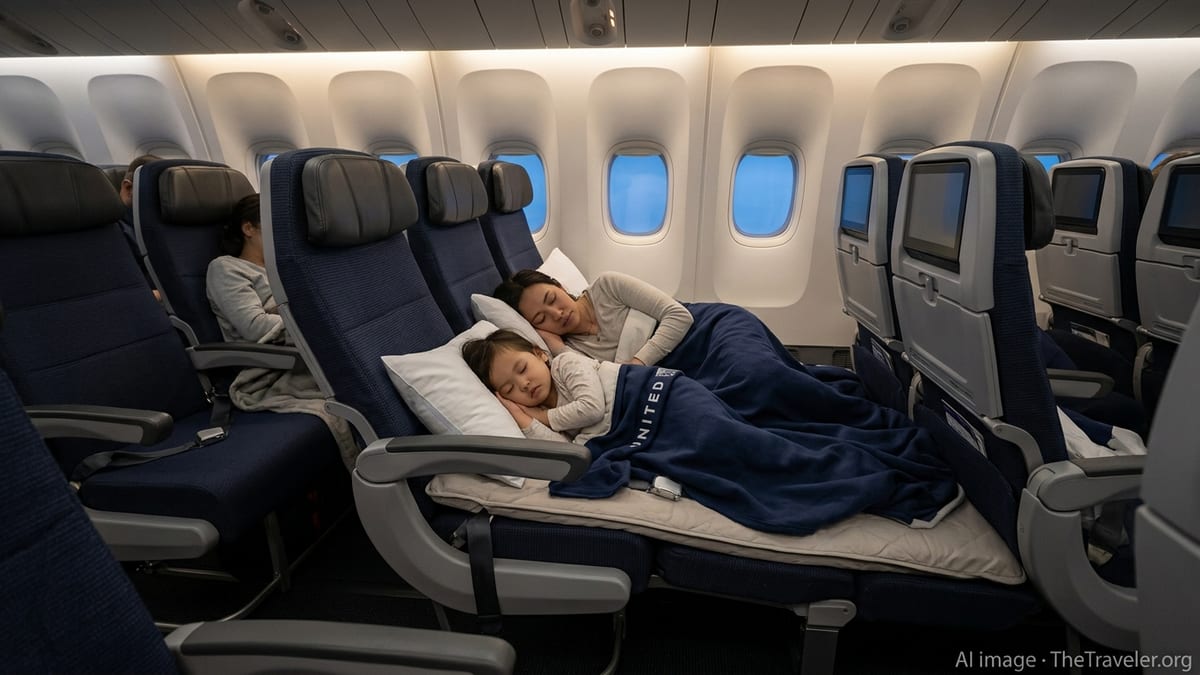
New Economy Couch Concept Targets Long-Haul Comfort
According to published coverage and product materials, Relax Row is designed around three adjacent United Economy seats that can be converted into a flat, couch-like surface. Passengers in these rows can raise and lock leg rests to create a continuous platform across the row, which is then topped with a thin mattress pad, blanket and pillows to form a makeshift bed. The configuration is intended to give travelers a way to lie down fully or at least stretch out much more than in a conventional reclining economy seat.
Reports indicate that the airline plans to introduce Relax Row first on select widebody aircraft that operate long-haul international routes, where the ability to sleep can significantly affect the overall travel experience. The concept resembles “sky couch” style products already offered by a small number of carriers, but this marks the first time a major North American airline has committed to such a dedicated couch-style option in standard economy.
Public information suggests that United is initially focusing on aircraft in the Boeing 787 family, a core part of its long-haul fleet. The goal is to install Relax Row on dozens of planes in the coming years, giving the airline a differentiated product for cost-conscious travelers who still prioritize rest on overnight flights.
How Relax Row Works Inside the Economy Cabin
Relax Row does not involve a separate cabin; instead, it is integrated into the existing main economy section. A limited number of three-seat blocks are fitted with upgraded leg rests and hardware that allow the seat bases to transform into a continuous surface. When activated, the leg rests rise to meet the seat cushions and lock into position, creating a flat or near-flat platform that spans the entire row.
Information shared by early briefings indicates that there will typically be between nine and twelve Relax Rows on each equipped aircraft, depending on the specific configuration. Seat pitch in these rows is expected to be around 32 inches, slightly more generous than standard economy, which should help accommodate the conversion hardware without removing entire rows or substantially cutting overall seat count.
Travelers booking Relax Row are expected to receive additional soft-product touches such as a dedicated mattress pad, blanket, pillow and a special seat belt configuration that can be used safely while lying down. When the product is not in “couch” mode, the seats function as regular economy positions, including the ability to use the leg rests like standard foot supports for seated passengers.
Positioned Between Economy and Premium Cabins
Relax Row arrives in a market where airlines have steadily layered products between basic economy and full business class. United already offers Economy Plus for extra legroom and Premium Plus as a true premium economy option with wider seats and greater recline, while its Polaris cabin provides fully flat individual beds and direct aisle access for business-class travelers.
Industry comparisons suggest that Relax Row is meant to fill a unique space within this spectrum. It is likely to be priced above standard economy and Economy Plus, but below Premium Plus and well under Polaris business-class fares. For solo travelers who value the ability to stretch out, couples seeking more privacy, or families with young children who benefit from extra space, the new product could offer a more attainable path to near-flat rest without paying business-class prices.
Aviation analysts point out that United’s move also responds to evolving passenger expectations. As more travelers become familiar with fully flat seats at the front of the plane, pressure has grown to improve rest options further back. By repurposing a traditional three-seat block into a shared bed, United aims to capture additional revenue while making use of cabin space that once only incidentally offered lie-flat potential when flights were lightly loaded.
Families and Sleep-Focused Travelers in the Spotlight
Public commentary and early reactions indicate that United is especially targeting families with children for Relax Row. The shared surface gives parents a controlled space where children can lie down, play or sleep under closer supervision than in separate seats. For overnight transoceanic flights, this could be particularly appealing to caregivers seeking a more predictable way to manage jet lag and restless kids.
At the same time, frequent flyers and long-haul regulars have highlighted potential benefits for adults who simply struggle to sleep while sitting upright. User reactions on travel forums point out that having an entire row to oneself has long been considered an unofficial “hack” for better rest in economy. Relax Row effectively formalizes that experience, pairing it with added padding, proper restraints and a consistent booking process.
There are, however, practical considerations. The total length of three adjacent economy seats provides a sleeping surface that may feel short for taller adults, and the shared nature of the couch means it may work best for one adult and one child or for travelers willing to coordinate how they use the space. Even so, early commentary suggests that many passengers view the ability to lie down at all in economy as a meaningful improvement over conventional seating.
Rollout Timeline, Pricing Questions and Competitive Impact
United has outlined an initial rollout beginning in 2027, with a stated ambition to equip a significant portion of its long-haul fleet, including a substantial number of Boeing 787 aircraft, by the end of the decade. The airline has indicated that overall seat counts in the economy cabin should remain largely unchanged, suggesting that Relax Row is being integrated through design efficiencies rather than wholesale reconfiguration.
Specific pricing details have not yet been widely disclosed. Coverage of the announcement notes that the airline is still evaluating how to structure fares, surcharges or post-booking upgrades for the new product. Observers expect a dynamic model that reflects route length, demand patterns and seasonality, similar to how airlines currently price extra-legroom, premium economy and paid upgrades to business class.
Competitively, Relax Row could prompt other North American carriers to revisit their long-haul economy offerings. Outside the region, couch-style seats have already appeared in select markets, but they remain relatively rare and often tied to specific aircraft types or routes. By embracing the concept across a large widebody fleet, United is positioning itself as an early mover in mainstreaming the economy couch for transoceanic travel.
For now, travelers watching this development will be weighing how Relax Row might fit into their own trip planning once booking opens. If pricing lands closer to traditional seat upgrades than to premium cabins, the product could become a popular middle-ground choice for passengers who want genuine rest on long flights without committing to the cost of a business-class bed.