

More news on this day
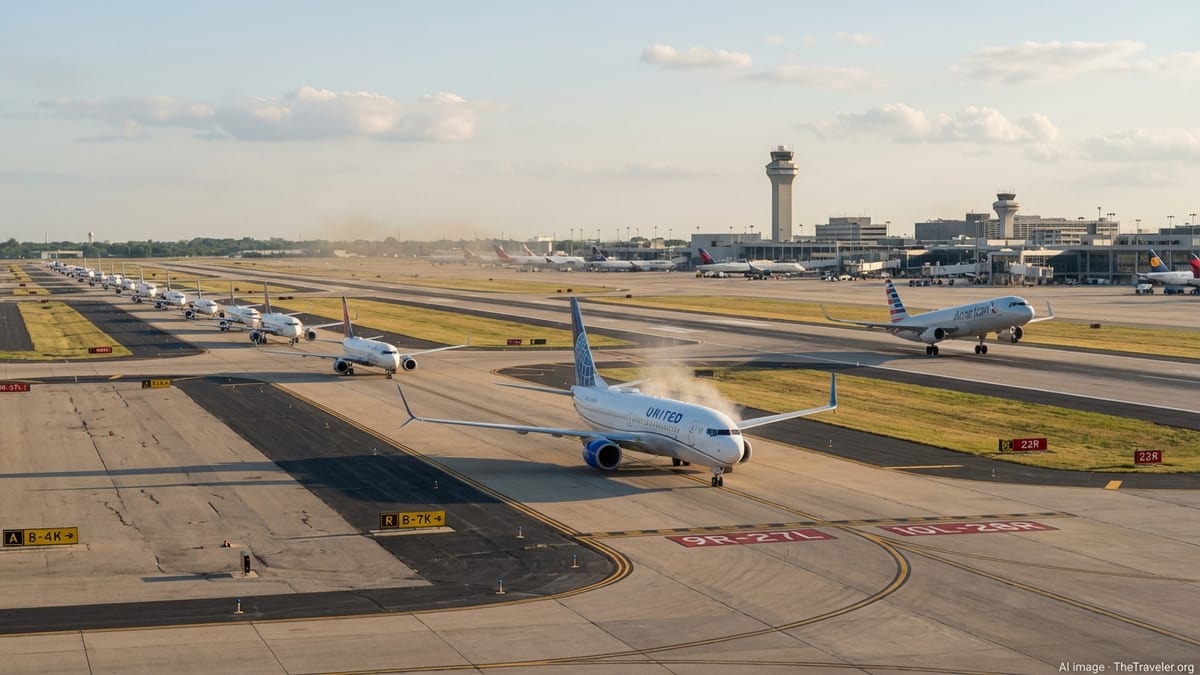
United Airlines and American Airlines are reshaping their summer 2026 schedules at Chicago O’Hare after the Federal Aviation Administration moved to cap daily flights, a rare step aimed at preventing severe congestion and delays at one of the nation’s busiest hubs.
What the FAA’s O’Hare Cap Actually Does
The FAA plans to limit Chicago O’Hare to about 2,800 takeoffs and landings per day throughout the peak summer scheduling season, which runs roughly from late March through late October 2026. Regulators say that level matches what the airport’s six-runway layout, terminal gates and air traffic control staffing can handle reliably without tipping into chronic gridlock.
The cap is a direct response to airline schedules that had swelled well beyond that threshold. Planning documents show that peak days this summer were set to exceed 3,000 operations, driven largely by ambitious growth from United and American. Officials warned that allowing those flights to proceed unchecked risked cascading delays, missed connections and greater strain on an air traffic system already stretched by controller shortages and ongoing construction at O’Hare.
Rather than imposing one-off emergency restrictions during bad weather or holiday surges, the FAA is taking the unusual step of putting a hard ceiling in place before the season begins. The agency will work with carriers to rebalance schedules in 30-minute blocks between early morning and late evening, dialing back the busiest banks of departures and arrivals until the airport is brought back to what it calls a “demonstrated manageable capacity.”
While the number sounds abstract, for travelers the cap means fewer flights overall than airlines had hoped to offer from Chicago this summer. The goal, however, is that the flights that do operate are more likely to run on time, with less risk of daylong meltdowns when thunderstorms or runway closures hit.
How United Airlines Is Adjusting Its Summer Plans
United, which uses O’Hare as its largest hub, has been at the center of the rapid build-up in flights. After gaining additional gates from the city in 2025, the carrier laid out plans to ramp up to roughly 750 to 780 daily departures from Chicago this summer, a sharp jump from an average of just over 540 last year.
Those aspirations will now have to be scaled back. In statements responding to the FAA’s move, United has signaled it will cooperate with schedule reductions while emphasizing its desire to maintain a safe and reliable operation. Behind the scenes, that likely means trimming frequencies on some routes, swapping out smaller regional jets for larger mainline aircraft on others, and smoothing out the sharpest peaks in its daily departure banks.
Travelers can expect United’s changes to be most visible on short-haul flights to nearby Midwest cities and on some duplicate frequencies to popular domestic destinations. Instead of six or seven daily flights, for instance, certain routes could see a reduced pattern with larger planes to preserve overall seat capacity where demand is strongest.
United’s tight connection banks at O’Hare may also be refined, with the airline spreading arrivals and departures more evenly across the day to meet the FAA’s half-hourly limits. That could lengthen some connection times but may ultimately make missed connections and rolling delays less common when weather or air traffic issues arise.
American Airlines Balances Growth With New Limits
American Airlines has also been aggressively adding capacity at O’Hare. The carrier announced plans to boost spring and summer departures by about 30 percent compared with 2025, aiming for more than 520 daily flights and more than 75 destinations from Chicago as it seeks a stronger foothold at the hub.
The FAA’s cap arrives just as that growth wave was set to crest. American has publicly praised regulators for acting early to protect the airport’s “operational integrity,” framing the limits as a path to a more reliable summer for its customers. Internally, that translates into reworking schedules that were built around additional gates and expanded flying.
For travelers, the impact is likely to center on marginal flights at off-peak times or on thinner routes where multiple daily frequencies had been planned. American may opt to consolidate some departures, use larger aircraft on high-demand routes, and adjust its banked schedule so that O’Hare’s busiest morning and afternoon waves fall within the FAA’s new thresholds.
The airline is also expected to preserve key business and leisure routes that underpin its Chicago network, even if that means sacrificing some experimental additions or late-night frequencies. The carrier has emphasized that it sees the cap as an opportunity to improve the customer experience, suggesting that reliability will be a major focus of its eventual summer schedule from O’Hare.
What Passengers Should Expect This Summer
For travelers already holding tickets through Chicago, the most immediate consequence of the FAA’s decision is a higher chance of schedule changes in the weeks ahead. As United and American finalize their adjusted summer timetables, some passengers can expect revised departure times, aircraft type changes, or even rebookings onto alternative flights that better fit within the daily cap.
Airlines will be required to update schedules with reservations systems and notify customers once their changes are approved. In most cases, travelers should be able to accept the new itineraries or request alternatives without additional fees if the schedule shift is significant. Those planning complex connections through O’Hare may want to build in a bit more buffer time than usual, especially during peak afternoon and evening periods when storms are most likely to disrupt operations.
On balance, the FAA and the airlines argue that the cap will trade a small reduction in choice for a more stable experience. With fewer flights crowding the same runways and taxiways, delays caused by minor hiccups should be easier to absorb, and the airport’s gate and staffing resources will be under slightly less strain on peak travel days.
Passengers connecting through O’Hare should still be prepared for busy terminals and full flights, as both United and American intend to protect as much seat capacity as possible by using larger planes and focusing on their most profitable routes. But if the plan works as intended, summer 2026 could see fewer headlines about daylong snarls and mass cancellations at Chicago’s primary hub.
Why the FAA Is Intervening Now
Although the FAA routinely coordinates schedules at tightly constrained airports, the decision to cap flights at O’Hare is notable because it is being taken preemptively, before a crisis has fully materialized. Officials say they were guided in part by what happened at Newark Liberty International Airport in recent years, where last-minute schedule cuts were ordered to stem chronic congestion and air traffic delays.
O’Hare presents a similar challenge: a modern airfield with multiple parallel runways, but aging terminals, gate bottlenecks and an air traffic control facility still grappling with staffing gaps. Construction projects to expand and reconfigure terminals are under way and will continue through the summer, further complicating ramp operations and limiting flexibility during peak periods.
By imposing a clear daily ceiling now, regulators hope to avert the kind of gridlock that can ripple well beyond Chicago, affecting flights and connections across the United States and abroad. United and American both rely heavily on O’Hare as a connecting hub, so disruptions there can quickly cascade through their national and international networks.
The move is also a signal to other fast-growing airports that the FAA is ready to act earlier when airline schedules outpace the practical limits of infrastructure and staffing. For travelers, Chicago’s new cap may serve as an early test of whether deliberate restraint and closer coordination can deliver a smoother peak travel season at some of the country’s busiest hubs.