

More news on this day
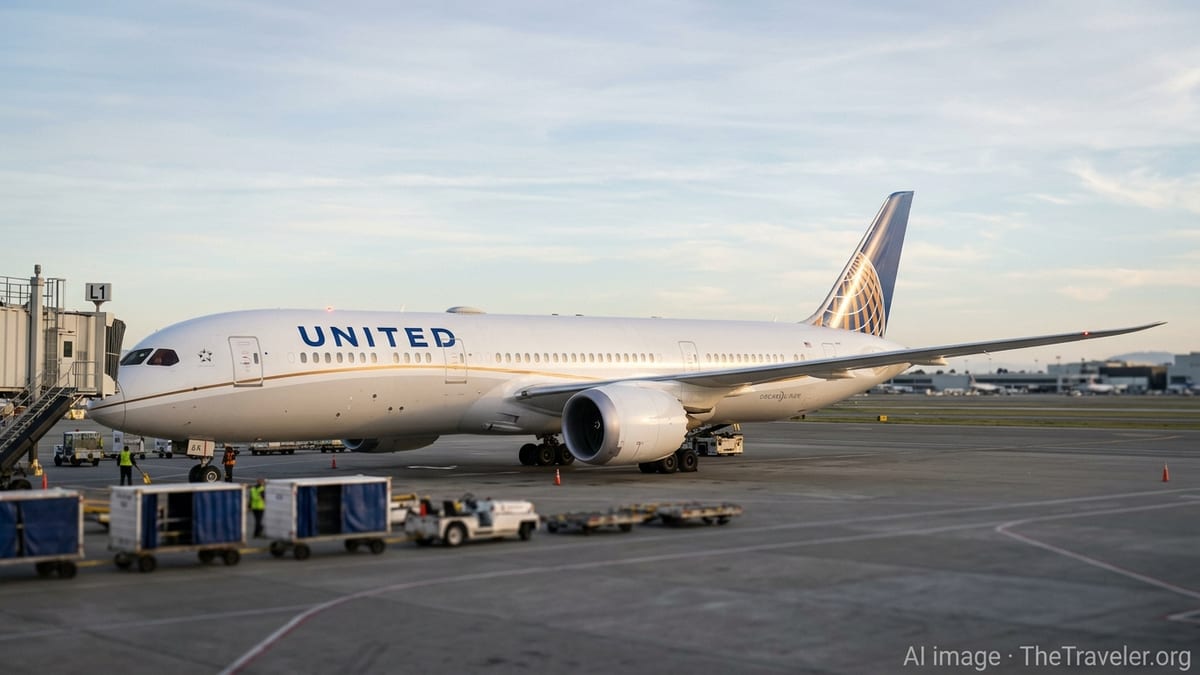
United Airlines is preparing to deploy what industry observers describe as the most premium-heavy Boeing 787-9 ever operated by a United States carrier, a low-density, long-haul “high J” Dreamliner that trades dozens of economy seats for 99 revenue-generating premium seats and a redesigned Polaris business-class experience.
Get the latest news straight to your inbox!
A New Flagship for United’s Long-Haul Network
United has spent several years tilting its long-haul strategy toward premium revenue, and the newest Boeing 787-9 configuration is the clearest expression of that shift so far. Publicly available information about the “Elevated” interior shows a total of 99 premium seats across Polaris business class and Premium Plus, a record share of cabin space dedicated to higher-yield passengers on any United widebody.
The aircraft, often referenced by enthusiasts under the internal 78L code, cuts total capacity compared with United’s existing 787-9 layout. Analyses of fleet data indicate total seats drop by roughly 35, while premium seating rises from 69 to 99, significantly increasing the proportion of passengers paying for extra space, privacy and amenities. Economy still accounts for the largest single cabin, but its relative share is meaningfully reduced.
Reports from aviation outlets suggest the first 787-9s with this interior are being delivered ahead of their first planned long-haul duties in 2026. Initial international routes are expected to include San Francisco to Singapore and San Francisco to London, two markets where sustained premium demand and long stage lengths make a low-density, business-heavy jet particularly attractive.
Inside the 99-Seat Premium Layout
The heart of United’s new 787-9 is an expanded Polaris cabin, growing to 64 suites in a 1-2-1 configuration that gives every passenger direct aisle access. Specialist coverage of the configuration notes that this is the largest concentration of long-haul business-class seats on any United aircraft and among the most premium-heavy layouts in the transpacific and transatlantic markets.
Behind Polaris, the Premium Plus cabin scales up to 35 seats, a notable increase compared with the 21-seat layout on United’s current Dreamliners. The seats are described as wider recliners with greater pitch than standard economy, complemented by added storage, upgraded soft goods and, on these aircraft, design cues carried over from Polaris. For many travelers, this is likely to function as an intermediate step between business and economy on ultra-long sectors.
Economy itself is not neglected. Coverage of the Elevated interior highlights that the main cabin features large 4K OLED seatback screens, Bluetooth connectivity and refreshed finishes intended to brighten the cabin and visually tie it to the premium spaces. Even with fewer rows, the cabin aims to hold its own in an increasingly competitive long-haul market where inflight entertainment and connectivity are central to the value proposition.
Polaris Studio: United’s Hard-Product Leap
Central to the 787-9 gamble is a new iteration of United’s Polaris business-class seat, often referred to as Polaris Studio. Aviation publications describe a suite-style layout with sliding privacy doors, a larger work surface and an extended ottoman that can serve as a companion seat during meals. The seat is designed to align United more closely with leading global business-class products, particularly on ultra-long-haul routes where rest and privacy carry a premium.
Alongside the physical shell, the soft-product details are getting attention. Reports indicate that the Polaris Studio experience is paired with refreshed bedding from Saks Fifth Avenue, upgraded amenity kits featuring high-end skincare brands and new noise-cancelling headphones. Some coverage has also highlighted a caviar-based amuse-bouche as a signature touch on select services, signaling United’s intent to compete head-on in the high-end business-class space historically dominated by international carriers.
Connectivity and entertainment are another focus. The Elevated interior is expected to incorporate Starlink-powered high-speed internet and the largest seatback screens currently offered on a United aircraft, both in Polaris and economy. For business travelers accustomed to working gate-to-gate, these upgrades are likely to be as important as the hard-shell seat enhancements.
Revenue Strategy Behind a Low-Density Dreamliner
United’s choice to remove dozens of economy seats in favor of additional premium capacity reflects a broader industry trend. Financial disclosures and industry analysis over recent years show that premium cabins generate a disproportionate share of long-haul revenue, even when occupancy rates are similar to or lower than those in economy. A 787-9 that concentrates 99 seats in premium cabins is a direct bet that this revenue mix will hold or strengthen.
By boosting business-class capacity to 64 seats, United positions itself to capture more corporate contracts and high-spend leisure traffic on trunk routes like San Francisco to Singapore. These flights are not only long but frequently operate in time slots that maximize business connectivity at both ends, making them ideal candidates for a premium-heavy configuration that can support both paid bookings and frequent-flyer upgrades.
The trade-off is risk. With fewer total seats, the unit cost per available seat mile can rise if premium demand softens or if the airline struggles to consistently fill the larger Polaris and Premium Plus cabins at sustainable fares. Industry commentators note that this configuration could prove especially sensitive to economic cycles, corporate travel budgets and competitive moves from rivals that may respond with their own product refreshes or pricing tactics.
What It Means for Travelers and the US Premium Market
For passengers, the arrival of United’s 99-seat premium 787-9s signals more choice at the upper end of the market and a clearer hierarchy of comfort offerings across the cabin. Frequent flyers can expect more opportunities for long-haul business-class redemptions and upgrades on specific routes, though the expanded Polaris cabin may also change waitlist dynamics and elite upgrade expectations.
Premium Plus customers stand to benefit from a larger, more clearly defined cabin that feels less like a bolt-on and more like an integral part of the aircraft design. Travelers who might previously have chosen economy extra-legroom seats may now consider stepping up to Premium Plus on very long segments, particularly if pricing gaps remain modest and the product consistently delivers on comfort and service.
At the network level, this aircraft type is likely to cluster on high-yield routes, creating a two-tier experience within United’s own 787-9 fleet. Some flights will feature the ultra-premium, low-density configuration, while others retain more traditional layouts with smaller premium cabins and more economy seats. For travelers, that makes paying close attention to aircraft type and seat maps increasingly important when planning big-ticket international trips.
More broadly, United’s move sharpens the premium competition among US carriers. Comparisons with rival 787-9 offerings suggest that no other US airline currently matches this concentration of premium seating on a single aircraft type. If the strategy proves successful, it may encourage further cabin densification at the top end of the market, pushing business-class products closer to what has traditionally been considered first-class territory on long-haul routes.