

More news on this day
United Airlines is preparing to overhaul the comfort equation in its long-haul economy cabins, unveiling a new “Relax Row” concept that converts three adjacent seats into a couch-style space aimed at families, couples and solo travelers willing to pay for more room without stepping up to premium economy or business class.
Get the latest news straight to your inbox!
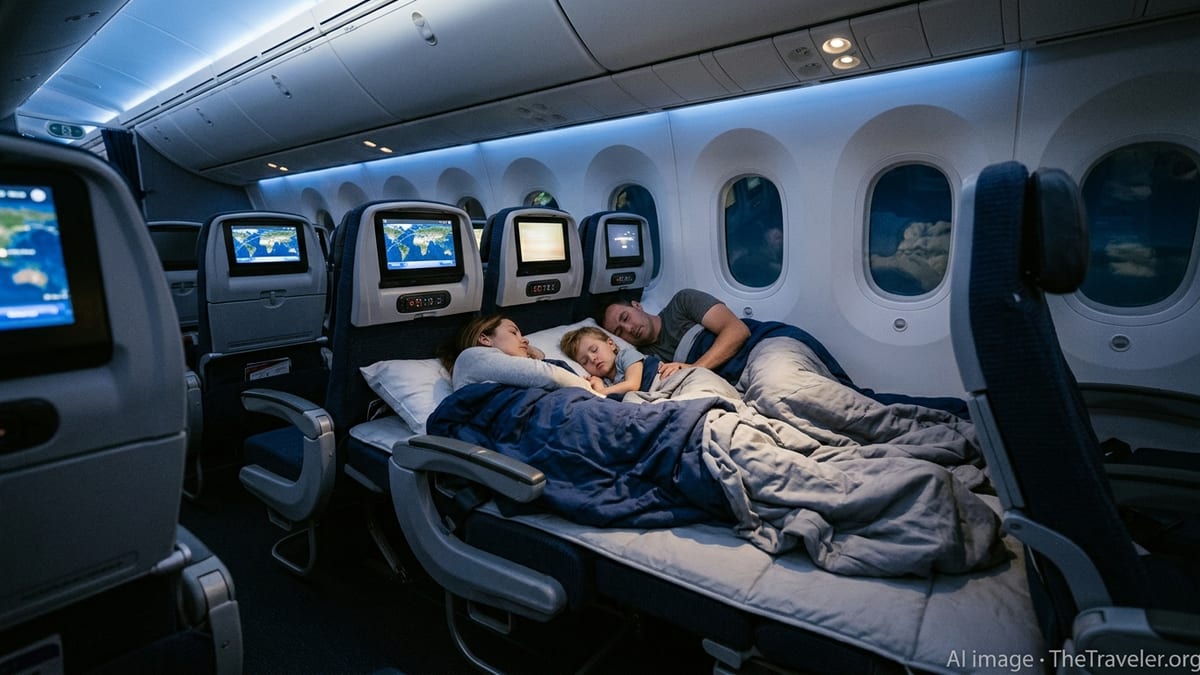
A Couch in the Sky for Economy Flyers
Publicly available information shows that United’s Relax Row is built around a dedicated set of three economy seats that can be turned into a mattress-like surface after takeoff. Adjustable leg rests flip up to form a continuous platform, allowing passengers to stretch out, curl up with children or simply create more personal space than a standard seat provides on overnight journeys.
The product is targeted at long-haul flights rather than short domestic hops, with United positioning Relax Row as a new tier between regular economy and its United Premium Plus cabin. The rows will sit in the main economy cabin but are expected to carry a separate surcharge that reflects the additional space and included soft amenities such as mattress pads, blankets and extra pillows.
According to descriptions shared in airline-focused forums and product summaries, United intends Relax Row to appeal especially to families with young children who struggle with traditional seating, as well as cost-conscious travelers who value sleep but find full flat-bed business class prices out of reach. The concept echoes earlier “sky couch” style offerings seen at other carriers, but marks a first for a major North American airline.
Rollout Plan Across 787 and 777 Long-Haul Fleet
Reports indicate that United plans to introduce Relax Row from 2027, starting with its Boeing 787 Dreamliners and Boeing 777 widebody aircraft that operate many of the carrier’s long-haul services. Over time, the airline is expected to equip more than 200 aircraft with the new seating option, creating up to 9 to 12 Relax Row sections per plane depending on configuration.
These aircraft underpin United’s network between the United States and major destinations in Europe and Asia, including transatlantic trunk routes from Newark, Chicago and Washington, and transpacific services from West Coast hubs such as San Francisco and Los Angeles. Once fully rolled out, the product is likely to be visible on a wide range of overnight segments linking North America with cities such as London, Frankfurt, Tokyo and Seoul.
Seat layout information shared by aviation enthusiasts suggests that Relax Row sections will be carved out of the standard economy cabin with a pitch of around 32 inches, which places them between regular economy and extra-legroom seating in terms of spacing. United is signaling that it can introduce the product without removing large numbers of existing seats, an important consideration for revenue on high-demand routes.
Pricing details have not yet appeared in public booking displays, and airlines typically test different surcharge levels by route and season. Industry observers expect United to follow the model used by other couch-style products, where passengers pay a premium on top of standard economy fares to secure the full row and the associated bedding kit.
How Relax Row Fits Into the Global Comfort Arms Race
The new United concept arrives as airlines worldwide are searching for ways to differentiate economy cabins without cannibalizing premium products. Carriers such as Air New Zealand and All Nippon Airways have previously experimented with couch-style seating that allows passengers to stretch out over three seats on long flights, particularly on leisure-heavy routes.
Those earlier initiatives demonstrated that some travelers are willing to pay for more horizontal space even if service levels remain essentially economy. For United, Relax Row offers a way to compete in that niche while reinforcing its broader strategy of layering multiple comfort and pricing tiers, from basic economy through extra-legroom, premium economy and Polaris business class.
Travel analysts point out that long-haul economy travelers have become more vocal about comfort, especially on overnight flights of eight hours or more linking the United States with Europe and Asia. Seats that feel narrow, limited recline and limited ability to sleep are frequent themes in passenger feedback, and airlines are under pressure to respond without dramatically increasing fares.
By introducing Relax Row, United is signaling that it sees value in monetizing unused lateral space in rows that might otherwise go out with empty seats. At the same time, the airline is betting that travelers will trade some traditional perks of higher cabins, such as upgraded dining, for the simple ability to lie down or spread out at a lower price point than business class.
Passenger Reactions and Practical Questions
Early reaction in frequent flyer communities has ranged from enthusiasm to skepticism. Many long-haul flyers welcome the prospect of a more affordable way to rest on overnight sectors, especially parents who currently rely on ad hoc strategies such as hoping for an empty middle seat or booking an entire row of standard economy seats when loads permit.
Others are focused on practical details that have not yet fully emerged. Questions include how United will control access to Relax Row, what happens when only part of a row is booked, and how crew will manage issues such as seatbelt use, safety demonstrations and shared armrests once the platform is deployed. Observers also note the potential for disputes if families attempt to use the space without having paid for it, particularly on full flights.
There is also debate about who will fit comfortably in the space when the seats are converted into a couch. Taller passengers may find that legs extend into the aisle, while some travelers are concerned about whether the sleeping surface will be firm enough for longer stretches. Industry watchers suggest that trials and early customer feedback on routes across the Atlantic and Pacific will determine how the product evolves.
Despite the open questions, the concept has already sparked discussion across competing airline communities about whether similar options will spread. Commentators on rival-carrier forums have speculated on whether other U.S. airlines might adapt their widebody cabins to offer a comparable couch-style experience if United’s Relax Row proves commercially successful.
What It Could Mean for Long-Haul Travel Between America, Europe and Asia
If United delivers Relax Row at scale, the move could subtly shift how travelers think about long-haul economy seating on key intercontinental corridors. For families and couples planning trips between the United States and destinations in Europe or Asia, the option to buy a semi-private couch area may become a standard part of the shopping process, alongside premium economy upgrades and mileage redemptions.
From a competitive standpoint, airlines operating on overlapping routes may feel pressure to respond with their own comfort upgrades, whether in the form of enhanced extra-legroom seats, improved bedding for economy, or entirely new cabin sub-brands. That dynamic could ultimately raise baseline expectations for comfort even among travelers who never purchase a Relax Row.
For now, the announcement highlights how quickly the line between traditional cabin classes is blurring. By turning a standard row of three seats into a configurable space for rest and relaxation, United is testing whether small structural innovations in the economy cabin can deliver both new revenue and a noticeably better experience for passengers crossing oceans.