

More news on this day
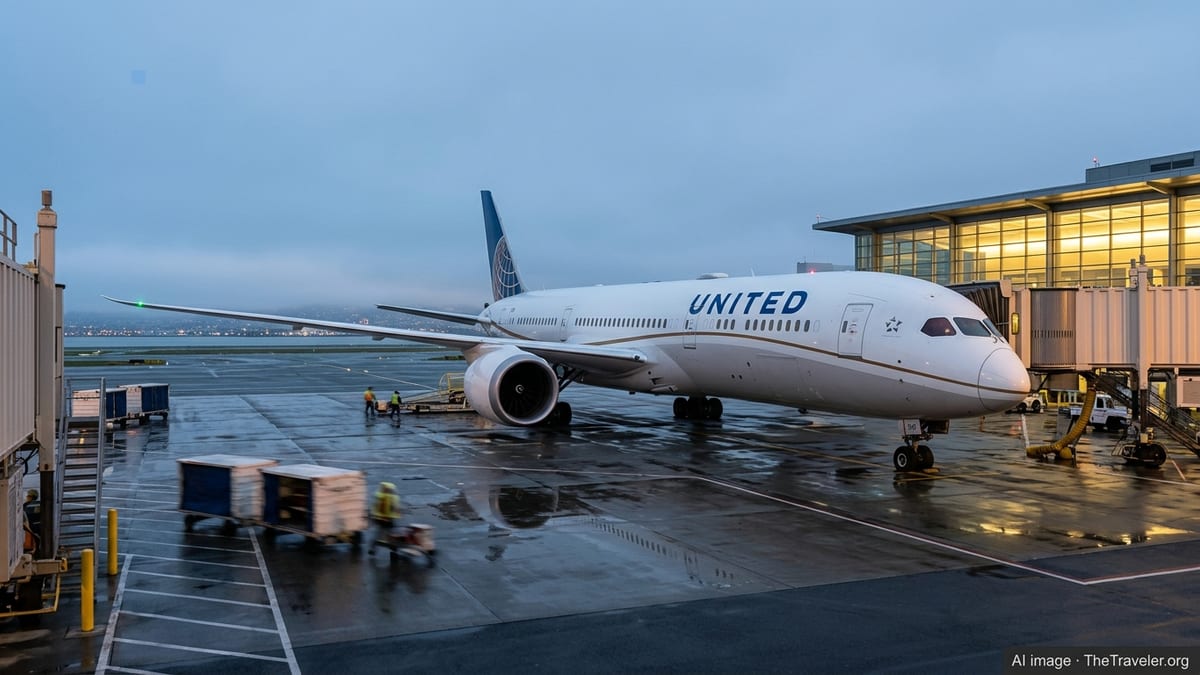
United Airlines is preparing a major escalation in the global premium travel race, introducing a new Boeing 787-9 Dreamliner configuration with a record share of high-yield business and premium economy seats on flagship routes from San Francisco to Singapore and London.
Get the latest news straight to your inbox!
Premium-Heavy Dreamliner Redefines Cabin Mix
Publicly available fleet information and recent industry coverage indicate that United’s latest Boeing 787-9 Dreamliners, due to enter long-haul service from early 2026, will feature one of the most premium-heavy layouts operated by a U.S. carrier. The aircraft is tied to the airline’s "Elevated" interior program, which focuses on expanding revenue-rich cabins while trimming standard economy capacity.
The new configuration centers on an enlarged Polaris business class cabin and a significantly expanded United Premium Plus section. Internal seat maps and specialist reporting describe 64 Polaris business seats, including eight larger Polaris Studio suites, alongside 35 Premium Plus seats, 39 Economy Plus seats and a reduced number of standard economy seats. In total, well over half of the Dreamliner’s cabin footprint is dedicated to premium offerings.
Industry analysts note that this shift reflects broader market dynamics. Premium economy demand on long-haul routes has climbed sharply in recent years, with data firms reporting double-digit percentage growth in bookings as travelers seek more comfort without committing to full-fare business class. United’s strategy aligns with this trend by emphasizing both Polaris and Premium Plus in a single, highly segmented cabin plan.
The Boeing 787-9 platform itself supports this approach. The type’s combination of fuel efficiency, range and lower cabin altitude has made it a workhorse for ultra long-haul missions such as San Francisco to Singapore, where passenger comfort and operational economics are equally critical.
Polaris Studio Leads Ultra-Luxury Push
At the top of the new Dreamliner hierarchy sits Polaris Studio, a small set of enlarged business suites positioned in the first row of each business class section. According to published descriptions of the Elevated interior, these eight suites are approximately 25 percent larger than standard Polaris seats and feature full-height privacy doors, companion seating ottomans and upgraded materials aimed at high-spend corporate and premium leisure travelers.
The broader Polaris cabin also receives a comprehensive overhaul. Reports indicate lie-flat, all-aisle-access seats with improved privacy, expanded personal storage, wireless charging, Bluetooth audio connectivity and 4K seatback screens that are among the largest specified by a U.S. airline in business class. The technology focus is designed to match or exceed leading Asian and European competitors on core transpacific and transatlantic routes.
United is also layering in new soft-product elements tailored to the Elevated Dreamliners. Public coverage of the cabin concept highlights upgraded onboard dining with touches such as caviar amuse-bouche service in Polaris Studio and expanded à la carte options for the broader Polaris cabin. These service enhancements are intended to create clear differentiation between cabin tiers while justifying higher fares.
By combining an expanded number of business seats with a more exclusive front-row suite product, United is effectively segmenting its long-haul premium cabin in the same way many airlines have segmented economy and premium economy in recent years.
Record Premium Seats on San Francisco to Singapore
The ultra long-haul San Francisco to Singapore market has become a key proving ground for United’s premium-heavy strategy. Flight data and scheduling information show the carrier plans to deploy the refreshed 787-9 configuration on this route from late 2025 into 2026, building on its existing nonstop presence between the two technology and finance hubs.
Industry analyses point out that San Francisco to Singapore ranks among the world’s longest regularly scheduled services, with block times typically exceeding 16 hours. On such sectors, corporate contracts, high-spend technology workers and affluent leisure travelers drive outsized demand for lie-flat seating and extra personal space, making a dense premium configuration commercially attractive.
With 64 Polaris seats and 35 Premium Plus seats, the new Dreamliner is expected to offer the highest total count of premium seats ever deployed by a U.S. airline on the route. Aviation commentators note that this will position United to compete more directly with Asian carriers that already emphasize large premium cabins in the Singapore market.
The 787-9’s range and efficiency are central to this deployment. The aircraft’s composite structure, advanced aerodynamics and modern engines allow United to operate ultra long-haul segments with a heavier share of spacious, lower-density seating while still maintaining viable seat-mile economics.
Strengthening the Transatlantic Franchise to London
Across the Atlantic, United is also expected to base the premium Dreamliner at its San Francisco hub for services to London, one of the most competitive long-haul markets globally. Publicly available route planning commentary suggests that San Francisco to London, together with key services from hubs such as Newark and Washington Dulles, will be among the primary transatlantic beneficiaries of the new configuration.
London remains a cornerstone for corporate travel, particularly in sectors such as finance, technology and professional services. Industry reports consistently identify the San Francisco to London corridor as a strong performer for business-class demand, with nonstop services in both directions often commanding some of the highest average fares in United’s network.
By concentrating a large Polaris and Premium Plus footprint on these flights, United is effectively turning its Dreamliners into premium shuttles between major technology and financial centers. Analysts suggest that the combination of more business seats, a clearly defined premium economy cabin and upgraded economy amenities could help the carrier secure a larger share of high-yield travelers who might otherwise choose European or Middle Eastern competitors.
The move also supports broader network flexibility. With a standardized premium-heavy 787-9 fleet segment, United can rotate the aircraft seasonally between San Francisco to London, San Francisco to Singapore and other hub-to-hub routes as demand patterns evolve.
Elevated Economy and Competitive Implications
While most attention focuses on Polaris and Premium Plus, the Elevated interior also introduces notable changes in the main cabin. Official descriptions of the layout highlight larger 4K seatback screens in economy, Bluetooth pairing for personal headphones, additional power outlets and reengineered seat structures designed to provide a subtle cradling effect for long-duration comfort.
Although the total number of standard economy seats falls compared with United’s earlier 787-9 layouts, the airline is positioning the remaining seats as a more technologically advanced and comfortable proposition. The presence of 39 Economy Plus seats, offering extra legroom and the same upgraded entertainment and power features, is intended to bridge the gap between full premium economy and standard coach.
From a competitive standpoint, the Dreamliner refresh signals that U.S. carriers are prepared to match foreign rivals not only in cabin design but also in the proportion of the aircraft devoted to premium products. Aviation analysts point to a broader trend among network airlines of monetizing comfort, where everything from lounge access to extra legroom has become a revenue driver.
For travelers on United’s long-haul routes out of San Francisco, the arrival of these premium-heavy 787-9s will translate into a noticeably different onboard landscape. With more seats at the top of the cabin, a larger mid-tier option and upgraded economy, the airline is betting that passengers will pay more for comfort and choice on some of the world’s longest and most competitive flights.