

More news on this day
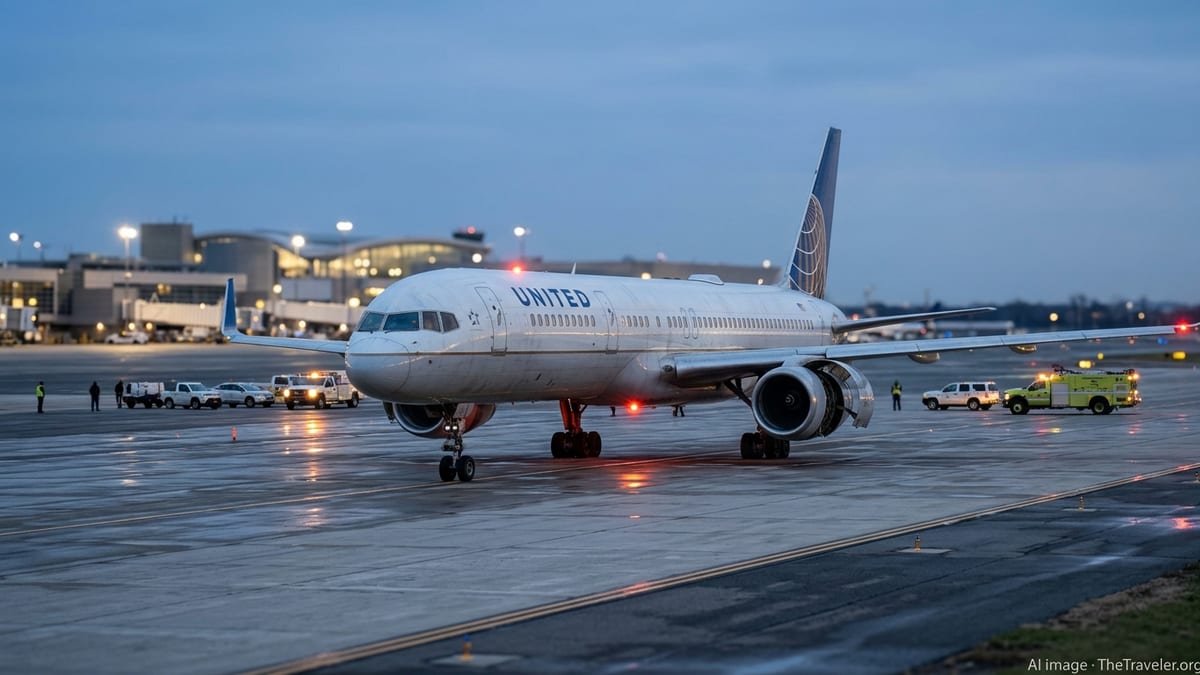
A United Airlines Boeing 757 operating a domestic flight to Newark Liberty International Airport completed a safe landing after one of its two engines was shut down in flight, with reports indicating that the crew, airline, and U.S. aviation system executed emergency procedures as designed and brought all passengers and crew to the gate without injury.
Get the latest news straight to your inbox!
Calm Response as Twin-Engine Jet Diverts to Single-Engine Operation
According to early operational reports, the United States-registered Boeing 757 was approaching the New York metropolitan area when the flight crew elected to shut down one of the aircraft’s engines following an in-flight anomaly. The decision aligned with standard safety protocols for modern twin‑engine aircraft, which are certified to continue flying safely on a single engine for extended periods.
Flight tracking data and public aviation logs indicate that the aircraft maintained a controlled profile toward Newark Liberty International Airport, with no rapid descent or abnormal maneuvers observed. Passengers reported a relatively calm cabin environment, with onboard announcements emphasizing that the aircraft was designed to operate safely even after the loss of one engine.
The Boeing 757 family has a long record of operating in demanding conditions, including transcontinental and transatlantic routes, and is routinely trained for one‑engine‑inoperative scenarios in simulator sessions. The crew’s decision to follow a deliberate, checklist‑driven process reflects an industry approach that prioritizes stabilizing the situation over attempting to maintain schedule or avoid delays.
Coordinated Emergency Measures at Newark Liberty
As the aircraft continued toward Newark on a single engine, emergency protocols at the airport were activated, resulting in the pre‑positioning of fire and rescue vehicles along the runway and taxiways. This visible presence is a routine component of a precautionary response to any declared in‑flight issue and does not necessarily indicate imminent danger, but ensures that specialized teams are ready if needed.
Reports from the airfield environment indicate that the landing rollout was controlled and that the aircraft remained on the runway centerline before exiting to a taxiway under its own power. Once the aircraft stopped at a safe location, ground crews carried out standard post‑landing inspections while passengers remained on board or proceeded to deplane in an orderly manner.
Newark Liberty, one of United Airlines’ key hubs, is accustomed to handling diversions and technical incidents involving large commercial aircraft. Longstanding coordination between airport operations, air traffic services, and airline control centers helps support a structured response that is largely invisible to passengers but is critical for maintaining safety margins during unusual events.
Airline Training and Safety Systems Underpin Outcome
The safe outcome of the flight illustrates the layered nature of aviation safety in the United States. Pilot training for major carriers includes recurrent simulator sessions that rehearse a range of engine malfunctions and failures, from takeoff to landing, with particular emphasis on maintaining control, communicating clearly, and following checklists rather than improvising under pressure.
The Boeing 757’s design incorporates redundancy in critical systems, including hydraulics, electrics, and flight controls, allowing the aircraft to retain full controllability even if a powerplant is shut down. When one engine is taken offline, the remaining engine is managed carefully within defined performance limits, and route or altitude adjustments are made to preserve a generous safety buffer.
Publicly available safety records show that incidents involving in‑flight engine shutdowns rarely lead to injuries when handled according to established procedures. In many cases, such events conclude with uneventful landings and thorough technical inspections, reinforcing the principle that modern commercial aviation is designed to manage technical faults without compromising passenger safety.
Technical Inspection and Regulatory Review Ahead
After the aircraft came to rest at Newark, maintenance teams began the process of securing and assessing the affected engine. This process typically includes visual inspection of the nacelle and fan area, checks for fluid leaks or heat damage, and detailed review of engine data recorded by onboard monitoring systems. If initial checks suggest more complex internal issues, the engine may be removed for workshop examination.
Regulatory frameworks in the United States require that events involving an in‑flight engine shutdown be documented and reported. Publicly accessible databases maintained by aviation authorities often include brief descriptions of such incidents, along with follow‑up findings on mechanical causes and any recommended maintenance or inspection changes.
While early indications point to a controlled, precautionary shutdown, additional clarity is expected as technical reports are compiled. Historical records show that similar events may be traced to components such as fuel system parts, sensors, or wear within rotating assemblies, with subsequent industry responses often focused on inspection intervals and part replacement schedules.
Travelers Weigh Experience Against Broader Safety Context
For passengers aboard the United flight, the experience of landing on one engine at a major U.S. hub is likely to stand out as a memorable and unsettling travel moment. Yet, in the broader context of commercial aviation, such incidents are rare relative to the enormous number of daily flights and are managed within a safety system designed to anticipate and contain technical irregularities.
Analyses of past events involving twin‑engine aircraft show that precautionary returns and diversions typically end with routine taxi‑in and disembarkation, followed by rescheduling or rebooking of passengers affected by aircraft out‑of‑service time. For travelers, the most visible impacts tend to be delays and missed connections rather than physical harm.
As air travel demand across the United States remains strong, events like the Newark engine shutdown underscore the role of training, engineering redundancy, and coordinated emergency planning in sustaining public confidence. While investigations will focus on the technical origin of the problem, the safe landing and absence of injuries highlight how the aviation system is structured to respond decisively when equipment does not perform as expected.