

More news on this day
United Airlines is introducing a new long-haul seating concept called United Relax Row, a configurable block of economy seats that can convert into a shared couch, expanding lie-down options beyond premium cabins and signaling a new phase in the competition for comfort in the back of the plane.
Get the latest news straight to your inbox!
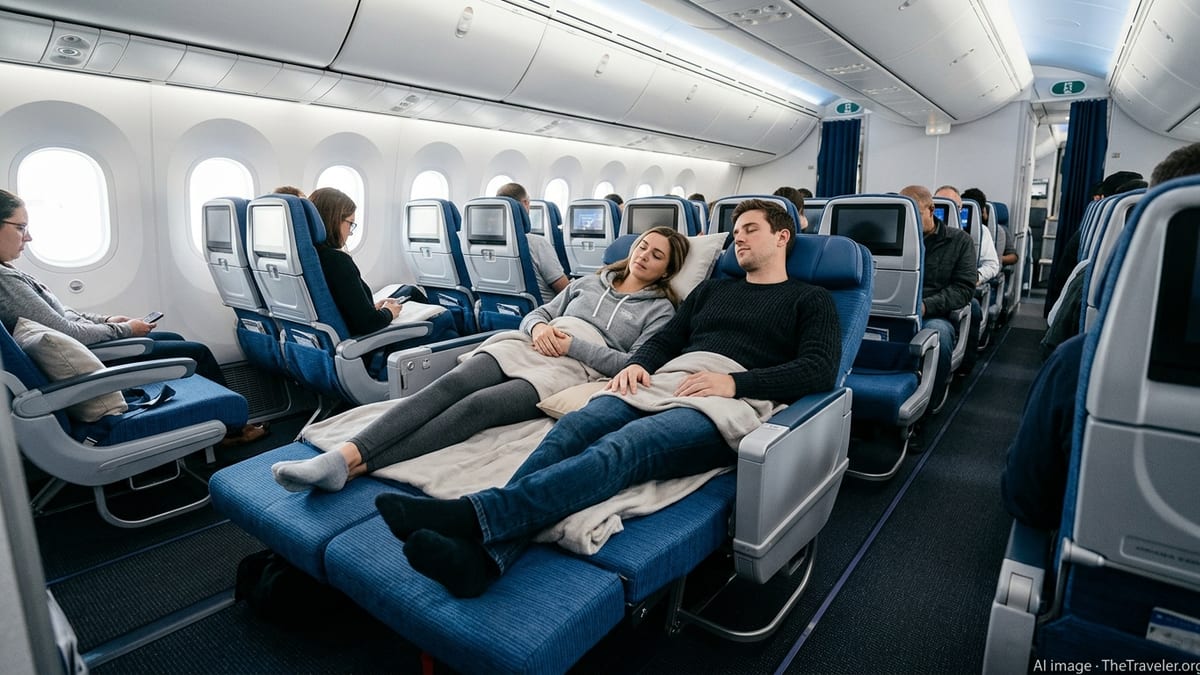
New Couch-Style Option in the Economy Cabin
According to published coverage and product descriptions shared with travelers, United Relax Row is designed as a set of standard United Economy seats that can be transformed into a flat, couch-like surface after takeoff. The concept adapts an idea previously seen on a handful of international carriers and brings it into the North America to long haul market under United’s branding.
The new product is configured as a dedicated zone of rows within the main cabin, positioned between regular United Economy and the higher priced United Premium Plus section. Reports indicate that each Relax Row consists of a small block of adjacent economy seats that can be booked together, either by couples, solo travelers willing to pay for extra space, or families who want a more flexible area for rest during overnight flights.
When the aircraft reaches cruising altitude, customers can raise special leg rests and reposition dedicated cushions to span the full width of the row, effectively creating a padded couch surface. The seats retain conventional seatbelts and are used upright for taxi, takeoff and landing, in line with standard safety procedures already familiar to economy passengers.
Initial information shared across aviation forums and customer communications indicates that Relax Row will be offered on selected long haul routes where overnight flying and demand for rest are highest, rather than across the entire fleet from day one. That rollout strategy mirrors how many airlines introduce new hard products, beginning with specific widebody aircraft types and key international markets.
Positioned Between Economy and Premium Plus
United Relax Row is being marketed as part of the broader spectrum of United seating options, which range from Basic Economy through Economy, Economy Plus, Premium Plus, and premium cabins such as Polaris business class. Publicly available product comparisons show that Relax Row is intended to sit in the gap between standard economy and the dedicated Premium Plus cabin in terms of both pricing and experience.
Unlike United Premium Plus, Relax Row does not appear to introduce a completely different seat shell or a separate cabin environment. Instead, it leverages the familiar three seat economy bench layout and adds hardware that allows the leg rests and seat bases to align and lock into a couch configuration. This approach enables United to create a new experience without sacrificing as much cabin density as a traditional premium economy redesign.
Industry observers note that the airline has filed patents around this style of transformable row, suggesting United aims to differentiate itself from domestic competitors that have so far focused upgrades primarily on business class suites and conventional extra legroom seating. The introduction of Relax Row follows United’s recent emphasis on upgraded interiors, larger seatback screens and enhanced connectivity across long haul aircraft.
From a revenue perspective, the new product gives the carrier another tier to monetise unused seat blocks that might otherwise go out partially filled, especially on flights with uneven demand across cabin zones. Travelers are expected to pay a supplement on top of the underlying economy fare to secure an entire Relax Row for their party.
Targeting Families and Overnight Travelers
The Relax Row product appears particularly tuned to the needs of families and overnight leisure travelers, groups that may not be willing or able to pay for full premium economy or business class, but who are highly sensitive to comfort on flights lasting eight hours or more. Public discussion of United’s family seating policies, including dynamic seat maps that aim to group children with adults in their party, suggests the airline is actively shaping its cabin layouts and tools with these customers in mind.
In practice, a Relax Row can be booked by a family of three who would be occupying an entire standard row in any case. Once in couch mode, the row offers extra flexibility for small children to stretch out under supervision while still remaining within the footprint of economy class. For couples, occupying all three seats and converting them into a shared couch can be significantly cheaper than purchasing two seats in Premium Plus or bidding for an upgrade into Polaris.
Solo travelers willing to pay a premium may also view Relax Row as a more attainable way to secure lie down rest on long haul itineraries without moving into a premium cabin. This echoes patterns seen on other airlines that offer similar couch products, where individuals sometimes purchase three adjacent seats to guarantee a flat surface during red eye flights.
However, published commentary from frequent flyers highlights that the comfort benefit depends heavily on securing exclusive use of the entire row. If the row is shared with unrelated passengers, the product effectively reverts to a slightly enhanced economy experience with improved leg rests rather than a genuine couch.
How It Compares With Existing Comfort Upgrades
United’s introduction of Relax Row comes as airlines continue to layer new comfort options within the economy and near economy bands. United already markets Economy Plus, which offers extra legroom and proximity to the front of the cabin, and United Premium Plus, which provides a larger seat, leg rest and upgraded dining in a semi distinct cabin. Relax Row adds a horizontal rest option to that mix but keeps customers within the economy service structure.
Compared with Economy Plus, Relax Row shifts the value proposition from pure legroom to overall flexibility and the possibility of lying down. For some passengers, particularly those who can sleep only when horizontal, that trade may be more attractive than a few extra inches of pitch. For others who prefer upright comfort, quick aisle access and lower surcharges, Economy Plus is likely to remain the preferred upgrade.
Premium Plus, by contrast, still offers more individual space, larger dedicated screens and differentiated service elements. Relax Row does not attempt to replicate that experience, instead positioning itself as a creative use of existing cabin geometry. As airlines globally work to extract more value from economy cabins, such modular products are becoming more common, especially on high competition long haul routes.
Industry analysts suggest that if Relax Row proves popular and can be integrated smoothly into United’s revenue management systems, the concept could eventually appear on a wider range of aircraft and be bundled with fare families or loyalty benefits. For now, reports indicate that access will be based on availability at booking or through paid upgrades closer to departure.
What Travelers Should Know Before Booking
For passengers considering United Relax Row, early indications point to several practical factors. First, availability is expected to be limited to a subset of rows on eligible long haul aircraft, with only a handful of Relax Row sections per plane. That scarcity means advance planning will be important for those who view the couch configuration as essential to their trip.
Second, because the product relies on passengers having control of the entire row, parties of two or three are likely to see the best value. Solo travelers may find pricing more variable, depending on whether United prices the row as a bundled product or as a collection of separate seats that must all be purchased together to enable couch mode.
Third, the experience will still reflect many core aspects of economy travel, including the same basic seat width and shared cabin environment. While the ability to stretch out flat is a significant improvement over a standard upright seat, customers should not expect the dedicated bedding, privacy, storage or service level associated with true premium cabins.
Finally, because the product is new, specific details around exact aircraft types, routes and fare rules are likely to evolve over time as United tests demand and refines the configuration. Travelers monitoring airline announcements and seat maps in the coming months can expect Relax Row to become a notable new feature of the carrier’s long haul economy offering, and a potential differentiator in a crowded transoceanic market.