

More news on this day
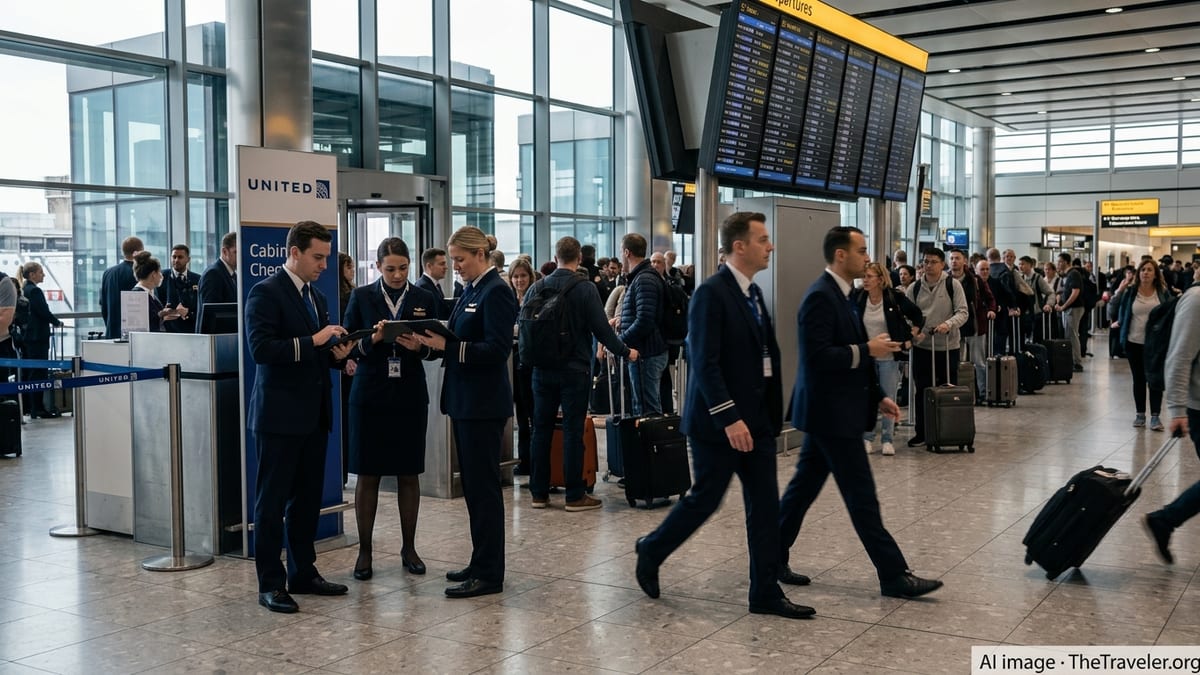
United Airlines is facing renewed scrutiny in both the United Kingdom and the United States after a wave of reports highlighted confusion, frustration, and schedule disruptions linked to London-related transfers and assignments affecting tens of thousands of its flight attendants.
Get the latest news straight to your inbox!
Background: A Strategic Focus on London and U.S. Bases
Publicly available information shows that United Airlines has spent the past several years expanding and reshaping its transatlantic network, with London Heathrow positioned as one of its most important international gateways. The carrier operates a dense schedule between Heathrow and major U.S. hubs, making the airport central to both its customer offering and its crew planning.
Coverage of recent labor negotiations indicates that roughly 30,000 United flight attendants, represented by the Association of Flight Attendants-CWA, are in the final stages of talks over a new contract. Pay and quality-of-life issues, including scheduling and base assignments, have been key points of contention. Those negotiations have unfolded against a backdrop of increasingly complex operations in Europe and North America.
Industry analysis notes that as airlines rebuild and reoptimize their long-haul networks, crew basing decisions have become tightly interwoven with commercial strategy. London, as a constrained and highly competitive market, requires intensive aircraft and crew utilization, putting additional pressure on scheduling systems whenever irregular operations or staffing shortages occur.
Transfer Policies Spark Confusion Among Flight Attendants
According to published coverage in aviation and labor-focused outlets, United has recently reopened or adjusted opportunities for flight attendants to transfer between its U.S. bases and its London Heathrow operation. Reports describe what some employees viewed as a rare chance to move to “dream” locations, only to discover that eligibility rules, immigration requirements, and seniority considerations significantly narrowed the pool of crew members who could actually take advantage of the options.
Accounts circulating in trade and specialist media describe a compromise structure in which flight attendants already authorized to live and work in the United States would be moved into U.S. bases, while those with the right to work in the United Kingdom would hold priority for roles associated with the London base. While designed to align staffing with legal and operational constraints, the framework has been portrayed as complicated and, at times, poorly understood on the front lines.
The result, according to these reports, has been a sense of a “mix-up” or misalignment between expectations and outcomes. Some flight attendants reportedly bid for transfers or reassignments believing that broader access to London flying or London domicile positions would follow, only to find that limitations tied to work authorization, language requirements, and route-specific staffing needs sharply curtailed the number of successful moves.
Operational Strain at London Heathrow Highlights Scheduling Risks
Recent operational data and traveler-focused analyses show that London Heathrow has experienced multiple periods of disruption in early 2026, affecting a long list of carriers including United. Delays, cancellations, air traffic flow constraints, and weather events have all contributed to a volatile environment that complicates crew rotations and connection times.
Travel rights organizations and flight disruption trackers have noted that when Heathrow experiences days with hundreds of delays and dozens of cancellations, airline crew plans come under immediate pressure. Reserve pools can be depleted quickly, legal duty limits become harder to manage, and hotel and transport logistics for crew are strained. For an airline with an extensive transatlantic footprint, these factors amplify any underlying weaknesses in scheduling systems.
Commentary from aviation experts has stressed that London’s slot-constrained, high-frequency environment leaves little margin for error. When a U.S. storm system disrupts departures from major hubs such as Newark or Chicago on the same day Heathrow faces its own bottlenecks, the knock-on effects can leave crews and passengers out of position on both sides of the Atlantic.
Contract Talks, Quality of Life, and Crew Deployment
Coverage of United’s ongoing contract talks with its flight attendants underscores how closely crew deployment issues are tied to broader concerns over working conditions. Negotiation updates describe demands for stronger protections around scheduling, more predictable days off, and improvements to how irregular operations and reassignments are handled, particularly on long-haul routes that touch London and other key international gateways.
Analysts following the talks have highlighted that crew basing and transfer policies are not just administrative matters but central to how flight attendants experience their jobs. Decisions about whether flying is concentrated in the United States or spread across international bases, and how easily crew can move between them, have a direct impact on commuting burdens, time away from home, and income stability.
Observers note that the apparent confusion over London-related transfers has arrived at a sensitive moment, with union leaders emphasizing economic gains and quality-of-life improvements while the airline focuses on cost discipline and network flexibility. Any perception of miscommunication around base assignments or route access can quickly become part of a wider narrative about respect, transparency, and trust between management and cabin crew.
Implications for Transatlantic Travelers
For passengers flying between the United States and the United Kingdom, the behind-the-scenes debates over flight attendant transfers and London scheduling may seem distant. Yet travel industry reporting suggests that the reliability of transatlantic services is closely linked to how smoothly airlines manage their crews. When basing, reserve coverage, and hotel arrangements for flight attendants are tightly coordinated, carriers are generally better positioned to recover from weather events, air traffic control restrictions, or sudden aircraft swaps.
consumer advocacy outlets have pointed out that, during recent waves of disruption on both sides of the Atlantic, crew availability has been one of several factors influencing whether flights could depart on time or be rescheduled efficiently. Where crew are scattered, overcommitted, or subject to last-minute reassignments, delays can lengthen and misconnected passengers may face longer waits for rebooking.
As United continues to refine its approach to London operations while finalizing a new contract with its 30,000 flight attendants, industry watchers expect further adjustments to transfer rules, bid processes, and base staffing. For travelers, the key indicators to watch will be day-to-day performance on U.S.–UK routes, the stability of published schedules, and the extent to which crews appear consistently positioned and supported at one of the world’s busiest international gateways.