

More news on this day
United Airlines is accelerating its ambitious plan to equip its entire mainline and regional fleet with free, high‑speed Wi‑Fi powered by SpaceX’s Starlink, with executives and program insiders now indicating a target of late 2027 for substantial completion.
The move positions the Chicago-based carrier at the center of an inflight connectivity arms race as global airlines turn to low‑Earth‑orbit satellite networks to finally make in‑the‑air internet feel more like broadband at home.
More News
- Bomb Cyclone Gianna Paralyzes Flights and Roads from Gulf Coast to New England
- After Deadly Mauao Landslide, Mount Maunganui Balances Grief With Tourism Survival
- Wet, Icy Start to February Disrupts Travel Across Britain
United’s Starlink Deal Scales Up To More Than 1,000 Aircraft
United’s partnership with SpaceX’s Starlink, first unveiled in 2024 and expanded through 2025, is one of the largest inflight connectivity programs ever attempted by a major carrier. The airline expects to bring the service to more than 1,000 aircraft across its mainline and United Express fleets, including Boeing 737 and 757 narrowbodies, long‑haul Boeing 767, 777 and 787 widebodies, and two‑cabin regional jets such as the Embraer 175.
Testing of Starlink hardware began on regional aircraft in early 2025, followed by the first customer flights later that year. By early 2026, United had effectively finished outfitting its dual‑cabin regional jets, giving a large portion of domestic customers access to fast, free internet on routes that historically offered limited or no connectivity.
United currently operates one of the world’s largest fleets, with more than 1,050 mainline aircraft in service and hundreds of regional jets flying under the United Express banner. Retrofitting such a large and varied fleet with new satellite antennas, cabin wiring and upgraded network hardware is a multi‑year engineering and certification effort that requires coordination among United, SpaceX, aircraft manufacturers and regulators.
People familiar with the rollout say the carrier is working aircraft type by aircraft type, focusing first on two‑cabin regional jets and high‑utilization domestic narrowbodies before shifting the installation focus to its long‑haul widebody fleet in 2026 and 2027. That sequencing underpins expectations that the majority of United’s regularly scheduled passenger flights will feature Starlink connectivity by late 2027.
Free Starlink Access Tied To MileagePlus Membership
In a notable strategic twist, United is using Starlink’s introduction to reshape how it charges for inflight connectivity. At present, standard Wi‑Fi on United typically costs MileagePlus members about 8 dollars and non‑members about 10 dollars on most domestic flights, with longer‑haul and regional services often priced higher. Those products are supplied by a mix of four legacy providers and can vary significantly in speed and reliability.
With the Starlink rollout, United is shifting to a model in which MileagePlus members receive gate‑to‑gate access to the new satellite network at no cost. Membership in MileagePlus is free, and the airline has already begun retiring annual Wi‑Fi subscription plans while telling existing subscribers that they will soon enjoy complimentary access on Starlink‑equipped aircraft as their flights gradually transition to the new system.
That approach mirrors a broader industry trend. Delta Air Lines has made Wi‑Fi free for SkyMiles members on most domestic mainline flights, while airlines such as JetBlue and Hawaiian have leaned heavily into complimentary connectivity as a brand differentiator. For United, using Starlink as a loyalty lever is designed to push more casual flyers into MileagePlus, deepening customer data and engagement while removing one of the most persistent friction points of modern air travel.
United executives have argued that they were hesitant to make inflight Wi‑Fi fully free until they were confident the network could handle the surge in demand. With Starlink’s architecture offering far greater bandwidth than earlier satellite systems, the airline now believes it can support streaming, gaming and heavy data use across cabins without the performance degradation that has plagued legacy systems when too many passengers log on at once.
Why Starlink Changes The Inflight Connectivity Equation
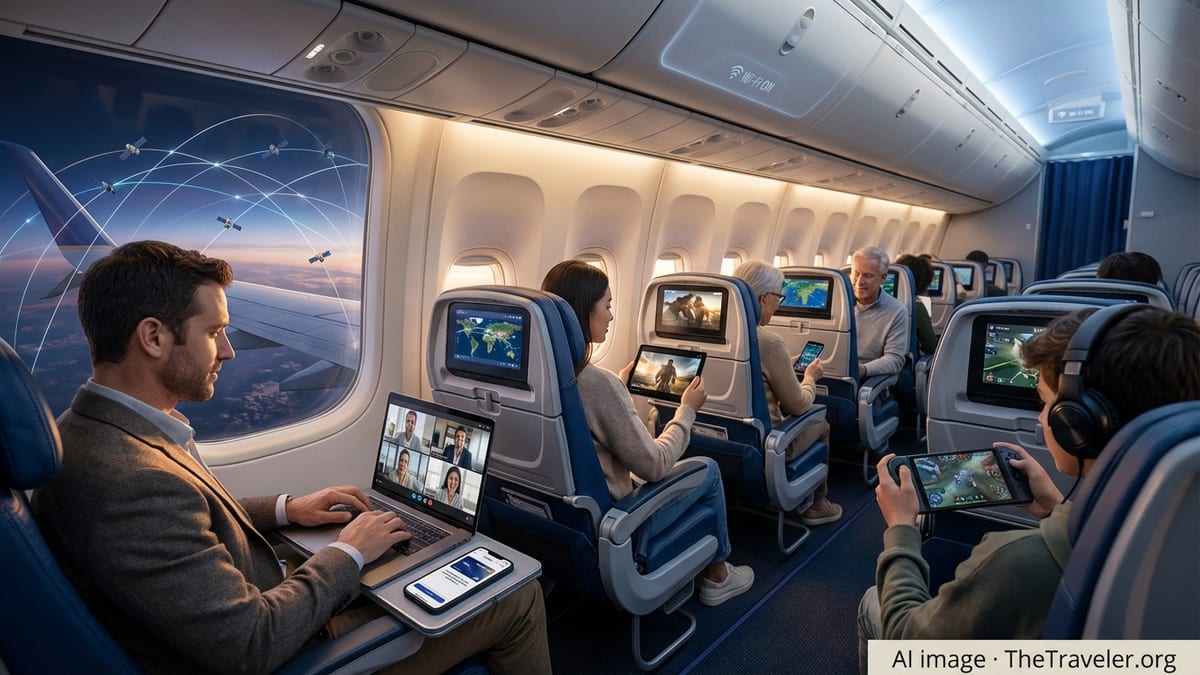
Starlink’s low‑Earth‑orbit satellites orbit closer to the planet than traditional geostationary satellites, sharply reducing latency and improving throughput. For passengers, that means pages load faster, video and audio streams are more resilient, and tasks like cloud‑based work, video conferencing and online gaming become realistic options at 35,000 feet, even on routes over oceans and remote regions.
United plans to tap that capacity to support a more integrated digital experience. The airline has highlighted scenarios where passengers can stream their preferred services, follow live sports, shop online, and interact with enhanced seatback entertainment options that draw on real‑time data. The carrier also sees operational benefits, including improved real‑time data links between aircraft and ground teams, better predictive maintenance and more reliable communication for crews.
Starlink’s growing constellation, which already numbers several thousand satellites with a planned expansion to tens of thousands, is designed to offer global coverage. That is particularly important to United, which operates one of the world’s largest long‑haul networks across the Atlantic and Pacific. Routes over polar regions and mid‑ocean, once connectivity blind spots, are being targeted as early beneficiaries of the new system as more satellites and aviation‑specific terminals receive regulatory approvals.
Industry analysts note that although Starlink’s inflight service is still relatively new, early deployments on carriers such as Hawaiian Airlines and regional operator JSX have demonstrated much faster and more consistent performance than older systems. United is betting that at scale, that technical advantage will translate into a meaningful differentiator for corporate and premium leisure travelers choosing between long‑haul carriers.
Inside A Complex, Multi‑Year Retrofit Program
Fitting more than 1,000 aircraft with new satellite equipment is not as simple as bolting an antenna onto the roof. Each aircraft type requires structural modifications, aerodynamic fairings, internal cabling, power integration and extensive certification work to ensure the system can safely operate in all flight conditions. Downtime must be carefully managed to avoid disrupting schedules, especially for high‑utilization aircraft types such as the Boeing 737 and Embraer 175.
United’s timeline calls for a phased retrofit, aligning Starlink installations with planned heavy maintenance checks wherever possible. Regional jets that cycle through maintenance bases more frequently were logical early candidates, enabling the airline to reach a visible milestone quickly: by early 2026, nearly all two‑cabin United Express regional jets had Starlink installed and active on commercial flights, according to the carrier.
Mainline narrowbodies are next in line. United has said it expects its first Starlink‑equipped Boeing 737s to enter revenue service in 2025, with installation rates ramping up through 2026. As hangar capacity and supply chains stabilize, the program will shift focus toward long‑haul widebodies, a crucial step if United is to deliver on its vision of gate‑to‑gate, long‑haul Starlink coverage by late 2027.
While the airline publicly refers to completing installations “over the next several years,” people involved in the program describe late 2027 as the internal target for having Starlink operational on the vast majority of United and United Express departures. Some aircraft may transition later, particularly new deliveries that come from the factory with different connectivity provisions, but the goal is for most customers, on most routes, to assume that their United flight includes the new free Wi‑Fi as a standard amenity.
Competitive Pressures In A Rapidly Evolving Market
United’s accelerated Starlink timeline unfolds against a backdrop of intense competition in the inflight connectivity market. Alaska Airlines recently moved up its own Starlink schedule, targeting completion of fleetwide installations by early 2027 while positioning free Wi‑Fi as a core benefit for members of its Atmos Rewards program. Hawaiian Airlines has already finished bringing Starlink to its Airbus fleet on long‑haul routes between Hawaii, North America, Asia and Oceania, and a growing roster of international carriers, including Emirates, Qatar Airways, airBaltic and Virgin Atlantic, have announced plans for free or low‑cost Starlink service.
At the same time, legacy satellite providers and air‑to‑ground networks are racing to upgrade their offerings, signing deals with airlines that have opted for incremental improvements rather than a wholesale switch to Starlink. For passengers, the result is a patchwork of experiences: blazing‑fast, nearly home‑like connections on some flights, and older, bandwidth‑constrained systems on others, sometimes even within the same carrier’s network.
By committing to Starlink at scale and tying access to a free, ubiquitous loyalty program, United aims to avoid that inconsistency. The airline’s executives have framed connectivity as a pillar of its broader premium strategy, on par with modernized cabins, upgraded lounges and a growing long‑haul network. In markets where multiple carriers now offer flat beds and similar schedules, having reliable, unlimited inflight Wi‑Fi could become a deciding factor for frequent flyers.
However, United is also entering a field where expectations are rising quickly. Competitors are marketing not just speed, but reliability, privacy protections and seamless authentication across devices. How effectively United executes its Starlink rollout, particularly on busy hub‑to‑hub and long‑haul routes, will shape whether its “fastest Wi‑Fi in the sky” ambitions resonate with travelers or become yet another promise tested by real‑world usage.
Environmental And Regulatory Questions Around Mega‑Constellations
The scale of Starlink’s satellite constellation, while central to its performance, has prompted questions among scientists and regulators about orbital debris and the sustainability of low‑Earth‑orbit operations. With thousands of satellites already aloft and tens of thousands more planned, critics worry about collision risks, light pollution and long‑term congestion in key orbital shells.
SpaceX has emphasized its use of autonomous collision‑avoidance systems, relatively low orbital altitudes that allow failed satellites to deorbit more quickly, and design features intended to minimize reflectivity. Regulators in the United States and abroad continue to scrutinize large constellations, balancing the commercial and societal benefits of expanded broadband access against environmental and safety concerns.
For airlines and passengers, those debates are largely invisible but not irrelevant. Should regulators impose new constraints on constellation sizes or satellite operations, future capacity growth and coverage patterns could be affected. For now, however, Starlink’s rapid expansion and improving coverage map underpin United’s confidence that it can offer reliable gate‑to‑gate service across its far‑flung network, including polar routes and transoceanic flights that have traditionally struggled with patchy or expensive connectivity.
United has not suggested that environmental concerns will slow its Wi‑Fi rollout, but industry observers say airlines and satellite providers may eventually face more pressure to disclose how they manage orbital debris risks, energy use and lifecycle impacts as space sustainability rises on the global policy agenda.
What United Passengers Can Expect Between Now And 2027
For travelers, the transition to free Starlink Wi‑Fi will not happen all at once. In the near term, United flights will fall into three broad categories. On some aircraft, particularly two‑cabin regional jets and a growing number of 737s, passengers will find United‑branded portals that connect directly to Starlink, with clear messaging that the service is complimentary for MileagePlus members from the moment they board.
On other aircraft, especially older narrowbodies and widebodies that have not yet entered the retrofit queue, legacy systems will remain in place, often with the familiar paywall and pricing structure. United will continue to sell monthly Wi‑Fi subscriptions and flight‑pass options for those services while emphasizing that Starlink access will expand progressively across the network as installations ramp up.
Customers can expect to see updated pre‑flight communications and app notifications highlighting whether their specific flight is scheduled to feature Starlink connectivity, as well as instructions on how to log in via a MileagePlus account. Over time, United aims to make that process nearly seamless, with auto‑authentication for frequent flyers and clear indications within the inflight entertainment interface that Starlink is active and ready to use.
By late 2027, if the airline hits its internal milestones, the average United customer departing a major hub such as Chicago, Newark, Denver, Houston, Washington Dulles, Los Angeles or San Francisco should be able to assume that free, high‑speed Starlink Wi‑Fi is part of the standard service offering, regardless of whether they are flying a short‑haul regional leg or a long‑haul international sector.
FAQ
Q1. When will United’s Starlink Wi‑Fi rollout be finished?
United describes the program as a multi‑year effort and has not published a hard end date, but based on current installation rates and fleet plans, industry expectations point to late 2027 for Starlink to be available on the vast majority of United and United Express passenger flights.
Q2. Will the new Starlink Wi‑Fi be free for everyone?
United plans to offer Starlink Wi‑Fi free of charge to all MileagePlus members. Since joining MileagePlus is free, most passengers will be able to access the service simply by logging in with their loyalty account details.
Q3. How will I know if my flight has Starlink Wi‑Fi?
As the rollout progresses, United is expected to display Starlink availability in flight details on its website and mobile app, as well as through boarding announcements and inflight signage. Early deployments have also included specific branding on the Wi‑Fi portal once onboard.
Q4. Which United aircraft are getting Starlink first?
United has prioritized two‑cabin regional jets and high‑utilization Boeing 737 aircraft in the early phases. Regional jets are already largely equipped, with more 737s joining the Starlink‑enabled fleet through 2025 and 2026 before long‑haul widebodies see accelerated installations.
Q5. Will Starlink work on long‑haul international and polar routes?
Yes. One of the key reasons United chose Starlink is its expanding global coverage, including over oceans and polar regions. As the satellite constellation grows and more aircraft are equipped, United expects to offer Starlink service gate‑to‑gate on most long‑haul international flights.
Q6. How fast will the inflight Starlink connection be?
Exact speeds will vary by aircraft and loading, but Starlink’s low‑Earth‑orbit network is designed to deliver high‑bandwidth, low‑latency connections that support streaming, video calls, cloud‑based work and gaming, making it significantly faster and more responsive than most legacy inflight Wi‑Fi systems.
Q7. Do I still need to pay if my flight does not have Starlink yet?
On aircraft that have not yet been retrofitted with Starlink, United will continue to offer existing paid Wi‑Fi services through its current providers. Prices and options will remain similar to today until those aircraft transition to the new system.
Q8. Will Starlink Wi‑Fi be available from boarding to landing?
United intends to offer gate‑to‑gate connectivity on Starlink‑equipped aircraft, meaning passengers can connect shortly after boarding and remain online until they arrive at the gate, subject to standard safety procedures during critical phases of flight.
Q9. How does United benefit from offering free Wi‑Fi?
Beyond improving the passenger experience, free Starlink access encourages more travelers to join and use MileagePlus, gives United richer customer data, and supports more efficient operations through better real‑time communications between aircraft, crews and ground teams.
Q10. Are there any environmental concerns about using Starlink for inflight Wi‑Fi?
Some scientists and regulators have raised concerns about the long‑term impact of large satellite constellations on orbital debris and light pollution. SpaceX has introduced measures to mitigate those risks, and regulators continue to oversee constellation deployments, but the broader environmental debate around mega‑constellations remains active even as airlines like United move ahead with their connectivity plans.