

More news on this day
A United Airlines flight bound for Newark Liberty International Airport made an urgent emergency landing back at Los Angeles International Airport on Monday, after passengers and ground observers reported flames and smoke coming from one of the jet’s engines shortly after takeoff.
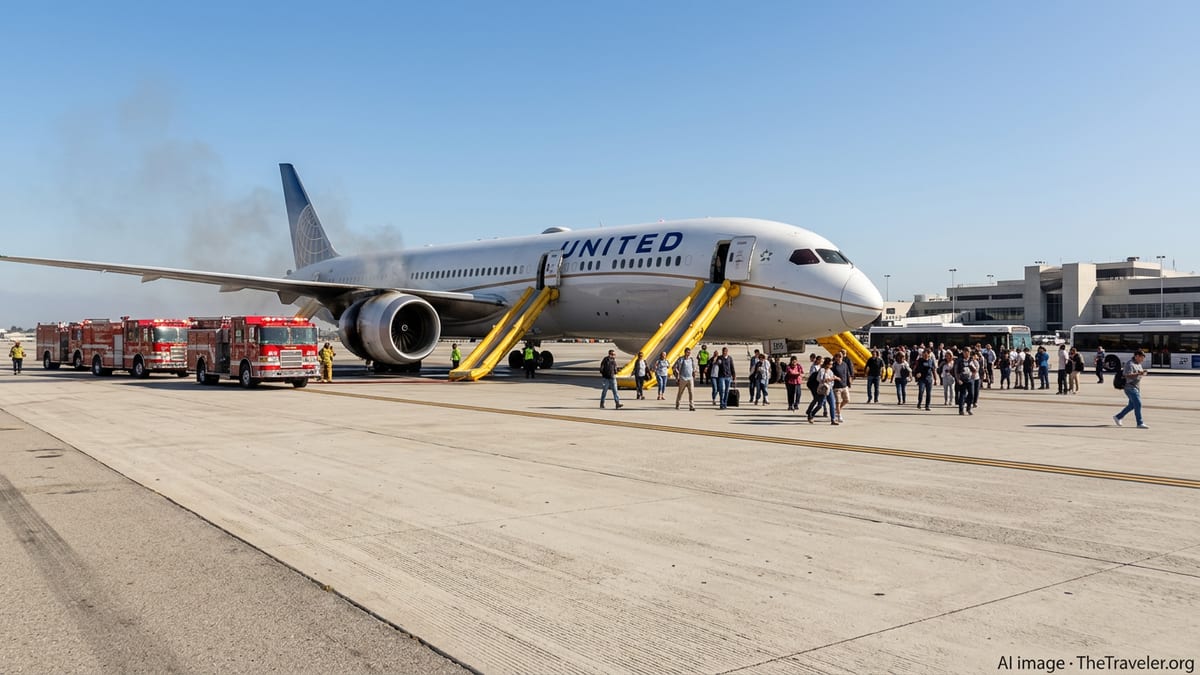
Engine Flames Force Turnback to Los Angeles
United Airlines Flight UA2127, a Boeing 787-9 Dreamliner operating a regularly scheduled service from Los Angeles to Newark, departed LAX late Monday morning before the crew declared an emergency and requested an immediate return. According to flight tracking data and officials, the aircraft took off around 10:43 a.m. local time and began turning back less than 20 minutes into the flight after an apparent problem with its left engine.
Passengers seated on the left side of the widebody jet reported hearing a loud bang followed by vibrations and seeing flashes of orange outside the window. Videos shared by travelers and bystanders on the airfield show dark smoke and intermittent flames emanating from the engine as the aircraft circled back toward Los Angeles.
Despite the dramatic visuals, the crew maintained control of the aircraft and completed a textbook emergency approach and landing. The Dreamliner touched down safely at approximately 11:19 a.m., with fire and rescue vehicles staged along the runway as a precaution.
Full-Scale Evacuation on Taxiway
After the landing, the crew brought the aircraft to a stop on a taxiway, where the captain ordered a full evacuation. Inflatable emergency slides were deployed from several doors, and more than 250 passengers and crew members evacuated the aircraft within minutes, many leaving personal belongings behind as they slid to the pavement.
Footage from the scene shows travelers sliding down, some stumbling as they reached the bottom, while airport fire crews doused the affected engine and monitored for any residual hot spots. The Los Angeles Fire Department later confirmed the reported engine fire was contained within about an hour of the aircraft’s return.
Authorities said there were no serious injuries, though at least one passenger was treated for a minor cut, consistent with the types of scrapes and bruises often associated with rapid slide evacuations. United Airlines stated that it was cooperating with airport officials and federal regulators to determine the cause of the engine incident.
Temporary Ground Stop and Airport Disruption
The emergency prompted a brief but significant disruption at one of the country’s busiest hubs. The Federal Aviation Administration issued a temporary ground stop at Los Angeles International Airport while UA2127 was returning and emergency crews worked on the taxiway, halting departures for roughly half an hour.
Arriving flights continued to land, but some were held on the ground or assigned to alternate taxi routes as responders surrounded the United aircraft. The affected Boeing 787 remained parked away from terminal gates as investigators and maintenance teams began their initial examination.
Within a short period, normal operations gradually resumed, though the incident created knock-on delays for some departures and connections at LAX during the busy midday travel window. The flight to Newark was canceled, and United began the process of reaccommodating UA2127’s passengers on later services.
Passengers Describe Tense Moments in the Cabin
Accounts shared by passengers describe a cabin that moved quickly from routine to tense as the engine problem unfolded. Several travelers said they sensed a jolt and an unusual noise shortly after takeoff, followed by the crew’s calm but firm announcements instructing everyone to remain seated with seat belts fastened as the plane turned back.
Some passengers reported seeing flames from the window and smelling smoke, heightening anxiety until the aircraft was firmly on the ground. Others praised the flight attendants for repeatedly briefing travelers on brace positions, post-landing instructions and how to use the emergency slides in the event of an evacuation.
Once the aircraft came to a stop and the evacuation order was given, the tone shifted from tense silence to urgent movement. Those who went down the slides described the descent as fast and jarring but said ground staff and firefighters quickly moved in to guide people away from the aircraft and toward waiting buses.
United later used portions of its terminal facilities, including premium lounge space, to stage and support UA2127’s passengers while the airline arranged replacement flights and worked to reunite them with carry-on bags left on board during the evacuation.
Investigation Focuses on Dreamliner Engine
The aircraft involved in Monday’s incident is a Boeing 787-9 powered by General Electric GEnx engines, a widely used combination on long-haul routes. While serious engine events on this model are rare, any report of flames and visible fire triggers a detailed technical and regulatory investigation.
United Airlines said its maintenance teams would work alongside federal safety officials to inspect the affected engine and related systems. Investigators will be looking at engine performance data, cockpit voice and flight data recordings, and witness statements from crew and passengers to determine what triggered the apparent failure.
Industry safety experts note that modern twin-engine widebody jets are engineered to operate safely on a single engine, and that crews train extensively for engine fire and shut-down scenarios. The safe return of UA2127, they say, demonstrates both the resilience of the aircraft systems and the importance of adhering to established emergency procedures.
For travelers, the images of flames and emergency slides at a major U.S. airport are unsettling. Yet Monday’s episode also underscores how much aviation safety has improved over decades, with redundancies, intensive crew training and robust oversight combining to turn a potentially catastrophic event into an incident with no serious injuries.