

More news on this day
A United Airlines Boeing 787-9 Dreamliner operating Flight UA2127 from Los Angeles to Newark made an urgent emergency landing back at Los Angeles International Airport on Monday after passengers and observers reported flames coming from one of the jet’s engines shortly after takeoff, prompting a dramatic full evacuation on the runway.
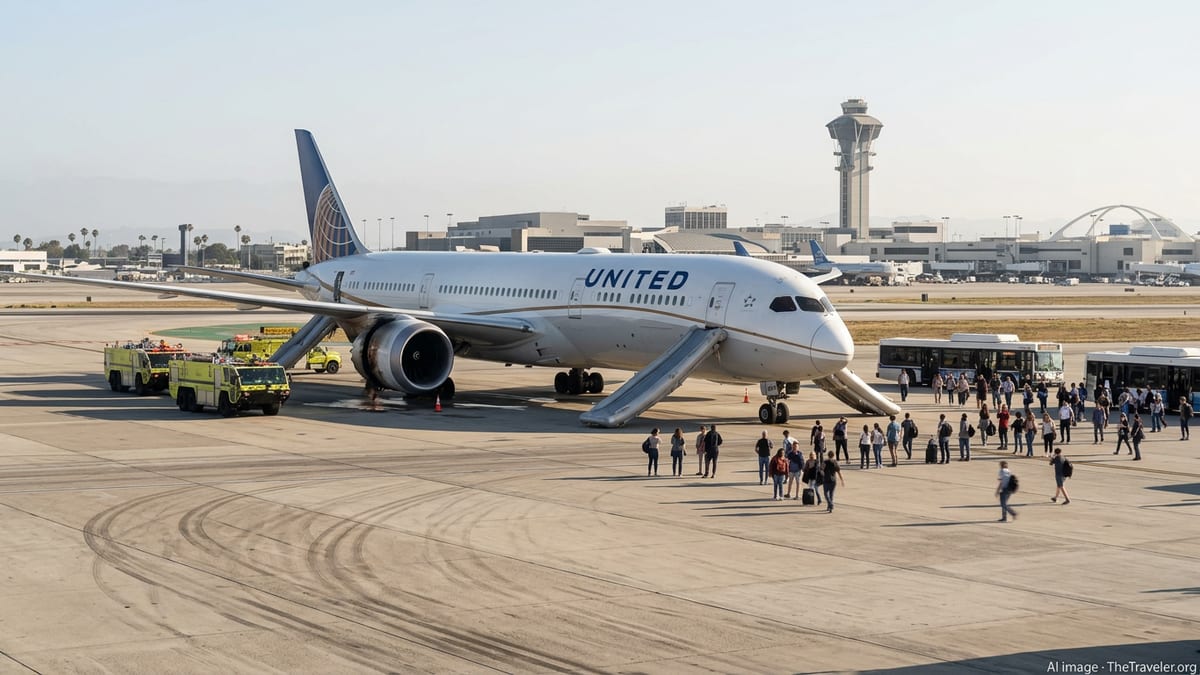
Flight to Newark Cut Short by Suspected Engine Fire
United Flight UA2127 departed Los Angeles International Airport late Monday morning on a scheduled service to Newark Liberty International Airport when the crew reported an issue with the left engine shortly after takeoff. According to flight tracking data and airport officials, the widebody jet had been airborne for around 30 to 40 minutes when it turned back toward Los Angeles.
Witnesses on the ground and passengers on board reported seeing flames and smoke from the affected engine as the aircraft circled back toward the airport. While United described the issue as a problem with one of the engines, Los Angeles Fire Department officials later confirmed they responded to what was reported as an engine fire and considered the blaze contained within an hour of landing.
The Boeing 787-9 landed safely at LAX at roughly 11:20 a.m. local time, with fire and rescue crews positioned along the runway. The aircraft stopped on a taxiway rather than proceeding to a gate, as crews quickly moved to assess the condition of the engine and prepare for a possible evacuation.
Initial information from the Federal Aviation Administration indicated that flight operations at LAX were briefly halted during the incident, with a ground stop lasting around half an hour as the emergency response unfolded and the runway area was secured.
Runway Evacuation Sends Passengers Down Emergency Slides
Once the aircraft came to a complete stop, United’s crew initiated an evacuation on the taxiway, deploying inflatable emergency slides from multiple doors. Video shared by travelers at the airport showed passengers sliding down and running across the tarmac as fire crews surrounded the Dreamliner and focused attention on the left side of the aircraft.
Authorities said there were more than 250 passengers and crew members on board, including 12 crew, when the emergency landing was made. All 268 people were able to leave the aircraft, with most descending the bright yellow evacuation slides in a matter of minutes before being directed to waiting buses.
Emergency officials reported no serious injuries. One passenger was treated for a minor cut to a finger, but there were no hospitalizations and no reports of smoke inhalation or other medical issues. Airport officials described the evacuation as orderly, though footage showed some passengers sprinting away from the plane once they reached the ground.
Passengers were transported by bus back to the terminal area, where United teams began the process of rebooking travelers and accounting for luggage left on board during the rapid evacuation. Some travelers were later escorted to the United Club lounge at LAX as airline staff worked to reunite them with carry on items retrieved from the aircraft.
Ground Stop Disrupts Busy Los Angeles Hub
The emergency return of UA2127 had significant ripple effects across operations at Los Angeles International Airport, one of the nation’s busiest hubs. The FAA issued a ground stop for departing flights as the Dreamliner approached and landed, temporarily halting traffic while emergency crews remained on standby along the runway.
The ground stop, which lasted roughly 30 minutes, caused short delays for some departing flights as airlines held aircraft at gates or in taxi queues. Arrivals were also managed more cautiously as the active runway and adjacent taxiways remained occupied by fire trucks, airport operations vehicles and passenger buses ferrying evacuees back to the terminal.
Once the United jet was secured and towed from the taxiway, LAX gradually resumed normal operations. Passengers in the terminals reported public address announcements about an ongoing emergency response, yet the incident was largely confined to the airfield, with little visible impact inside the concourses beyond some delayed departures.
Airport officials said there was no threat to terminals or surrounding areas and emphasized that the quick coordination between air traffic controllers, pilots and emergency services helped contain both the safety risk and the operational disruption.
Investigators Focus on Engine and Safety Procedures
The aircraft involved in the incident is a Boeing 787-9 Dreamliner, one of United’s flagship long haul models, widely used on transcontinental and international routes. A key focus of the inquiry will be the left engine, where the reported flames and smoke were seen, as investigators seek to determine whether the problem stemmed from an internal mechanical failure, a fuel system issue or another component.
The Federal Aviation Administration is expected to review cockpit voice and flight data recordings, maintenance logs, and crew reports as part of its investigation. United said its technical teams would conduct a detailed inspection of the aircraft before it returns to service, and that the airline is cooperating fully with federal authorities.
Initial accounts indicate the crew followed established safety procedures, including shutting down the affected engine in flight, returning promptly to the departure airport and opting for a full evacuation once the aircraft had stopped on the taxiway. Aviation safety experts note that while modern jet engines are designed to contain failures, any visible flames or sustained smoke typically trigger a conservative response from pilots and ground teams.
Although engine incidents are rare, commercial aviation is built on multiple layers of redundancy. The 787-9 is designed to fly safely on a single engine in the event of a shutdown, and airlines routinely train crews to manage such emergencies, from cockpit decision making to coordinating with cabin crews on the timing and execution of an evacuation.
Passengers Describe Frightening Moments and Relief
For passengers aboard UA2127, the episode turned what was meant to be a routine cross country flight into a frightening midair emergency. Several travelers later described hearing a loud bang from the left side of the aircraft shortly after takeoff, followed by a shudder and an uneasy quiet as the crew began to assess the situation.
Some passengers reported smelling smoke and seeing a flash from the engine area as the aircraft banked back toward Los Angeles. Cabin crew moved quickly through the aisles, reassuring travelers, enforcing the seat belt sign and preparing them for the possibility of an emergency landing.
As the Dreamliner descended toward LAX, passengers were briefed on brace positions and instructed to leave all belongings behind in the event of an evacuation. Once on the ground, the deployment of the slides, the rush toward the exits and the sprint across the tarmac added to the sense of urgency, though many later praised the professionalism of the crew and the calm shown by fellow travelers.
In the terminal, some passengers described a mix of shock and relief as they processed what had happened, reached out to relatives and awaited updates on how and when they would continue their journeys to the East Coast and beyond.