

More news on this day
United Airlines long haul flight UA84 from Newark to Tel Aviv was forced to make an unscheduled emergency landing in Athens on Saturday after Israel abruptly closed its airspace in the wake of coordinated US and Israeli strikes on targets in Iran, stranding hundreds of passengers and adding fresh disruption to an already volatile regional aviation landscape.
Mid-Atlantic Diversion as Airspace Shuts Down
Flight UA84, a Boeing 787-9 Dreamliner operating United’s flagship route from Newark Liberty International Airport to Tel Aviv Ben Gurion Airport, departed New Jersey on the afternoon of February 27, 2026, for an overnight journey of just under 11 hours. Several hours into the flight, as the aircraft traversed the eastern Mediterranean, the crew received notice that Israeli airspace had been closed to all civilian traffic following the strikes on Iran.
According to flight tracking data and aviation officials, controllers instructed the aircraft to divert away from its planned approach to Tel Aviv as the airspace shutdown took effect. With limited nearby alternates that could handle a fully loaded long haul widebody, the airline and air traffic control coordinated a diversion to Athens International Airport, where the aircraft landed safely in the early hours of February 28.
Passengers reported that the captain informed the cabin of a sudden security-related airspace closure and a precautionary diversion. While there were no indications of a technical emergency onboard, the shutdown of Israel’s skies transformed UA84 into an urgent operational situation as the crew raced to reach a suitable alternate before fuel margins became restrictive.
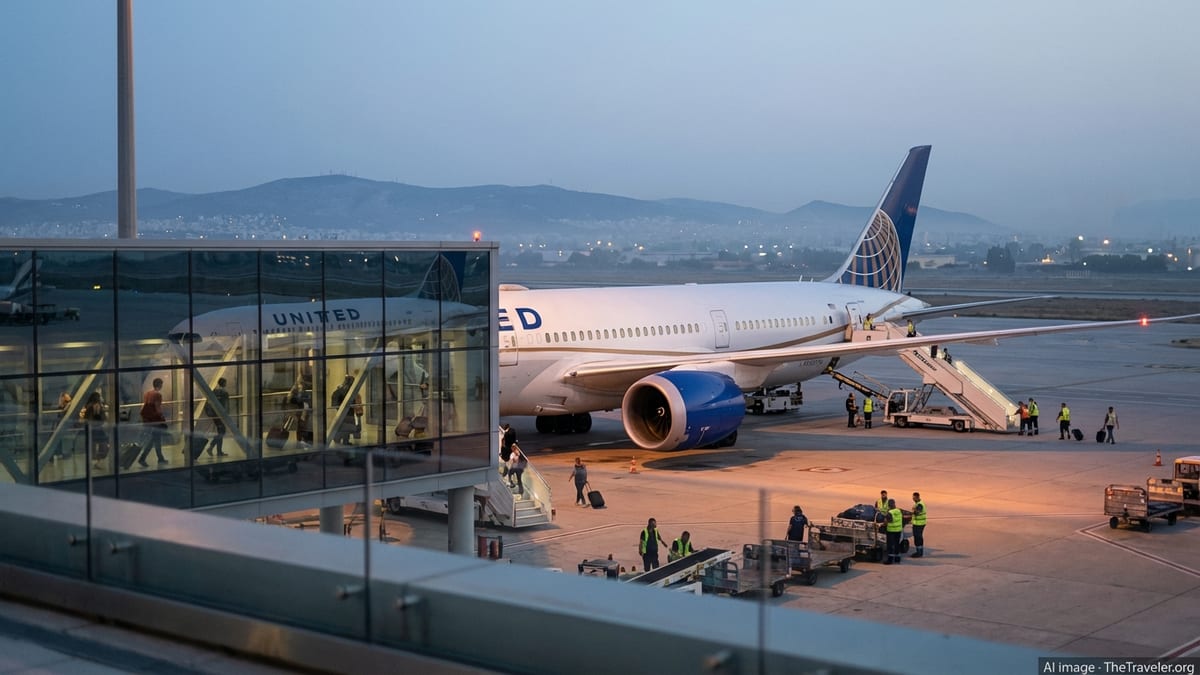
No injuries were reported, and the aircraft taxied to a remote stand at Athens, where ground staff and local authorities assisted with deplaning and onward arrangements.
Passengers Stranded in Athens Amid Uncertainty
The diversion left UA84’s passengers unexpectedly disembarking in Greece instead of Israel, with many facing missed meetings, family events, and religious travel plans in Tel Aviv and beyond. Travelers arriving in Athens described scenes of confusion as they attempted to secure hotel rooms, rebook connections, and clarify when or if they would be able to continue to Israel.
United Airlines said it was working with local partners in Athens to provide accommodation, meals, and assistance in line with its policies for significant disruptions. The carrier began rebooking affected passengers on future services and exploring options to reposition them once Israeli airspace is reopened and operations at Ben Gurion Airport can safely resume.
Some passengers with tight schedules opted to make their own alternative arrangements, including regional flights to other hubs or surface travel within Europe, while monitoring developments. Others chose to remain in Athens under airline care, waiting for clearer guidance on when regular Tel Aviv flights might restart.
The diversion also highlighted the knock on impact such closures can have on crew scheduling. Long haul flight and duty time limits mean that even after Israel reopens its skies, UA84’s original crew may not be legally able to operate a continuation of the journey without mandated rest, adding further delay.
Israel Closes Skies After US–Israel Strikes on Iran
The disruption to UA84 unfolded against a rapidly escalating security backdrop. In the early hours of February 28, United States and Israeli forces launched strikes on Iranian targets, prompting immediate concern over potential retaliatory missile or drone attacks across the region. In response, Israeli authorities announced a nationwide state of emergency and ordered a full closure of the country’s airspace.
The move halted all civilian arrivals and departures at Ben Gurion Airport and other Israeli fields, with aviation authorities urging passengers not to travel to airports and instead to seek information directly from their airlines. At the same time, Iran and several neighboring states imposed temporary restrictions on their own airspace, forcing international carriers to redraw routes across a wide swath of the Middle East.
Flightradar data showed large gaps in the skies over Israel, Iran, and parts of Iraq as commercial traffic was rerouted around the affected zones. Cargo and passenger flights that were already airborne diverted to alternate airports across the Mediterranean, including Athens, Larnaca, Rome, and various Gulf and European hubs.
Industry analysts noted that the airspace closures followed a pattern seen during previous spikes in regional tension, but the speed and breadth of Saturday’s restrictions underscored heightened fears that the confrontation between Iran and Israel could intensify in the days ahead.
Global Airlines Scramble to Reroute and Cancel
United’s UA84 was among a growing list of flights disrupted as closures rippled through the region. Carriers including Wizz Air, Air India, and UPS rerouted aircraft that had been bound for Tel Aviv, while several European and Asian airlines suspended services to Israel, Lebanon, and selected Iranian destinations for at least 24 hours.
Air India diverted a Delhi to Tel Aviv service back toward India, while low cost operators rerouted flights to Cyprus and other Mediterranean alternatives. Cargo operators shifted scheduled runs to Rome and other hubs better able to handle large freighters diverted at short notice. Aviation regulators advised airlines to avoid certain air corridors above Iran and neighboring countries until the security picture becomes clearer.
For airlines, the operational challenges are significant. Long haul routes must be replanned to factor in new overflight restrictions, additional fuel requirements, and longer block times, all of which add cost and complexity. For passengers, the impact is more immediate in the form of missed connections, extended layovers, and in some cases outright cancellations as airlines trim schedules.
Travel agents and online booking platforms reported a surge in customer queries regarding flights to and through the Middle East, with many travelers seeking to reroute via Europe or delay departures until there is more clarity around airspace availability.
Travelers Face a New Era of Route Volatility
The sudden diversion of UA84 underscores how quickly geopolitical shocks can reshape global travel plans, particularly on routes serving politically sensitive regions. Industry experts say airlines now build far more real time contingency planning into their network operations teams, using constant feeds from flight tracking services, military advisories, and aviation authorities to adjust routings on the fly.
For travelers, the incident is a reminder to monitor itineraries closely before departure and to remain flexible once in the air. Many carriers encourage customers headed to or overflying high risk regions to ensure they have up to date contact information in their reservations so they can receive alerts about last minute changes, diversions, or cancellations.
Airlines, meanwhile, are likely to review their risk assessments for routes touching Israel, Iran, and surrounding airspace. That may include shifting departure times, adding fuel reserves, or adopting more northerly or southerly routings that increase flight time but keep aircraft further from potential conflict zones.
As of Saturday afternoon, it remained unclear how long Israel’s airspace would remain shut and when United would be able to operate a recovery flight from Athens to Tel Aviv. For the passengers of UA84, the hope is that this unexpected detour will remain a short interruption in their journeys rather than the beginning of a prolonged suspension of service to one of the region’s most important gateways.