

More news on this day
United Airlines long haul flight UA84 from Newark to Tel Aviv made an unscheduled diversion to Athens on Saturday after Israel abruptly closed its airspace in the wake of coordinated United States and Israeli strikes on targets inside Iran, forcing airlines to reroute or halt services across the eastern Mediterranean and Middle East.
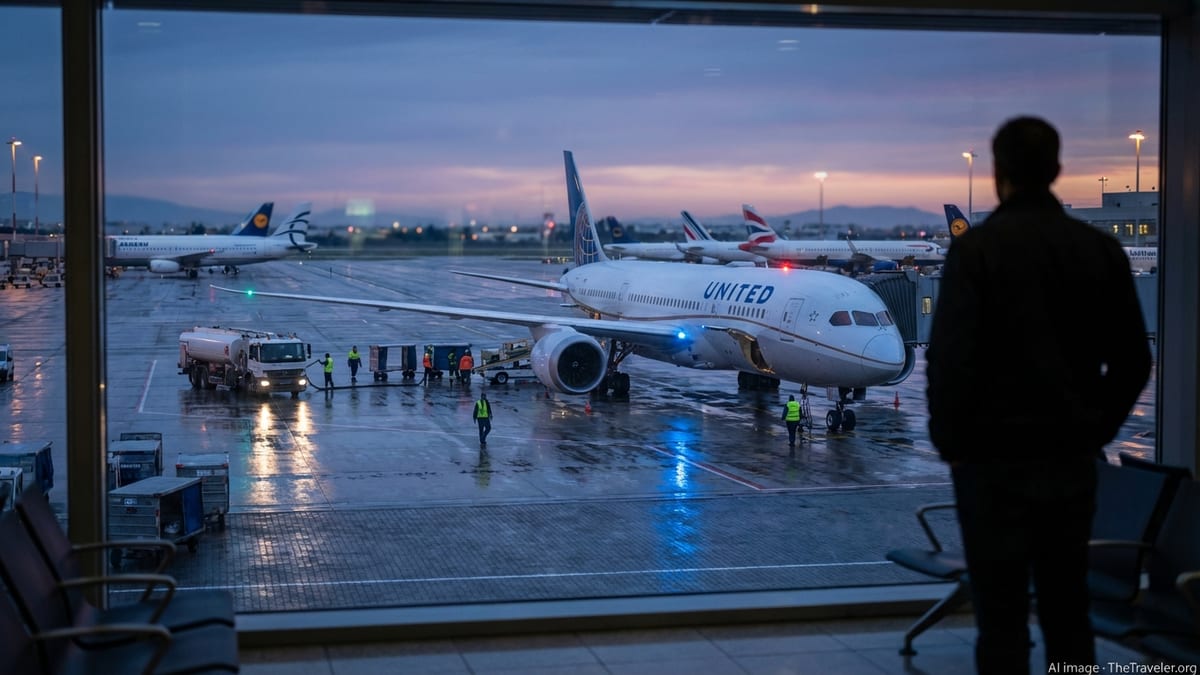
Airspace Closure Forces Transatlantic Jet to Change Course
United flight UA84, a regularly scheduled overnight service from Newark Liberty International Airport to Tel Aviv’s Ben Gurion Airport, was already en route when Israeli authorities ordered a complete suspension of civilian air traffic. Aviation notices issued early Saturday placed a hard stop on arrivals and departures, leaving airlines with little choice but to divert aircraft that were already in the air and delay those still on the ground.
Flight tracking data showed UA84 adjusting course over the eastern Mediterranean and heading toward Athens, one of the primary diversion airports for traffic bound for Israel. The aircraft, operated by a Boeing 787 Dreamliner, continued safely to the Greek capital, where it landed without incident. Passengers on board faced extended delays as ground teams and airline operations worked to determine when, and if, the flight could continue onward to Tel Aviv.
The diversion came amid a broader shutdown of Israeli airspace that followed joint US and Israeli military strikes on Iranian targets. The heightened security posture raised concerns about potential missile or drone activity in the region, prompting authorities to temporarily halt normal civil aviation operations.
Regional Tensions Ripple Through Civil Aviation
The emergency diversion of UA84 was one visible example of a much wider disruption across the region’s skies. Israel’s closure of its airspace, coupled with temporary restrictions and cautionary measures affecting Iran and neighboring countries, created a complex patchwork of no-go zones for airlines traversing key east–west corridors.
Airlines with services into Tel Aviv, including low cost carriers and global network airlines, were forced to reroute flights to alternate airports such as Larnaca, Athens and Rome, or to hold departures at origin until conditions became clearer. Cargo operators serving Israel also altered plans, diverting freighter flights to other Mediterranean gateways while they reassessed risk and routing.
The situation was compounded by simultaneous restrictions in and around Iranian airspace after the strikes, with real time tracking data showing commercial aircraft rapidly vacating or bypassing the country. Long haul flights connecting Europe, North America and Asia had to adopt longer, less direct routings in order to avoid potential conflict zones, adding flight time and fuel burn and placing additional strain on airline schedules and crews.
Impact on Passengers and Operations at Athens
For passengers on UA84, the unscheduled landing in Athens turned what is normally a nonstop overnight journey into an open ended travel ordeal. On arrival, travelers were met by airline staff and local ground handlers as United assessed hotel availability, rebooking options and crew duty limitations in line with safety regulations.
Some passengers were expected to be accommodated on later services once conditions allowed flights to Tel Aviv to resume, while others faced the difficult decision of postponing or canceling their trips altogether. Families, business travelers and those with onward connections from Tel Aviv all saw their plans upended in a matter of hours by geopolitical events far beyond the airline’s control.
For Athens International Airport, the diversion added to a sudden influx of traffic redirected from Israel and surrounding airspace. The Greek hub, already a major regional gateway, frequently serves as an alternate airport during disruptions in the eastern Mediterranean. Airport authorities and air traffic controllers had to manage arriving aircraft that were not on the original schedule, while ensuring that parked jets, fuel supplies and passenger facilities could handle the unexpected surge.
Airlines Weigh Safety, Schedules and Demand
United Airlines, which has historically had a strong presence in the US–Israel market, has repeatedly had to adjust its Newark to Tel Aviv service in response to changing security assessments. The diversion of UA84 underscores how quickly operations can shift when tensions in the region escalate, and how airlines must continuously balance commercial demand with evolving risk calculations.
Industry practice in such situations is clear: safety and regulatory compliance take precedence over schedule reliability. Carriers typically rely on real time intelligence from government agencies, international aviation bodies and security partners to determine whether routes can be safely operated. When airspace closures are ordered, as occurred on Saturday, airlines are obligated to reroute or cancel, even if aircraft are already airborne and passengers are hours into their journeys.
The operational fallout can be significant. Extended routings and diversions increase fuel costs, disrupt crew rotations and can create knock on delays across wider networks. However, airlines acknowledge that these are unavoidable consequences when flying near active conflict zones, and that passengers increasingly expect conservative decision making when safety is at stake.
What Travelers Headed to Israel Should Expect
With Israel’s airspace closed on Saturday and regional tensions running high after the strikes on Iran, travelers bound for Tel Aviv and other nearby destinations have been urged to monitor airline notifications closely and be prepared for sudden changes to itineraries. Even once the immediate closure is lifted, airlines are likely to phase services back gradually, prioritizing safety briefings, revised routings and crew availability before returning to normal schedules.
Passengers holding tickets to or from Tel Aviv over the coming days may see options such as free rebooking, travel vouchers or refunds, depending on the carrier’s policy and the duration of the disruption. Many travelers are also exploring alternative routings via regional hubs in Europe or the eastern Mediterranean, though these options are heavily dependent on how quickly airspace restrictions are eased.
For now, the diversion of UA84 to Athens serves as a stark reminder of how swiftly geopolitical tensions in the Middle East can reverberate through global aviation. A routine overnight transatlantic trip can turn into a multi leg journey through an unexpected gateway, and both airlines and passengers are once again being forced to adapt in real time to a rapidly evolving security landscape.