

More news on this day
A United Airlines passenger jet narrowly avoided a collision with a military Black Hawk helicopter near John Wayne Airport in Southern California earlier this week, an incident that has prompted a federal investigation and renewed concerns about how military and civilian aircraft share crowded airspace.
Get the latest news straight to your inbox!
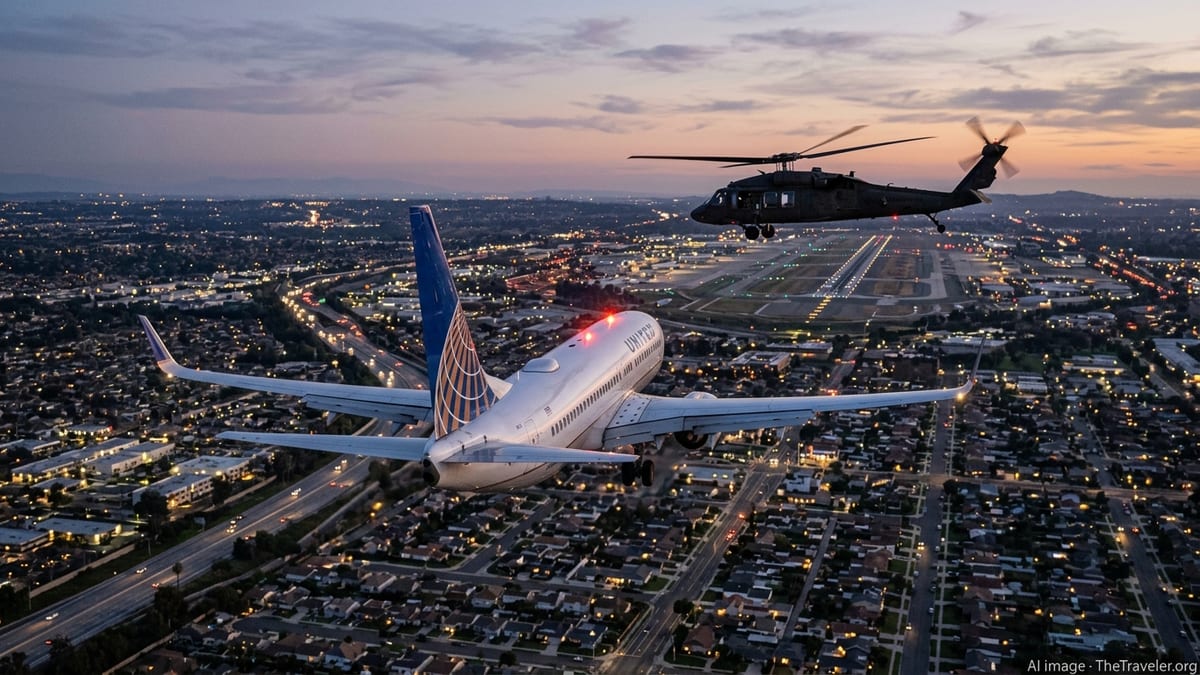
Close Call Over Orange County Skies
Publicly available information indicates the incident occurred around 8:40 p.m. local time on Tuesday near John Wayne Airport, which serves the densely populated Orange County region. A United Airlines jet with more than 160 people on board was descending toward the airport when an onboard alert warned that another aircraft had crossed its path.
Reports indicate the other aircraft was a UH-60 Black Hawk helicopter operated by a military unit returning from a training mission. Flight data described in news coverage suggests the helicopter, flying under a military callsign, entered the jet’s intended flight path at a similar altitude, triggering a collision-avoidance warning in the United cockpit.
According to those accounts, the United flight crew halted their descent and leveled off, allowing the helicopter to pass ahead. The maneuver kept the aircraft separated by only a few hundred feet vertically, a margin that aviation specialists classify as a serious loss of separation in controlled airspace.
No injuries were reported among passengers or crew, and the jet continued to John Wayne Airport for a safe landing. Even so, the proximity of the two aircraft and the reliance on last-second evasive action are being treated as a significant safety lapse.
FAA Investigation and Key Questions
The Federal Aviation Administration has opened an investigation into the close call, according to published coverage of the incident. Investigators are expected to examine radar tracks, radio transcripts, and data from onboard systems to reconstruct how the aircraft ended up on intersecting paths so near a busy commercial airport.
One focus is likely to be how air traffic control handled the mix of traffic that evening. John Wayne Airport sits beneath some of the most complex controlled airspace in the United States, with airliners, business jets, training aircraft, and nearby military operations sharing narrow corridors. Analysts say even minor deviations from assigned headings or altitudes can quickly erode safety buffers when traffic is dense.
Specialists following the case also point to collision-avoidance technology as both a safeguard and a signal of risk. The United crew reportedly responded to an alert from their traffic collision avoidance system, which is designed to issue instructions in real time when two aircraft appear to be converging. The successful response underscores the system’s importance, but the fact that it had to intervene suggests earlier layers of protection did not prevent the conflict.
Investigators are also expected to review whether the encounter complied with relatively new FAA guidance on minimum separation standards between helicopters and fixed-wing traffic near major airports, rules that were strengthened after earlier serious incidents elsewhere in the country.
Pattern of Civilian–Military Close Calls
The Orange County near miss comes at a time of heightened scrutiny over how military helicopters operate near busy commercial hubs. In recent years, publicly available reports have documented a series of close calls and one catastrophic collision involving passenger jets and military rotorcraft, particularly around Washington’s Reagan National Airport.
Data discussed in federal hearings and safety reviews describe thousands of close calls in the capital region over several years, including dozens where helicopters and airliners came within a few hundred feet of each other. Those findings led investigators to question long-standing helicopter routes that threaded through the same airspace used by approaching and departing jets.
In one widely reported case, an American Airlines regional jet collided with a U.S. Army Black Hawk helicopter over the Potomac River in January 2025, killing everyone aboard both aircraft. Subsequent hearings highlighted how a combination of route design, visual separation procedures, and equipment use created conditions in which pilots had little time to see and avoid one another.
Following that crash, federal agencies and the military introduced new limits on certain helicopter operations near Reagan National and explored changes to training, tracking technology, and coordination protocols. Safety advocates now argue that the California incident shows the need to ensure similar protections apply at other high-traffic airports where military training flights and commercial operations intersect.
Implications for Travelers and Local Communities
For passengers, the close call near John Wayne Airport is likely to reinforce unease following a series of aviation safety headlines ranging from runway incursions to midair conflicts. Experts note that commercial air travel in the United States remains extremely safe in statistical terms, but say that serious near misses are treated as urgent warnings rather than minor scares.
Orange County residents, many of whom live directly under flight paths into John Wayne Airport, have long debated the balance between access, noise, and safety. The idea that a passenger jet and a military helicopter came within a short distance of each other above the region adds a new dimension to those discussions, especially given the lack of open land beneath many of the airport’s approach routes.
For now, travelers are unlikely to see visible changes to day-to-day operations at the airport. However, specialists say the incident could accelerate behind-the-scenes adjustments, such as revised arrival and departure procedures, updated coordination agreements with nearby military units, or new guidance for controllers managing mixed civilian and military traffic.
Airlines, including United, generally emphasize that they comply with air traffic control instructions and established procedures, while also relying on advanced onboard systems to maintain safe separation. The latest close call is expected to feed into broader safety reviews already underway across the industry and at federal agencies.
Calls for Stronger Coordination and Technology
Aviation analysts say the Orange County incident is likely to intensify calls for more robust coordination between military flight planners and civilian aviation authorities, especially around large metropolitan areas where training routes overlap with commercial corridors. Recommendations discussed in recent years have included dedicated segregated routes, stricter altitude limits for helicopters, and more consistent use of transponders and location-broadcast systems.
Experts also highlight the role of technology such as Automatic Dependent Surveillance-Broadcast, which continuously shares aircraft position information, and enhanced collision-avoidance algorithms tuned to account for the unique flight profiles of helicopters. Some safety advocates argue that making such systems mandatory for more categories of military flights operating near major airports would reduce the chance of sudden, close encounters.
The federal investigation into the United jet’s close call is expected to take weeks or months, and any formal recommendations may follow even later. Still, the event has already sharpened the debate over how to reconcile military training needs with the expectation of routine, uneventful commercial flights in some of the nation’s busiest air corridors.
For travelers passing through John Wayne Airport and other hubs where civilian and military activity converge, the near miss serves as a reminder that the complex choreography of modern air traffic depends on layers of technology, procedure, and coordination working together without fail.