

More news on this day
United Airlines is introducing a new Relax Row option in its economy cabin on select long-haul flights to Europe, Asia and the Caribbean, creating a more flexible stretch-out space for travelers who want added comfort without paying full business-class prices.
Get the latest news straight to your inbox!
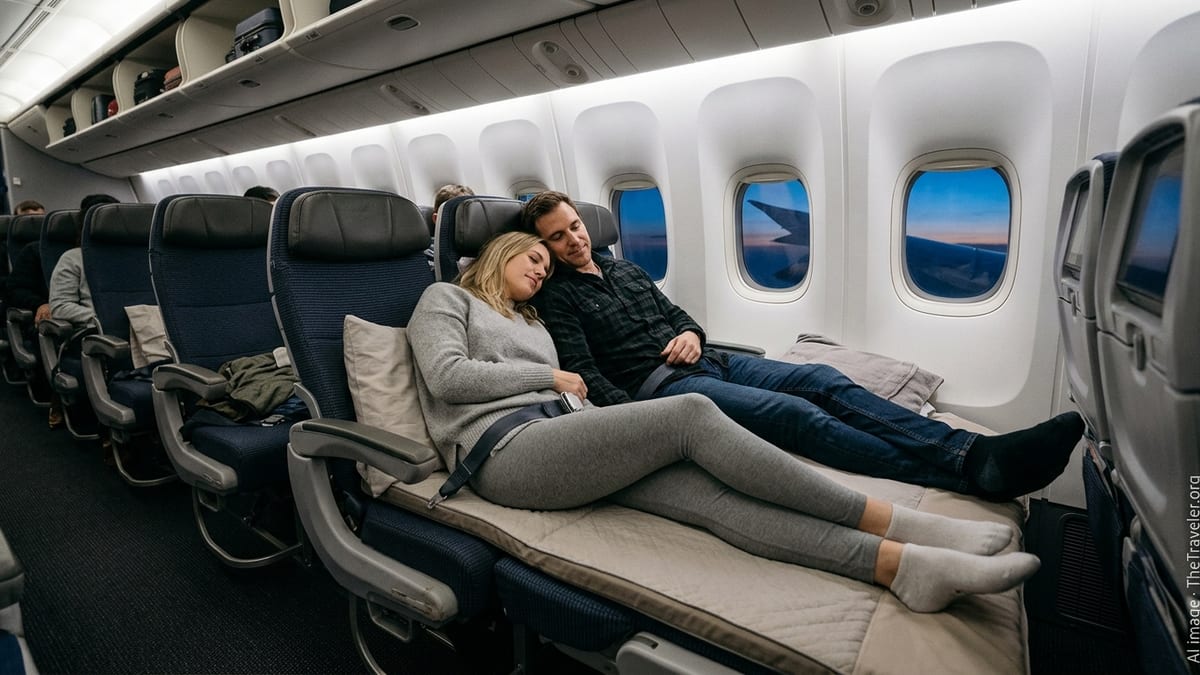
A New Lie-Flat Style Option in Economy
Publicly available information indicates that United’s new Relax Row is designed as a sky‑couch style product, where a block of adjacent economy seats can be converted into a larger, cushioned surface for resting. The concept allows passengers, typically solo travelers, couples or parents with young children, to book a dedicated row and then use specially adapted leg rests and mattress-style padding to turn the space into a quasi lie-flat area once the aircraft is in cruise.
Reports suggest that the Relax Row will be offered on widebody aircraft operating long-haul services, rather than on shorter domestic flights. United’s international network spans key gateways across the Atlantic and Pacific, and the airline has been steadily upgrading cabins and in-flight amenities across premium and economy sections. The Relax Row product fits into this broader trend of creating intermediate comfort options between standard economy seats and the much higher-priced premium cabins.
Industry coverage compares the setup to existing sky couch products offered by some Asia-Pacific carriers, but notes that United is tailoring the concept to its own fleet and seating layout. Seats used for Relax Row remain standard economy chairs for taxi, takeoff and landing, but are configured with extended leg rests, modified armrests and additional soft furnishings that can be deployed at cruising altitude to create a more bed-like surface.
Targeted to Key Long-Haul Routes in Europe, Asia and the Caribbean
According to published route information, the Relax Row option is focused on long-haul international flights where passengers are most likely to value extra rest and personal space. These include overnight services to major European hubs, lengthy transpacific sectors to Asia, and select high-demand leisure routes to the Caribbean, where flight times can stretch well beyond typical short-haul holiday services.
United’s network strategy has emphasized growth across the Atlantic and to Asia, with successive schedule updates adding new cities and increasing frequencies to established destinations. By layering the Relax Row product onto these long segments, the airline is aiming to differentiate its economy cabin in markets where competition between global carriers is intense, and where travelers often weigh comfort for overnight flights as heavily as price.
Caribbean deployment is expected to focus on longer flights from central and western North American gateways, where customers may face journey times comparable to a short transatlantic crossing. For families heading to resort destinations, a convertible row that doubles as a shared lounging space during cruise could be marketed as a way to make overnight or near-overnight travel more manageable, especially when traveling with younger children.
How Relax Row Fits Between Economy and Premium Cabins
Available descriptions of the Relax Row indicate that it will be sold as an add-on to standard economy fares, rather than as a separate cabin like premium economy or business class. In practice, travelers would book an economy ticket and then pay an additional fee to secure a Relax Row, much as they might currently pay for extra legroom or preferred seating. Pricing has not been widely published, but commentary from frequent flyers suggests that the airline is likely to position it well below business class fares while still charging a noticeable premium over regular seats.
This structure reflects a broader industry move to segment the cabin and monetize space and comfort more granularly. Airlines increasingly offer a spectrum of options, from basic economy with heavy restrictions to premium economy and lie-flat business suites. Relax Row fits into that spectrum by turning what is physically the same economy seat hardware into a more valuable space through configuration and guaranteed empty adjacent seats.
For United, which has invested heavily in its Polaris business-class brand and in refreshed premium economy seating, the Relax Row gives it an additional upsell opportunity within the main cabin. Travelers who cannot justify or find availability in premium cabins, but who are willing to pay more for rest on a long overnight sector, are the obvious target for this new product.
What Passengers Can Expect Onboard
Based on descriptions circulating in aviation forums and consumer coverage, a typical Relax Row will consist of three adjacent economy seats with mechanical or powered leg rests that rise to meet the seat cushions, forming a continuous platform. Once the aircraft reaches cruising altitude and seatbelt sign restrictions allow some movement, passengers can unfold a thin mattress or padded cover over the row, along with extra pillows and blankets, to create a more comfortable surface for reclining or lying sideways.
Safety requirements mean that during taxi, takeoff and landing each traveler must still be seated upright with their own seatbelt fastened in a single seat position. In cruise, however, the row can function as a combined lounging area, within limits set by crew instructions. Some observers note that the product is particularly appealing to couples and parents with small children, who can share the space for reading, sleeping or entertaining a toddler without relying solely on a single upright seat.
Comfort expectations are being framed as a step up from standard economy, rather than equivalent to a true flat bed in business class. The width and length are constrained by the existing row dimensions, and the cushioning is thinner than a dedicated lie-flat pod. Even so, travelers accustomed to trying to sleep upright in a narrow seat may see substantial benefit in being able to stretch out, especially on flights exceeding ten hours.
Pricing, Availability and Competitive Impact
Initial commentary from travel analysts and frequent flyer communities indicates that United has room to experiment with pricing, given the large gap that often exists between economy and business-class fares on long-haul routes. There is speculation that the airline may vary prices dynamically based on route length, demand and season, or introduce bidding and upgrade-style offers closer to departure for unsold Relax Rows.
Because the product relies on blocking off entire rows that could otherwise be sold as separate seats, the economic viability will depend on how much extra revenue United can generate per row versus selling it to three individual passengers. That trade-off suggests that Relax Row is most likely to appear on flights and dates where the airline expects strong interest from higher-spending leisure or small-business travelers, but where premium cabins cannot absorb all of the demand for additional comfort.
From a competitive standpoint, the introduction of Relax Row aligns United with a small but growing group of global airlines experimenting with sky couch and economy lie-flat concepts. For travelers choosing between carriers for long-haul journeys to Europe, Asia or Caribbean destinations, the availability of such an option may become another factor in airline selection, alongside schedule, mileage earning and traditional cabin products.
If United can strike a balance between cost and comfort, industry observers suggest that Relax Row could reshape expectations of what is possible in the main cabin on very long flights, providing a more attainable tier of rest and space for travelers who have historically been limited to sitting upright for the duration of overnight journeys.