

More news on this day
United Airlines is preparing to shake up the long-haul economy experience with its new Relax Row seating, a couch-style option designed to give travelers more space, more rest, and a taste of lie-flat comfort on routes linking the United States with key destinations in France, Spain, and Italy.
Get the latest news straight to your inbox!
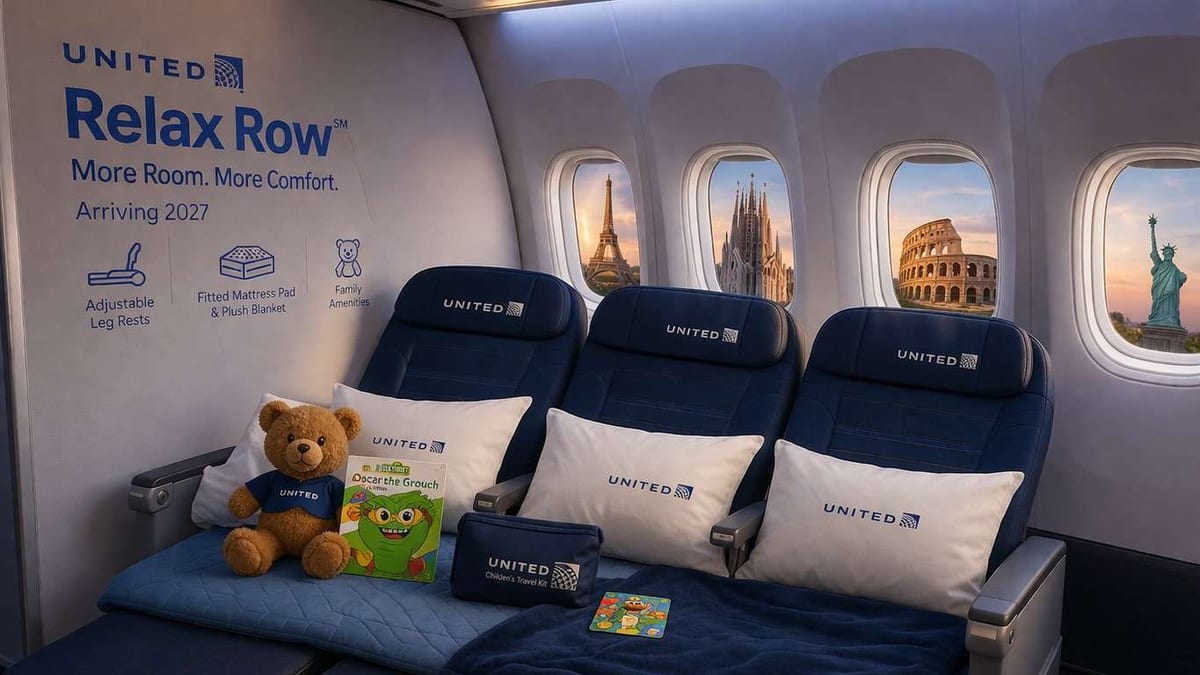
Image by Travel And Tour World
What United’s Relax Row Actually Is
According to publicly available information, United’s Relax Row is a dedicated block of three economy seats that can be converted into a couch-like surface for sleeping or lounging. Each seat is fitted with an individually adjustable leg rest that pivots up to fill the space between the seats and the floor, creating a flatter, wider platform than a standard row of economy chairs. Reports indicate that this configuration is aimed at solo travelers, couples, and parents with young children who want extra room without moving up to premium cabins.
Coverage of the product launch notes that United will supplement the hardware with soft goods specifically tailored to couch-style travel. Customers booked in a Relax Row are expected to receive a fitted mattress pad designed for the three-seat surface, along with a blanket and two extra pillows to make it easier to sleep on overnight flights. Families are set to receive kid-focused touches such as a plush toy and children’s amenity kit, signaling that United is targeting both leisure and family segments on long-distance routes.
Industry comparisons suggest that the concept is broadly similar to couch-style offerings introduced earlier by carriers in other regions, but this marks the first time a North American airline has committed to a lie-flat style experience in the main economy cabin. Analysts say the move could reset expectations around what is possible in long-haul economy, especially on heavily traveled transatlantic sectors.
Rollout on Boeing 777 and 787 Long-Haul Flights
Publicly available details show that Relax Row will debut on United’s long-haul widebody fleet, specifically Boeing 777 and Boeing 787 aircraft. Reports indicate that the first aircraft equipped with the new seating are scheduled to enter service in 2027, with United planning to extend the option across more than 200 twin-aisle jets by 2030. These are the backbone aircraft for the airline’s intercontinental network, including flights between the United States and major European gateways.
Coverage of the announcement indicates that each outfitted aircraft will feature around a dozen Relax Row sections located in the standard economy cabin. The airline appears to have opted for a relatively limited number of these couch-style rows per plane, preserving overall seat count while testing demand at a premium over regular economy fares. Industry observers say that this measured approach allows United to gauge how travelers respond before potentially expanding the concept further.
Network data shows that United’s Boeing 777 and 787 fleets operate many of the carrier’s longest and most in-demand routes across the Atlantic and beyond. As Relax Row comes online, passengers flying overnight from U.S. hubs such as Newark, Chicago, Washington, and San Francisco to major cities in France, Spain, and Italy are likely to be among the first to see the new seating offered as an upgrade option at booking or check-in.
Enhanced Comfort on Key Routes to France, Spain, Italy and the U.S.
Route maps and schedule information indicate that United’s widebody network already covers a broad range of destinations in France, Spain, and Italy, making those markets prime candidates for the new product. Travelers flying between the United States and cities such as Paris, Nice, Barcelona, Madrid, Rome, Milan, and Venice are expected to see Relax Row listed alongside traditional economy and extra-legroom seats once the rollout begins.
For overnight crossings in both directions, the ability to turn an entire three-seat row into a couch could significantly change how economy passengers experience long-haul travel. Travel analysts note that many flyers currently attempt to “create” their own couch by spreading out across empty seats when flights are lightly loaded. Relax Row formalizes this idea into a bookable product, ensuring guaranteed access to a full row along with dedicated bedding, rather than relying on chance and seat availability on the day of departure.
Reports also suggest that United sees particular potential among families and small groups traveling between North America and Southern Europe, where demand for leisure travel remains strong. A pre-reserved couch-style row may be especially attractive for parents seeking a contained space where younger children can stretch out and sleep during overnight sectors, potentially reducing stress on both families and surrounding passengers.
A New Competitive Frontier in Economy Comfort
Industry coverage portrays Relax Row as part of a broader competitive push among global airlines to differentiate the economy experience without cannibalizing higher-yield cabins. While business class suites and premium economy seats have drawn much of the investment over the past decade, the couch-style row concept targets travelers who are price-sensitive but still willing to pay more for tangible comfort improvements on flights of eight hours or longer.
Aviation commentators point out that United’s move arrives at a time when transatlantic competition is intense, with both legacy carriers and low-cost long-haul operators vying for travelers headed between the United States and Europe. Adding a novel economy product could help the airline stand out on routes to tourism hot spots in France, Spain, and Italy, where customers often weigh small differences in comfort and amenities when choosing between multiple carriers and connecting options.
At the same time, Relax Row may help United respond to shifting traveler expectations around sleep and productivity. With more passengers treating the cabin as an extension of the living room or home office, the ability to lie flat, plug in multiple devices, and create a more private-feeling space could strengthen customer perceptions of value, even if the product sits firmly within the economy fare structure.
What Travelers Can Expect Next
While detailed pricing has not yet been widely disclosed in public sources, reports indicate that Relax Row will be sold as an add-on to standard economy fares rather than as a separate cabin. This structure would align the product with existing options such as extra-legroom seating or preferred seats, allowing travelers to choose a Relax Row upgrade during booking or later in the trip-planning process as availability permits.
Travel industry observers expect the airline to fine-tune availability, pricing, and placement of Relax Row sections as aircraft enter service and initial demand patterns become clear. Given the limited number of couch-style rows on each plane, early adopters on routes linking the United States with France, Spain, and Italy may find that acting early at booking offers the best chance of securing the new seats.
For long-haul travelers, the launch of Relax Row signals a continued shift toward more customizable experiences within the economy cabin. As United prepares to bring the product to its widebody fleet over the next several years, passengers crossing the Atlantic between North America and Europe’s most popular leisure destinations could soon find that a good night’s sleep is no longer the exclusive preserve of premium cabins.