

More news on this day
United Airlines is rapidly repositioning itself at the top end of commercial aviation, rolling out a new generation of premium cabins that blend high-density luxury suites with an expanded premium economy offering, intensifying competitive pressure on rivals from North America, Europe and the Gulf.
Get the latest news straight to your inbox!
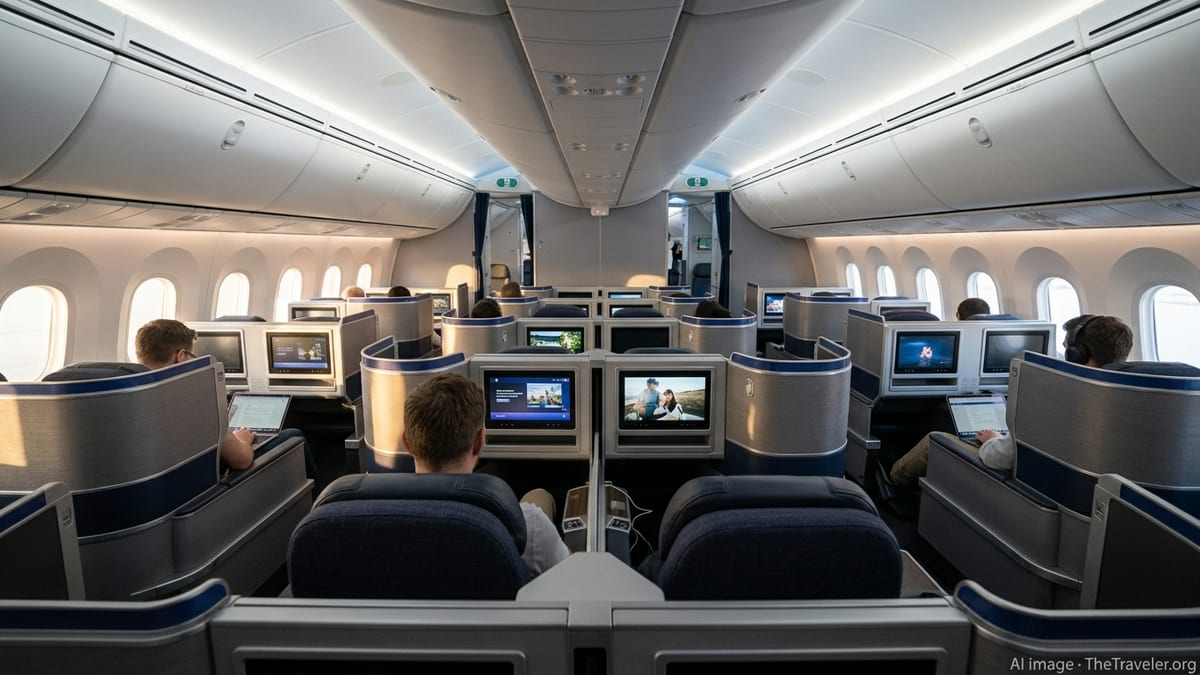
Polaris Studio Suites Redefine United’s Long-Haul Strategy
Publicly available information on United’s latest Boeing 787-9 Dreamliners indicates that the carrier’s new “Elevated” interior is built around Polaris Studio suites, a more spacious evolution of its established Polaris business class. The layout introduces eight front-cabin studio suites and dozens of lie-flat business seats, all with direct aisle access, privacy doors and upgraded finishes more often associated with boutique international carriers than with large U.S. networks.
Reports describe the Polaris Studio product as offering up to 25 percent more personal space than standard Polaris seats, enhanced privacy, companion seating options and significantly larger 4K seatback screens. The emphasis is on creating a self-contained environment for work, dining and rest on ultra-long-haul sectors, signaling that United now sees enclosed suites as the new baseline for its flagship routes rather than a niche product.
United’s first 787-9s with this configuration are expected to enter service on marquee long-haul routes from San Francisco, including services to Singapore and major European capitals. Industry analysis notes that by placing its newest suites on some of the world’s longest flights, the airline is using cabin innovation as a primary tool to attract high-yield corporate and premium leisure travelers who might otherwise select competitors such as Emirates, Qatar Airways, Air France or Lufthansa.
Aviation data also shows that nearly half of the seats on these reconfigured 787-9s are premium, with a mix of Polaris Studio, Polaris business, Premium Plus and extra-legroom economy. That ratio of premium to economy capacity is unusually high for a U.S. network carrier and has been cited by analysts as evidence that United is moving faster than many peers in reshaping its cabins around higher-margin products.
Premium Economy Becomes a Core Product, Not an Afterthought
While the headline-grabbing change is the new suite-style business cabin, United’s strategy places almost equal weight on Premium Plus, the airline’s premium economy brand. Earlier retrofit programs on Boeing 767 and 777 aircraft established Premium Plus as a distinct cabin with wider recliner seats, additional pitch and upgraded dining. More recent fleet plans show this cabin type being expanded and refined across incoming widebodies and future Airbus A321XLR narrowbodies.
According to fleet configuration data, the new 787-9 layout inserts a sizable Premium Plus cabin between Polaris and the main cabin, with privacy enhancements, wireless charging and larger screens compared with earlier versions. This brings United closer to, and in some respects beyond, the premium economy offerings of Air Canada, Delta, Lufthansa and Air France, which have also invested heavily in this segment but often with smaller dedicated cabins.
On forthcoming A321XLR aircraft, United plans to install both Polaris suites with doors and dedicated Premium Plus seating, creating a true three-class long-haul product on single-aisle jets targeted at transatlantic and deep South American missions. Industry observers point out that this approach differs from Emirates and Etihad, which rely primarily on widebodies for long-haul premium travel, and illustrates how United is using new-generation narrowbodies to project a widebody-style experience into secondary markets.
Consultants tracking airline revenue trends note that premium cabins have outperformed the main cabin in revenue metrics for United and several of its competitors. By growing the share of seats that sit between traditional business and economy, United appears to be betting that a larger cohort of travelers will pay for extra comfort, privacy and amenities if the hard product clearly differentiates itself from standard economy.
How United’s Cabin Push Compares With Global Rivals
United’s latest moves arrive amid a broader premium pivot across the industry. Delta, Air Canada and American Airlines have all announced new or refreshed business-class suites with doors, as well as premium economy expansions on key long-haul fleets. In Europe, Air France and Lufthansa are investing in next-generation business seats and reconfiguring cabins to add more premium rows, while Emirates and Etihad continue to refine their established first and business products.
However, analysts highlight several points of differentiation in United’s approach. First, the sheer proportion of premium seats on the new 787-9s appears higher than on most current widebody configurations at Delta, Air Canada or European network rivals. Second, United is pushing an integrated design language across Polaris Studio, Polaris, Premium Plus and economy, creating what observers describe as a coherent “nose-to-tail” premium narrative rather than isolated upgrades in one cabin.
Comparisons with Gulf carriers point to an important nuance. Emirates and Etihad continue to set benchmarks in ultra-luxury first class and spacious business cabins on select aircraft, yet their products can vary significantly by fleet and route. United’s initiative, by contrast, focuses on standardizing a high level of premium experience within its core long-haul workhorse types, which could give it an edge in consistency on key North America–Europe and North America–Asia corridors.
In premium economy, public configuration data suggests that several European and North American airlines still operate relatively small cabins, often fewer than 30 seats, positioned as a niche upsell. United’s choice to expand Premium Plus and place it at the heart of new aircraft layouts, including future narrowbodies, is seen by some industry watchers as a more aggressive repositioning of this class as a mainstream choice for long-haul travelers.
Design, Technology and Service Upgrades Target the Modern Traveler
Beyond seat counts and cabin layout, United’s refreshed interiors incorporate a series of design and technology upgrades that appear aimed squarely at the expectations of modern travelers. Polaris Studio and the latest Polaris suites introduce larger 4K screens, Bluetooth audio pairing, wireless charging and increased personal storage, while Premium Plus seats inherit many of the same digital conveniences.
The aesthetic of the “Elevated” interior, as described by airline communications and specialized aviation outlets, leans toward a calm, residential-inspired palette, with softer lighting and tactile materials that seek to distance the experience from the more utilitarian cabins of a decade ago. Observers note that these touches echo trends at Emirates, Qatar Airways and Air France, where mood lighting, quiet spaces and wellness-focused details have become central to the premium proposition.
Service elements are evolving alongside the hardware. United has introduced upgraded bedding, amenity kits with wellness products and expanded dining options in Polaris, including more elaborate pre-arrival meals on overnight flights. Some of these enhancements extend to Premium Plus, further blurring the line between traditional business and economy and reflecting a broader industry aim to keep travelers productive and rested throughout long journeys.
For business travelers, digital features such as improved satellite connectivity on newly delivered widebodies promise more reliable in-flight internet on transoceanic routes. Travel management companies and corporate buyers tracking these developments suggest that such connectivity, combined with suite-style privacy, is becoming as important as seat width and pitch when companies decide which carriers to prioritize for long-haul contracts.
Market Impact and What Comes Next
Financial disclosures and independent aviation reports indicate that United’s premium-focused cabin investments coincide with rising premium revenue and a strategy that leans less on competing purely on price in economy. By dedicating more floor space to higher-yield seats, the airline is seeking to offset the pressure from ultra-low-cost carriers in the rear of the aircraft with a stronger proposition at the front.
Industry analysts suggest that the move may pressure competitors in North America and Europe to accelerate their own cabin upgrades or risk losing share of high-spend travelers on transatlantic and transpacific routes. Delta and Air Canada have already responded with their own premium investments, while European groups such as Air France-KLM and Lufthansa are at various stages of rolling out new-generation suites and premium economy products.
For travelers, the near-term impact will be uneven, with the newest cabins initially concentrated on select routes and aircraft. Over time, however, as additional 787-9s and A321XLRs join the fleet and existing widebodies are refreshed, a larger share of United’s long-haul network is expected to feature suites and enhanced premium economy. Observers anticipate that this could gradually reset expectations for what constitutes a standard offering on key international city pairs.
As global airlines continue to invest in more personalized, technology-rich and comfort-driven cabins, United’s latest designs position the carrier among the leaders of this premium wave. The balance between luxury and density remains delicate, but current fleet plans and configuration choices suggest that the airline aims to keep pushing its premium footprint forward, challenging rival carriers from North America, Europe and the Gulf to keep pace.