

More news on this day
United Airlines has begun selling seats in its new Polaris Studio suites for the first scheduled passenger flights in April, marking a key milestone in the rollout of the carrier’s upgraded “Elevated 787” business-class product.
Get the latest news straight to your inbox!
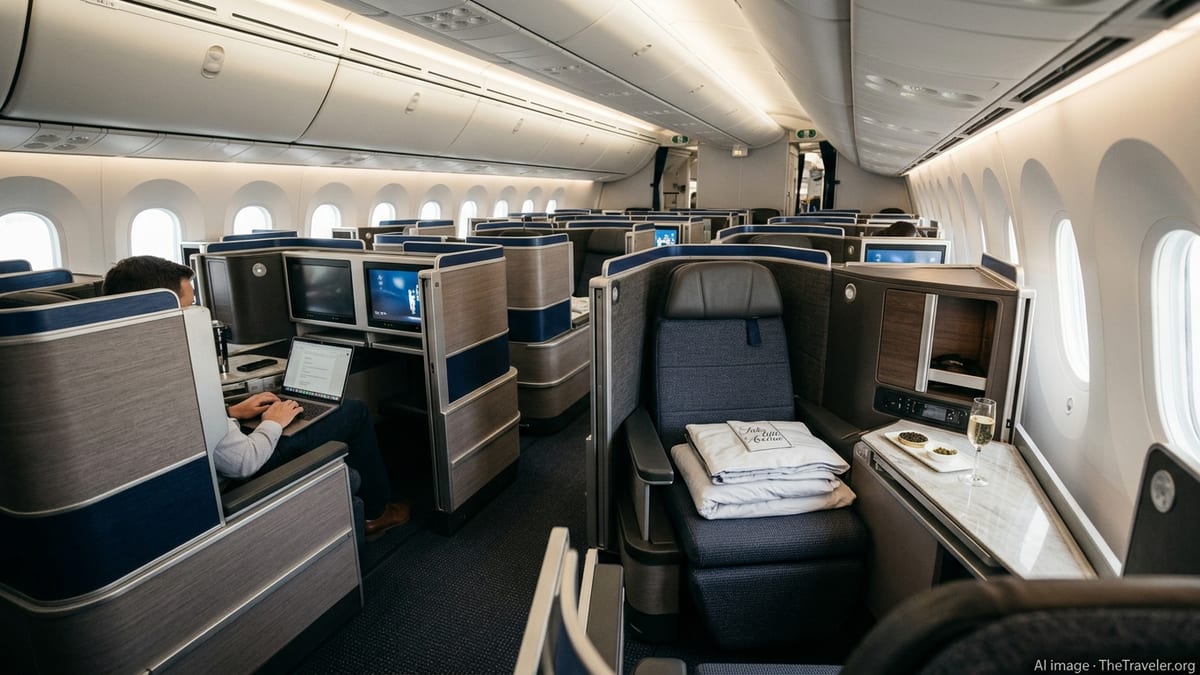
Early Access to United’s Most Premium Business Seat
Publicly available booking data shows that United has started offering Polaris Studio seats for sale on select flights in April, ahead of the wider international debut of its “Elevated” Boeing 787-9 Dreamliners later in 2026. The April services are primarily on domestic and shorter-haul routes as the airline familiarizes crews and markets the new product to early adopters.
According to published coverage and recent schedule filings, these first revenue flights are operating with United’s latest high-premium configuration of the 787-9, which introduces eight Polaris Studio suites at the very front of the business-class cabin. Travelers searching for premium seats on eligible April departures can now see a small, distinct cabin section where Studio suites are bookable as a higher tier of business class.
Reports from aviation analysts and frequent-flyer communities indicate that the April availability is still relatively limited, with Studio inventory concentrated on a handful of rotations that support crew training and operational testing. Nonetheless, the move to open sales confirms that United’s enhanced Polaris product is transitioning from concept reveal to real-world service.
Instead of a standalone cabin, Polaris Studio is marketed as the top subset of United’s international business class, similar to the “business plus” mini-suites offered by some European and Middle Eastern competitors. For travelers planning spring trips, the April flights represent one of the earliest opportunities to experience the new seat and upgraded amenities.
What Makes Polaris Studio Different
Polaris Studio is designed as an evolution of United’s existing Polaris business class, rather than a separate first-class cabin. Published specifications describe the Studio suites as approximately 25 percent larger than the standard Polaris seat, with fully closing doors for privacy and an expanded side console and work surface.
The eight Studio suites are positioned in the bulkhead row at the front of each Polaris section on the “Elevated 787” layout. Each has direct aisle access in a one-two-one configuration, with a second, fully certified seatbelt on the ottoman that allows a companion to join during meals or work. Industry reports note that the seat’s design is based on the Adient Ascent platform, adapted with United-specific finishes in wood-grain, metal, and fabric textures that align with the airline’s updated branding.
The hard product is complemented by larger 27-inch 4K OLED seatback screens, currently described in coverage as the biggest installed on any United aircraft. The suites also feature wireless charging pads, Bluetooth audio connectivity, individual reading lights, and multiple power and USB-C ports, aiming to appeal to business travelers who need to work throughout long-haul flights.
Soft-product enhancements are focused on dining and comfort. Polaris Studio customers receive expanded meal options, including an Ossetra caviar amuse-bouche and premium Champagne, alongside an a la carte menu tailored to the smaller cabin. Bedding continues to be supplied in partnership with Saks Fifth Avenue, with reports pointing to additional pillows and throws specifically stocked for Studio passengers.
How to Find and Book the New Suites in April
Travelers looking to secure one of the first Polaris Studio seats need to pay close attention to both aircraft type and cabin map when shopping for April flights. Publicly available seat maps for the updated Boeing 787-9 show two front-row Studio suites on each side of the aisle in the first business-class section, labeled distinctly from standard Polaris seats.
On United’s booking channels, these seats are sold as a premium subset of business class, with a fare or upgrade differential compared with regular Polaris. Reports from frequent travelers indicate that some Studio seats initially appear blocked during schedule transitions while the airline finalizes equipment assignments, so early shoppers may need to check back closer to departure to confirm availability.
The first wave of April operations centers on high-demand hub-to-hub routes, including select services that allow the airline to test the product on sectors of varying length. Schedule data and traveler reports point to limited domestic widebody rotations being used for crew familiarization, giving customers flying on those dates a preview of a cabin that is ultimately designed for long-haul international routes.
For loyalty program members, early Polaris Studio flights also provide a new use case for accrued miles and upgrade instruments. While exact pricing structures can vary, publicly available information shows a mix of outright paid fares, mileage redemptions, and cash or miles co-pays to move from standard Polaris to a Studio suite, particularly in the weeks immediately before departure.
Part of a Broader Premium-Cabin Arms Race
The decision to open Polaris Studio sales in April fits into a broader trend among global airlines as they compete for high-yield corporate and luxury leisure travelers. Over the past two years, several major carriers have introduced suites with doors and expanded personal space in business class, effectively compressing the gap between business and traditional first class.
Analysts note that United’s “Elevated 787” interior, which also brings upgrades to premium economy and economy, is intended to raise the overall share of premium seats on long-haul routes. Industry coverage highlights that the 787-9 layout includes 99 premium seats in total, one of the highest ratios among large U.S. airlines, with Polaris Studio as the marquee feature at the front.
By positioning Polaris Studio as an add-on within its existing business-class brand, United is following a model already seen with some European competitors that offer extra-spacious “front-row” suites. This approach allows the airline to capture additional revenue from travelers willing to pay for extra comfort and privacy, without reintroducing a separate international first-class cabin.
With April flights now bookable, United is effectively using a controlled domestic and near-international roll-in to generate awareness and feedback before the product becomes a staple on marquee long-haul routes such as San Francisco to Singapore and London later in 2026. For passengers, that creates a narrow window in which some of the newest hardware in the global business-class market is operating on relatively short sectors, making it easier to sample without committing to an ultra-long flight.