

More news on this day
United Airlines has begun selling domestic flights featuring its new Polaris Studio suites, giving travelers within the United States an early opportunity to experience the carrier’s next-generation premium cabin ahead of a broader international rollout in 2026.
Get the latest news straight to your inbox!
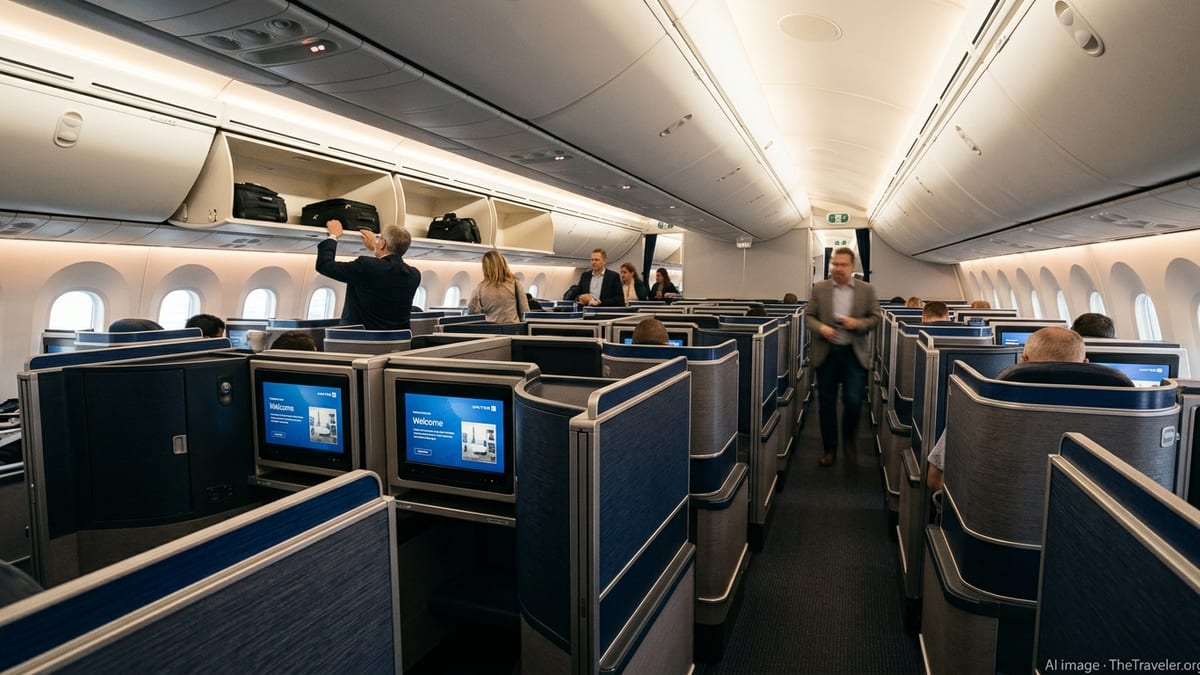
Polaris Studio Moves From Concept to Revenue Service
United first unveiled the Polaris Studio concept in 2024 as part of its “Elevated” interior for newly delivered Boeing 787-9 aircraft, describing a larger and more private front-cabin suite that sits a step above the standard Polaris business-class seat. Publicly available information shows that each Polaris Studio suite is about 25 percent larger than a conventional Polaris seat, with a sliding privacy door, expanded side console and an ottoman that can double as a buddy seat during flight.
Reports indicate that these aircraft, outfitted with a high share of premium seating, are now appearing on a limited number of domestic routes as United familiarizes crews and begins earning revenue with the new product. Aviation tracking and schedule data show Boeing 787-9s with the Elevated interior scheduled on select hub-to-hub flights, giving domestic customers access to a seat that has until now been discussed mainly in the context of future long-haul routes.
Travel industry coverage notes that these early domestic deployments are not a separate cabin class but rather a sub-section of the Polaris cabin marketed as “Polaris Studio” during seat selection. Passengers purchasing these seats are effectively buying a more spacious suite within the business cabin, with the same booking class but a noticeably different hard product at the very front of the aircraft.
The decision to place the new 787-9s on domestic sectors aligns with common airline practice when introducing a significantly updated cabin. Shorter, familiar routes allow flight and ground crews to adjust to new layouts, larger doors, upgraded inflight entertainment systems and revised galley workflows before the aircraft are rotated onto long-haul international services.
Domestic Flyers Gain Early Access to United’s Most Premium Seat
For travelers, the most immediate impact is that some domestic itineraries now include the option to reserve Polaris Studio suites, an offering that would typically be associated with long-haul transoceanic flights. According to published coverage, the refitted 787-9s carry a total of 99 premium seats, including a small number of Polaris Studio suites, a larger bank of refreshed Polaris suites and a sizable Premium Plus section.
Within that layout, Polaris Studio suites are distinguished by fully closing doors, large 27-inch 4K screens, Bluetooth connectivity and wireless charging at the seat. Reports detail a more residential design approach, including warmer finishes and a larger personal surface area for work or dining. On domestic sectors, this hardware represents one of the most premium business-class experiences currently available on a U.S. airline.
Travel writers who have previewed the cabin highlight that the new suites are designed not only for privacy but also for productivity and rest, with greater storage for personal devices, multiple power options and refined seat controls. The ability to convert the ottoman to a companion perch also lends itself to travelers who wish to dine or work face-to-face, a configuration that has historically been limited to select first-class products.
Because these aircraft are operating regular domestic segments rather than branded “premium transcontinental” services, the experience may differ from what is eventually offered on flagship long-haul Polaris Studio routes. Publicly available descriptions suggest that catering, amenity kits and lounge access policies will continue to follow United’s standard rules for the underlying fare and route, even when the hard product is identical to what will be used internationally.
Limited Routes, Dynamic Pricing and Seat Selection Nuances
At this stage, only a small number of domestic flights are scheduled with the new Polaris Studio-equipped 787-9s, and aircraft assignments can change as the rollout progresses. Schedule data and enthusiast tracking indicate that United is concentrating the first deployments on key hub-to-hub routes, including high-demand business markets where premium cabins tend to fill quickly.
Travel media reporting shows that Polaris Studio seats are sold within the broader Polaris fare structure, but seat selection can trigger additional fees or higher fare levels when demand is strong. In practice, that means some customers may book a standard business-class ticket and then choose to pay extra to sit in the Studio section, while others may find the seats included depending on the fare type, elite status or booking window.
Because aircraft swaps remain possible, consumer advocates recommend that travelers who specifically value the new suites monitor their reservations closely in the weeks before departure. If a route reverts to an older widebody or a narrowbody aircraft without suites, the seat map will reflect the change, and options to rebook or adjust travel plans will depend on United’s prevailing policies and any fare restrictions.
Industry analysts note that even with these caveats, the appearance of Polaris Studio on domestic schedules sets a new reference point for U.S. domestic premium travel. For frequent flyers accustomed to recliner-style first class on single-aisle jets, the opportunity to book a fully enclosed suite on a domestic segment represents a shift in expectations, particularly on routes where competitors rely on more conventional seating.
Part of a Wider Premium and Narrowbody Strategy
The domestic sale of Polaris Studio seats is one component of a broader premium push at United. Over the past several years, the airline has expanded its “United Next” program across narrowbody aircraft, adding seatback entertainment, larger overhead bins and upgraded domestic first-class seats. Parallel to this, the carrier has significantly grown the proportion of premium seats on widebodies, a strategy that publicly available financial commentary links to strong demand for higher-yield cabins.
Reports also point to a forthcoming Airbus A321neo “Coastliner” subfleet configured with lie-flat premium seating in a 1-1 layout, targeted at premium transcontinental and potentially select leisure markets. While these narrowbody cabins are not branded as Polaris Studio, they follow the same logic of densifying the front of the aircraft with higher-value seats and modern inflight technology.
By testing Polaris Studio on domestic routes while simultaneously preparing next-generation narrowbody cabins, United is positioning itself to compete more directly with U.S. and foreign carriers that have invested heavily in private suites and doors in business class. Analysts suggest that in markets where corporate contracts and loyalty are heavily influenced by the onboard experience, such improvements can be a meaningful differentiator.
For travelers, the overlap of these initiatives means that domestic route maps will increasingly show a patchwork of cabin types, from traditional recliners to lie-flat suites with doors. In this environment, choosing specific flights rather than simply booking by time of day may yield a noticeably different onboard experience, making detailed seat maps and aircraft information more important than ever.
What Travelers Should Watch as the Rollout Expands
As more Elevated 787-9s join the fleet through 2026, the presence of Polaris Studio on domestic itineraries is expected to grow, although United has not publicly detailed a full route-by-route plan. Industry coverage indicates that the airline intends to prioritize key long-haul international markets for the new product, with domestic rotations used to balance aircraft utilization and support training.
In the meantime, travelers looking to try the new suites can monitor flight listings for 787-9 aircraft showing a small bank of front-cabin seats separated from the main Polaris section. Because airlines routinely refine schedules months or even weeks before departure, flexibility in travel dates and times may improve the odds of securing one of the limited Studio seats at a favorable fare.
Observers expect that early customer feedback from domestic flights will play a role in fine-tuning service elements and potentially adjusting how the Studio section is marketed. If uptake is strong and reviews are positive, more aggressive deployment on competitive routes could follow, particularly where rival carriers are preparing similar next-generation cabins.
For now, the appearance of Polaris Studio on sale within the U.S. marks a significant milestone in United’s premium strategy, turning what had been a future-facing design reveal into a tangible option on select domestic flights and offering a preview of how transoceanic business travel on the airline may look in the coming years.