

More news on this day
United Airlines is introducing a new long-haul option called Relax Row, a configurable set of economy seats that can be turned into a shared, bed-like surface on international widebody flights, signaling a fresh attempt to bring lie-flat style rest to the back of the cabin.
Get the latest news straight to your inbox!
What United’s Relax Row Actually Is
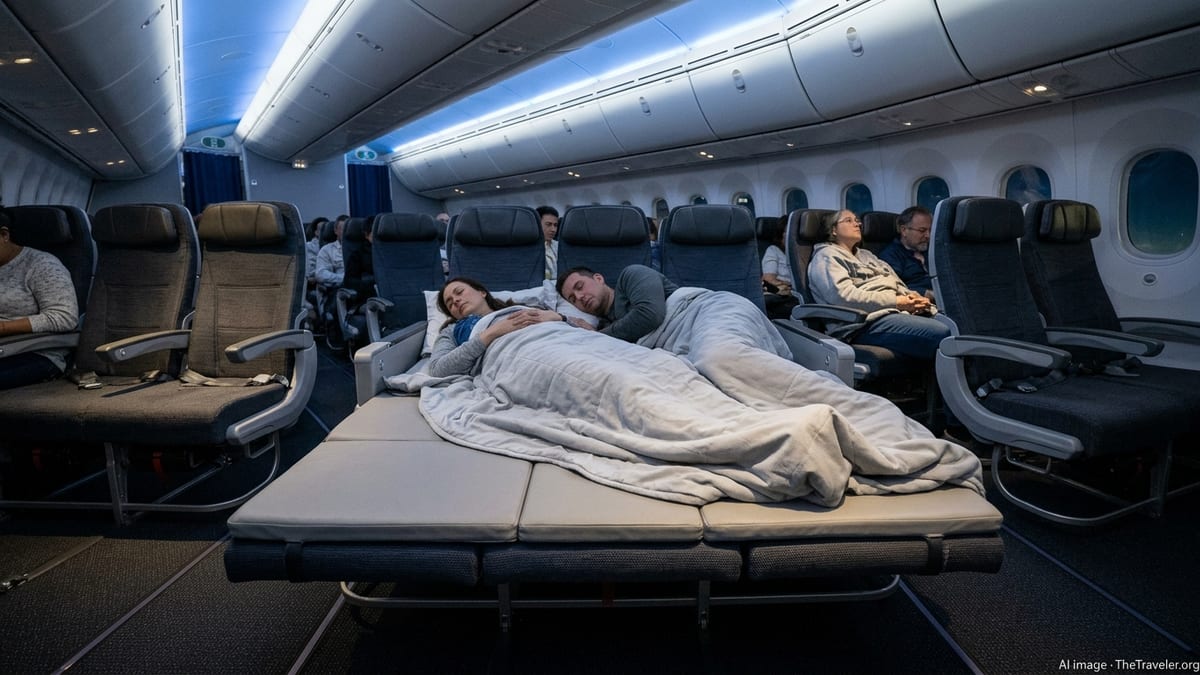
Relax Row is designed as a dedicated block of standard United Economy seats that can be converted into a flat, mattress-style surface after takeoff. Based on product details circulating in airline-focused forums and social media posts, the system uses a combination of retractable leg rests, cushions and padded overlays to create a continuous platform across a row, allowing passengers to lie down rather than sleep upright.
The configuration appears to be closest in spirit to couch-style products already flying with a few international competitors, where a trio of adjacent economy seats can be turned into a soft surface once the aircraft is in the cruise phase. In United’s case, Relax Row is framed as a branded, pre-bookable option that keeps passengers within the economy cabin but gives them access to a more sleep-friendly space for overnight sectors.
Early images shared online show standard-width economy seats with enhanced leg rests and additional padding that extends to fill the gaps between seat bases. The result is not a fully enclosed pod, but a horizontal area large enough for a couple or a parent and small child to stretch out, or for a solo traveler to curl up in a more natural sleeping position.
Initial feedback from travelers who say they have seen or tested the layout suggests that it is more comfortable than a traditional recliner seat, but less spacious than a true business-class bed. Many describe it as an optimized version of the experience frequent flyers know from lucking into an empty row across the Atlantic or Pacific.
Target Routes, Aircraft and Rollout Timeline
Publicly available information indicates that United intends to launch Relax Row on long-haul international routes operated by its Boeing 787 and 777 widebody fleets, focusing first on overnight flights where sleep is a priority. Discussion among aviation enthusiasts suggests a phased rollout beginning later this decade, with plans to equip more than 200 aircraft by around 2030 and to offer multiple Relax Row sections on each fitted jet.
The new option is emerging alongside United’s broader “Elevated” interior program for upcoming Boeing 787-9 deliveries, which includes reworked Polaris business-class suites and refreshed cabins in all classes. As those aircraft enter service on flagship routes such as San Francisco to London and Singapore, Relax Row is expected to complement the premium-heavy layout by adding a more comfortable, paid rest option in the economy cabin.
Because the product relies on dedicated hardware and certified seat modifications, it is unlikely to appear on narrowbody aircraft or domestic routes in the near term. Instead, Relax Row is being positioned as a differentiator on United’s longest sectors, where passengers are more willing to pay extra for meaningful sleep and where small gains in comfort can shape airline choice for years to come.
Industry observers note that United has been investing heavily in premium offerings at the front of the aircraft, and that Relax Row fits into a strategy of segmenting the cabin with more finely tuned products rather than simply adding seat pitch across the board.
Pricing, Booking and Who Relax Row Is For
While detailed pricing has not been formally published, commentary from frequent flyers and analysts suggests that Relax Row will likely be sold as a supplemental option on top of a regular economy ticket, either per passenger or per configured row. This could mirror the way airlines currently sell extra-legroom economy, preferred seats, or access to premium economy upgrades, but with a clearer focus on sleep as the selling point.
The likely target market includes couples traveling together, families with young children and solo travelers who place a high value on rest but cannot justify the cost of business class. For a family of three occupying the full row, the per-person cost may be more palatable than purchasing multiple premium-cabin tickets, while still providing a significant comfort upgrade over a standard economy configuration.
Reports suggest that operational rules will limit how and when the seating can be converted, with cabin crew requiring all passengers to be properly seated and belted for taxi, takeoff, turbulence and landing. The couch-style setup would primarily be used during stable cruise segments, and passengers would likely still need to share the installed seat belts or supplementary restraints to stay safely secured while lying down.
Because the surface is shared, etiquette will also play a role. Travelers booking Relax Row will need to be comfortable with the idea of a communal sleeping space, and many may prefer to reserve the product only when traveling with people they know, rather than sharing with strangers.
How Relax Row Fits into the Wider Economy Comfort Race
United’s move comes as global carriers compete to differentiate economy cabins on long-haul routes without absorbing the high costs or footprint of additional premium seats. In recent years, airlines such as Air New Zealand have experimented with bunk-style sleeping pods and couch-style rows in economy, while Gulf and Asian carriers have invested in more sculpted seats, mood lighting and upgraded soft products.
Relax Row places United into a small but growing group of airlines that see genuine lie-down rest in economy as a viable upsell, not just a marketing concept. Rather than radically altering the cabin layout, the product retools existing seat footprints and hardware, which could help keep costs down and make it easier to retrofit across large fleets if demand proves strong.
Analysts point out that the product also responds to shifting passenger expectations after years of increasingly dense seating. Travelers are more vocal about fatigue, jet lag and health on ultra-long-haul flights, and many are searching for mid-priced comfort options that sit between basic economy and the fully flat beds of business class.
If Relax Row gains traction, it could encourage rivals in North America and Europe to revisit shelved couch concepts or experiment with new forms of modular seating that better balance revenue and rest. The product may also influence how airlines design next-generation cabins, particularly on aircraft tailored to routes of 12 hours or more.
Opportunities and Open Questions
Although early reaction has been broadly curious and positive, several questions remain about how Relax Row will perform once widely deployed. Key unknowns include actual comfort levels on full flights, the ease of converting the seats in real-world conditions and whether the pricing hits the sweet spot between affordability for passengers and profitability for the airline.
There are also operational considerations. Cabin crew will need clear procedures for setting up and stowing the couch configuration, especially when flights encounter unplanned turbulence or when passengers request changes mid-flight. The product’s success may depend on how seamlessly these processes integrate into existing service routines without slowing down safety checks or meal service.
From a competitive perspective, observers will be watching whether Relax Row attracts customers away from premium economy or instead pulls upgrade revenue from travelers who would otherwise remain in standard economy. If the product primarily cannibalizes higher-yield cabins, airlines may think twice about expanding it; if it consistently sells to passengers who would not have paid extra otherwise, it could become a template for future economy innovations.
For now, Relax Row underscores a broader trend in long-haul travel: a renewed focus on sleep and wellbeing as core elements of the journey. As airlines look ahead to the next decade of international growth, products that turn more economy seats into viable, if compact, beds may become an increasingly common sight above the Atlantic and Pacific.