

More news on this day
United Airlines has quietly rewritten the fine print of its contract with passengers to give crews explicit power to remove travelers who play audio or video without headphones, sharpening expectations around onboard etiquette at a time when many U.S. flyers are paying more to navigate increasingly congested airports.
Get the latest news straight to your inbox!
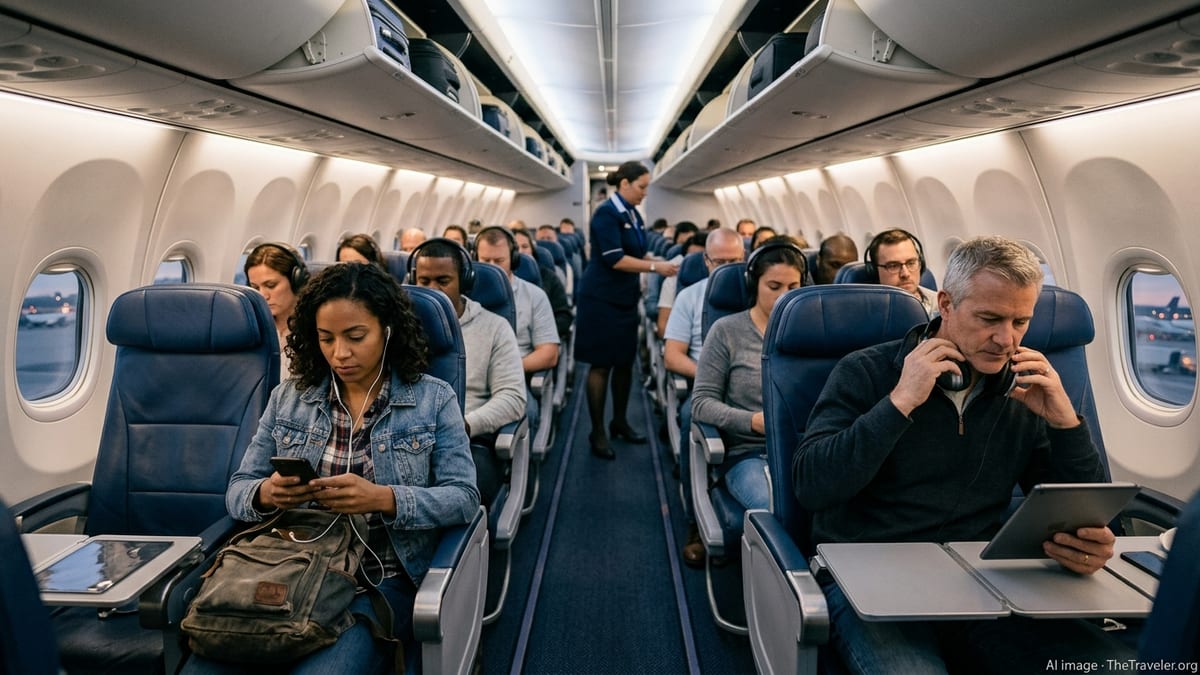
New Contract Rule Targets Speaker-Phone Flyers
Publicly available information shows that United updated its contract of carriage in late February 2026 to add a specific provision allowing the airline to refuse transport to passengers who do not use headphones while listening to audio or video content. The new clause sits within the broader section on refusal of transport, placing headphone use in the same legal framework as disruptive or unsafe behavior.
The change effectively transforms what was once framed as a courtesy request into a formal condition of travel. Reports circulating among frequent flyer communities indicate that cabin crews can now cite the contract language when instructing a passenger to mute a device or plug in headphones, and escalate if the traveler refuses to comply.
The revised contract also clarifies that voice and video calls are not permitted after the aircraft doors close, during taxi and in flight. That aligns written policy with what many travelers have already experienced informally, as crews seek to curb loud conversations conducted over Wi-Fi calling apps or speaker phones in tight cabins.
Legal analysts observing the aviation sector note that carriers have wide latitude to set conditions of carriage, provided they are disclosed to customers before purchase. With the headphone rule now embedded in United’s governing document, passengers who ignore reminders could find themselves denied boarding or removed from a flight for noncompliance.
From Courtesy Announcements to Harder Enforcement
For years, United and other major U.S. airlines have relied on onboard announcements asking customers to use headphones or closed captions when streaming entertainment. Travelers posting about recent flights describe hearing phrases such as “this is a quiet cabin” and “please use headphones for everyone’s comfort” during safety videos and crew briefings, particularly during busy holiday and summer travel periods.
Despite those reminders, complaints about out-loud videos, mobile games and music have become a regular feature of online travel forums. Several passengers recount situations in which a single phone game or shared video in a premium cabin could be heard across multiple rows, with other travelers or crew members eventually stepping in to ask the person to plug in headphones.
Until the 2026 update, enforcement often depended on individual crew discretion. Some travelers recall being told that headphones were “a courtesy, not a rule,” while others encountered strict interpretations in which flight attendants quickly intervened. The new contract language gives crews a clearer legal footing to treat persistent refusal as grounds for removal, narrowing the gap between policy and practice.
Industry observers suggest that this formalization may also help crews manage expectations in the cabin. By pointing to the contract, staff can frame headphone use as a standard condition that applies to everyone, rather than a subjective judgment about a particular passenger’s behavior.
Rising Fares and Packed Airports Heighten Tensions
The headphone crackdown arrives as many U.S. travelers report feeling squeezed by higher prices and more chaotic airport experiences. Public data on domestic airfares indicates that base ticket prices have climbed from pandemic lows, while additional fees for seats, bags and changes add to the perception of rising costs.
At the same time, the recovery in air travel has left many major hubs operating near capacity during peak periods. Travelers describe long security lines, crowded gate areas and tight connection times, particularly during storms or air traffic control disruptions that ripple through the network.
In that environment, seemingly small irritations such as loud videos or speakerphone calls can take on outsized significance. Social media posts from recent United flights often frame the new policy as a quality-of-life measure, arguing that a quieter cabin is one of the few comforts still within an airline’s direct control when schedules and infrastructure are under strain.
Consumer advocates, however, point out that policies aimed at passenger behavior do not address underlying causes of travel stress, such as staffing shortages, constrained airport capacity or complex fare structures. Some argue that as passengers pay more for basic trips, they may be less tolerant of additional rules that carry the threat of removal from a flight.
Airport Chaos Extends the Push for Quiet
The debate over headphones is no longer limited to the aircraft cabin. Travelers report increasingly common signs and announcements about “quiet zones” in certain airports, particularly in gate areas and lounges where people take work calls or stream entertainment while waiting for delayed flights.
Observers note that mobile devices have transformed terminal soundscapes over the past decade. Once dominated by public address announcements and occasional chatter, today’s concourses are often filled with overlapping audio from personal devices, video calls and portable speakers. As congestion grows, the number of people sharing the same space intensifies the effect of every unmuted screen.
United’s formal headphone rule in the air is prompting some frequent flyers to call for similar standards at busy gates, where boarding announcements compete with personal audio. While the contract of carriage governs behavior onboard and during the boarding process, airports themselves set many rules for public spaces, creating a patchwork of approaches to noise control.
Some aviation analysts suggest that more consistent expectations around device use across terminals and cabins could reduce conflict between passengers. Clear signage, pre-boarding reminders and the availability of low-cost earbuds in airport shops are among the measures being floated as ways to support compliance without escalating confrontations.
What United Travelers Should Know Before Boarding
For U.S. travelers planning to fly United in the coming months, the central practical change is straightforward: audio and video content must be listened to through headphones or earbuds, not device speakers, once onboard. Travelers who prefer to watch shows or play games at full volume may need to adjust habits or ensure they pack compatible headphones, especially as many smartphones no longer include traditional audio jacks.
The airline’s policies still allow personal electronic devices for entertainment, subject to standard restrictions during takeoff and landing. The new rule focuses on how sound is shared within the cabin, not on the content itself, although the contract also references offensive material as potential grounds for removal. Passengers can typically rely on subtitles, closed captions or muted screens if headphones are unavailable.
Travel planners recommend that flyers confirm they have working wired or wireless headphones, along with any necessary adapters, before heading to the airport. Some travelers also point to the value of noise-canceling models to reduce overall stress in crowded cabins, regardless of the new enforcement posture.
As United tightens its headphone expectations amid rising fares and persistent airport congestion, the balance between personal freedom and shared space is set to remain a flashpoint in U.S. air travel. Whether the rule ultimately contributes to calmer cabins or fuels new disputes may depend on how consistently it is enforced and how willingly passengers adapt to a quieter norm at 35,000 feet.