

More news on this day
United Airlines’ decision to intensify monitoring of sick leave among its crews is sharpening a high-stakes labor confrontation in the United States and adding new urgency to broader debates over worker protections and operational reliability across the Gulf, particularly in the United Arab Emirates.
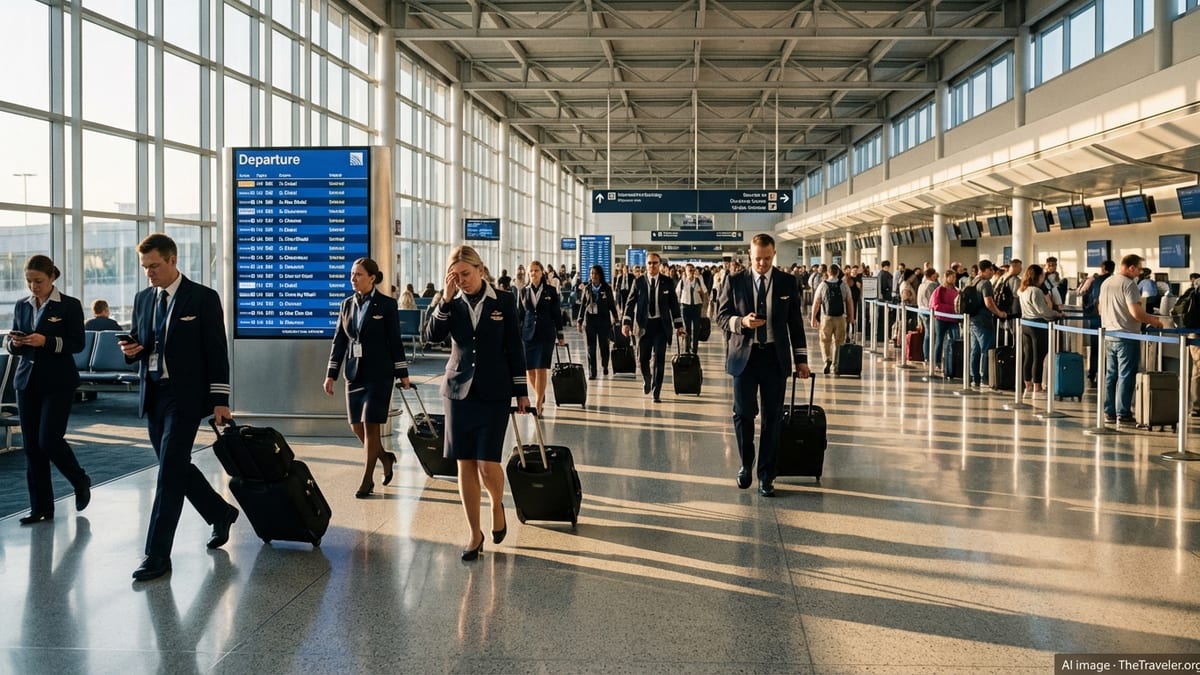
Data-Driven Attendance Rules Put Flight Crews Under Pressure
United’s sick leave policy has evolved into a tightly controlled, data-driven system that labor advocates say leaves little room for the unpredictability of illness. Flight attendants are required, whenever possible, to give at least eight hours’ notice before calling in sick, with failure to do so potentially triggering attendance “points” and formal performance warnings. Union leaders argue that this effectively forces crew members to predict when they will become unwell or face career-threatening discipline.
In recent years, United has also introduced broad requirements for medical documentation around weekends and peak holiday periods, demanding absence certificates for sick calls on certain days. While an independent arbitrator has affirmed the airline’s contractual right to seek medical proof in cases it deems suspicious, flight attendants say the practical impact is a culture of suspicion in which legitimate illness is routinely second-guessed.
United defends the measures as essential to running a massive global network where last-minute crew absences can cascade into delays and cancellations for thousands of passengers. The company encourages employees to seek professional medical care and stresses that proper documentation can protect them from discipline when illness is genuine. Yet for many in the cabin, the combination of strict timelines, detailed documentation demands and automated tracking systems feels less like support and more like surveillance.
Unions Claim Sick Leave Policies Undermine Contract Rights
The Association of Flight Attendants-CWA, which represents roughly 30,000 United flight attendants, has repeatedly challenged what it calls overreach on sick leave. Union leaders accuse the airline of using scheduling alerts and blanket documentation requirements in ways that erode rights negotiated under the collective bargaining agreement and, in some cases, risk conflicting with federal labor protections.
In a series of grievances and public statements, the union has criticized United’s weekend and holiday documentation mandates as “offensive” and “accusatory,” arguing that the policies treat every sick call as presumptively fraudulent. Complaints have also been raised with the U.S. Department of Labor over how United handles leave protected under the Family and Medical Leave Act, including allegations that workers face undue pressure when seeking time off for serious health conditions.
Beyond flight attendants, other unionized workgroups at United have questioned the company’s use of attendance point systems that sit outside formal contracts. Some labor advocates contend that disciplining employees for using accrued sick time under a parallel, company-written policy undermines the value of those negotiated benefits. For workers on the ramp or in maintenance, where safety-critical jobs demand full fitness for duty, the fear of punishment for calling in sick can create its own risks.
Contract Talks and Pay Disputes Add Fuel to the Fire
The tightening of sick leave controls is unfolding against the backdrop of protracted contract talks that have left morale strained across United’s workforce. Flight attendants are still working under a contract that became amendable in 2021, after members rejected a tentative agreement in 2025 that offered wage increases but, according to union leaders, failed to address quality-of-life issues such as scheduling, rest and sick leave protections.
Union officials argue that United’s aggressive attendance oversight is part of a broader strategy to keep labor costs in check while the company delays signing richer contracts. They say stricter sick leave rules, coupled with stagnant pay, effectively shift the burden of operational resilience onto workers’ health and family lives. The airline counters that it offers paid sick leave and competitive benefits, and that ensuring reliable staffing is fundamental to delivering the service passengers expect.
As new rounds of mediated negotiations get underway in Chicago, sick leave has become a symbolic flashpoint alongside wages and staffing. For many flight attendants, stories of discipline following short-notice sick calls or disputes over medical documentation resonate more sharply than abstract pay scales. The outcome of these talks will shape not only paychecks but the extent to which crews feel trusted when they report that they are too ill to fly.
UAE Carriers Highlight a Tougher Medical Verification Model
While United’s system is drawing scrutiny in the United States, the debate is playing out against very different norms in the United Arab Emirates, home to some of the world’s largest long-haul carriers. UAE labor law provides up to 90 days of sick leave a year for private-sector employees after probation, with a mix of full pay, half pay and unpaid days. In practice, however, cabin crew at Gulf airlines frequently face far more intensive in-person verification of illness than their U.S. counterparts.
Emirates, based in Dubai, typically requires flight attendants who report sick to present themselves at the airline’s own medical facilities, where in-house doctors assess fitness to work. For crew members, this can mean traveling to a clinic while feeling unwell, often during the overnight hours that long-haul operations demand. The process is designed to curb abuse of sick leave, but many employees say it can feel intrusive and exhausting.
These practices underscore the different legal and cultural frameworks that shape sick leave debates across regions. In the United States, disputes are often mediated through unions, arbitrators and federal regulators, with contractual language and statutory protections at the center of the argument. In the UAE, where most airline workers are expatriates on limited-term visas, in-house medical checks and company-run housing and transportation systems give employers greater day-to-day control, even when statutory leave entitlements look generous on paper.
A Global Tourism Industry Caught Between Reliability and Wellbeing
The intensifying focus on sick leave at United and among carriers in the UAE reflects a wider tension facing the global tourism and aviation sectors as they race to meet record travel demand. Airlines rebuilding networks after the pandemic are seeking every possible efficiency to keep flights on time, while labor shortages and congested hubs have left little spare capacity when crew members fall sick.
For travelers, stricter attendance policies can translate into fewer cancellations and more predictable schedules. Yet behind the scenes, flight attendants and ground staff describe an atmosphere where taking time off for illness feels risky, especially during peak holiday periods. In both the United States and the Gulf, unions and labor advocates warn that pushing employees to work while unwell may solve short-term staffing challenges at the expense of safety, service quality and long-term retention.
As data analytics and real-time monitoring tools become more sophisticated, airlines are likely to gain even greater visibility into patterns of absence across their workforces. The question now confronting regulators, unions and management from Chicago to Dubai is how to balance that technological oversight with policies that recognize illness as an unavoidable part of human life. The outcome of the sick leave battles at United and in the UAE’s aviation sector could help define what “responsible” workforce management looks like for a new era of global travel.