

More news on this day
Travelers flying long-haul between the United States, Europe, Asia, and Australia could soon stretch out across near lie-flat economy rows, as United Airlines prepares to roll out a new Relax Row product designed to bring more stretch-out comfort to the back of the cabin.
Get the latest news straight to your inbox!
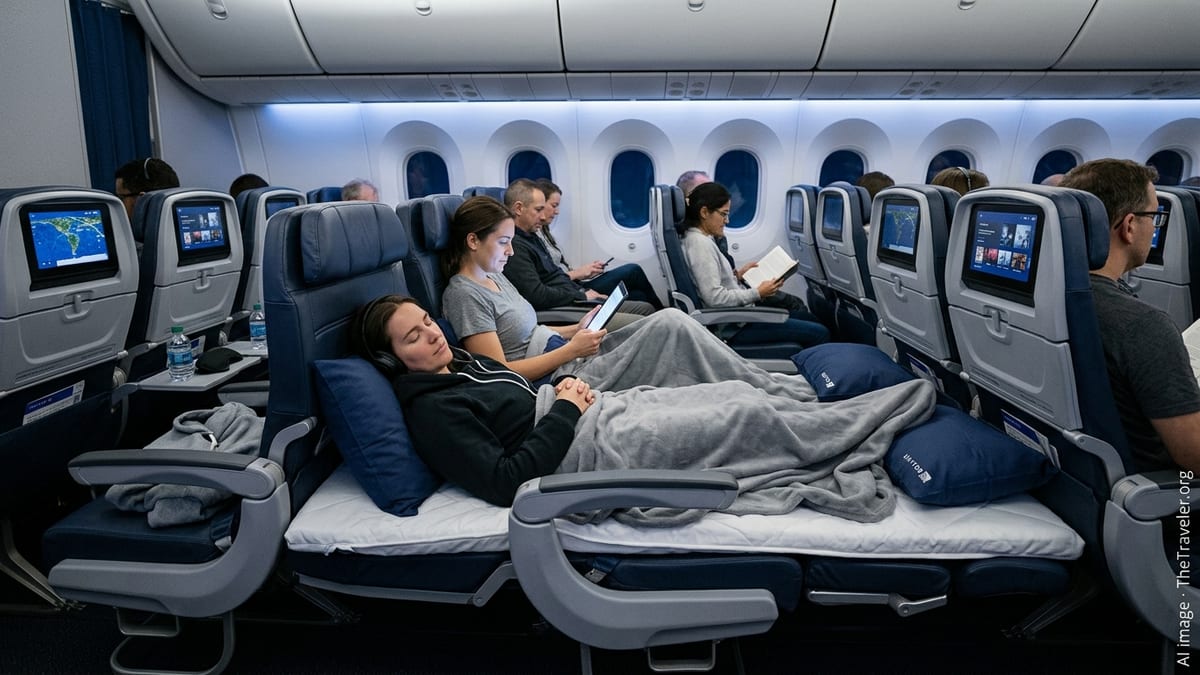
What United’s Relax Row Actually Is
Publicly available information indicates that United Airlines is developing an economy cabin feature called Relax Row, a set of standard economy seats that convert into a mattress-like surface after takeoff. Rather than individual pods, the concept relies on a dedicated row of three seats with upgraded leg rests and padding that can be configured into a continuous surface for reclining or sleeping.
According to recent press materials and industry coverage, the Relax Row is designed for travelers who want more space without paying for premium economy or business class. The airline is positioning the product as a more comfortable option within United Economy, intended to appeal to couples, solo travelers who prioritize rest, and families with young children who need room to stretch out on overnight sectors.
When in couch mode, the leg rests are expected to fold upward to create a flat or near flat platform across the three adjacent seats. Passengers booked in these rows are slated to receive extra soft furnishings compared with standard economy, including a custom-fit mattress pad, additional pillows, and a larger blanket tailored to the extended surface.
While the arrangement will not match the privacy or fully enclosed feel of a business class suite, the basic idea mirrors “sky couch” concepts offered by a small number of international carriers, bringing that style of economy upgrade to a major United States airline for the first time.
When and Where Travelers Can Expect the Upgrade
United has outlined a multiyear rollout plan that will matter to travelers planning future trips between North America and long-haul destinations in Europe, Asia, and Australia. Based on recent announcements summarized in financial and aviation industry news, the Relax Row is expected to debut in 2027, initially on select Boeing 787 and 777 widebody aircraft that operate long-distance international services.
The carrier has stated that more than 200 widebody jets are slated to receive Relax Row installations by 2030. These aircraft form the backbone of United’s long-haul network from U.S. hubs such as Newark, Chicago, Washington Dulles, San Francisco, Los Angeles, and Houston to major destinations across the Atlantic and Pacific. As the modification program advances, travelers flying between the United States and key markets including Western Europe, East and Southeast Asia, and Australia are likely to see the new seating option appear on route searches.
Because implementation is tied to aircraft, availability will vary route by route and by travel date as individual jets cycle through cabin refurbishment. Industry observers expect United to prioritize some of its longest overnight sectors, such as transpacific and deep transatlantic flights, where the ability to stretch out can be a strong selling point. Travelers will need to pay attention to aircraft type and seat maps at booking to verify whether a particular flight is scheduled with Relax Row installed.
In parallel, United is continuing to introduce its Elevated interior on new Boeing 787-9 aircraft, with entry into commercial service targeted from 2026. While the Elevated cabin mainly focuses on upgraded Polaris business class suites and premium economy, it underscores the airline’s wider strategy of differentiating the onboard experience across the cabin, including in standard economy.
How Relax Row Fits Between Economy, Premium Economy, and Business
The Relax Row concept is best understood as a bridge between traditional economy seats and the higher fare premium cabins already available on United’s long-haul aircraft. Unlike Polaris business class, which provides individual lie-flat seats with direct aisle access and sliding doors on new 787-9 deliveries, Relax Row remains part of the main economy cabin with shared space and limited privacy.
Compared with United Premium Plus, the airline’s premium economy product, Relax Row trades some vertical space and dedicated legroom for horizontal room. Premium Plus offers a wider, more reclined seat with greater pitch and enhanced service but does not include a bed-like surface. Relax Row goes in the opposite direction, transforming a standard-width triple into a sleeping platform, while retaining economy-level catering and service.
For travelers weighing options on long-haul journeys, the choice will likely come down to budget, schedule, and personal comfort preferences. Business class remains the most spacious and private, particularly on the latest Elevated-configured 787-9s, but fares are typically several times higher than economy. Premium Plus sits in the middle on price and comfort, while Relax Row is expected to carry a supplemental charge on top of an economy fare, offering a more attainable upgrade for those willing to share an open row and manage with less privacy.
Industry commentary suggests that United views this layered approach as a way to capture different segments of demand on the same aircraft, from cost-conscious leisure travelers to corporate passengers seeking full lie-flat beds. The introduction of a couch-style row in economy further extends that spectrum, giving passengers more ways to tailor comfort to their budget.
What Passengers Should Know Before Booking
Because Relax Row is still in the pre-launch phase, some practical details, including final pricing structures and booking rules, have not yet been fully disclosed in public documentation. However, travelers can draw on existing sky couch models and information shared in recent announcements to set expectations and plan ahead for trips from 2027 onward.
First, availability will be limited. Only selected rows in the economy cabin will be configured as Relax Rows, and demand is likely to be strong on popular overnight routes between the United States and Europe, Asia, and Australia. Travelers who want the product should expect to book early once schedules open, and to look carefully at seat maps to differentiate Relax Row from standard economy seating.
Second, the product is expected to come with specific safety and usage rules. Like similar offerings on other airlines, passengers will likely be required to be seated upright with standard seat belts fastened for taxi, takeoff, and landing, only converting the row into couch mode when the seatbelt sign is off. Shared rows also mean that parties may need to book all three seats in a Relax Row to take full advantage of the lie-flat surface without sharing with a stranger.
Third, travelers should recognize that while the surface may be marketed as lie-flat or mattress-like, it will remain a repurposed row of economy seats. There will be no privacy doors, and cabin noise and foot traffic will be similar to the rest of economy. Those who are highly sensitive to noise or seek full separation may still prefer premium economy or business class where budgets allow.
Preparing for a New Era of Long-Haul Economy Travel
The move toward couch-style economy seating arrives as airlines worldwide continue to invest heavily at the top of the cabin while also seeking ways to differentiate economy beyond extra-legroom rows. Recent coverage of cabin innovations shows a broader trend of carriers adding premium touches, from larger seatback screens and faster connectivity to redesigned business class suites with doors and enhanced bedding.
United’s Relax Row fits squarely within that pattern, signaling that the boundary between traditional economy and higher cabin classes is becoming more nuanced. For travelers who routinely fly long-haul between the United States and international hubs in Europe, Asia, and Australia, the coming years could offer a wider range of comfort options than ever before, often on the same aircraft.
Until the first Relax Row-equipped flights take off, travelers can monitor United’s official announcements and schedule changes for indications of which routes will be equipped first. As aircraft with Elevated interiors and new seating concepts enter service, passengers on long-distance itineraries may find that their choices in the back of the plane look markedly different from what they are used to today.
For now, the prospect of stretching out across a near lie-flat surface in economy represents a notable shift in how long-haul comfort is defined. While full details on pricing and rollout are still emerging, United’s plans suggest that travelers who strategically choose flights and book early could soon experience a new style of rest at 35,000 feet without leaving the economy cabin.