

More news on this day
A United Airlines Boeing 757 arriving at Newark Liberty International Airport completed a precautionary single-engine landing after an in-flight issue prompted the crew to shut down one of its two engines, with reports indicating that the aircraft touched down safely and passengers disembarked without injuries.
Get the latest news straight to your inbox!
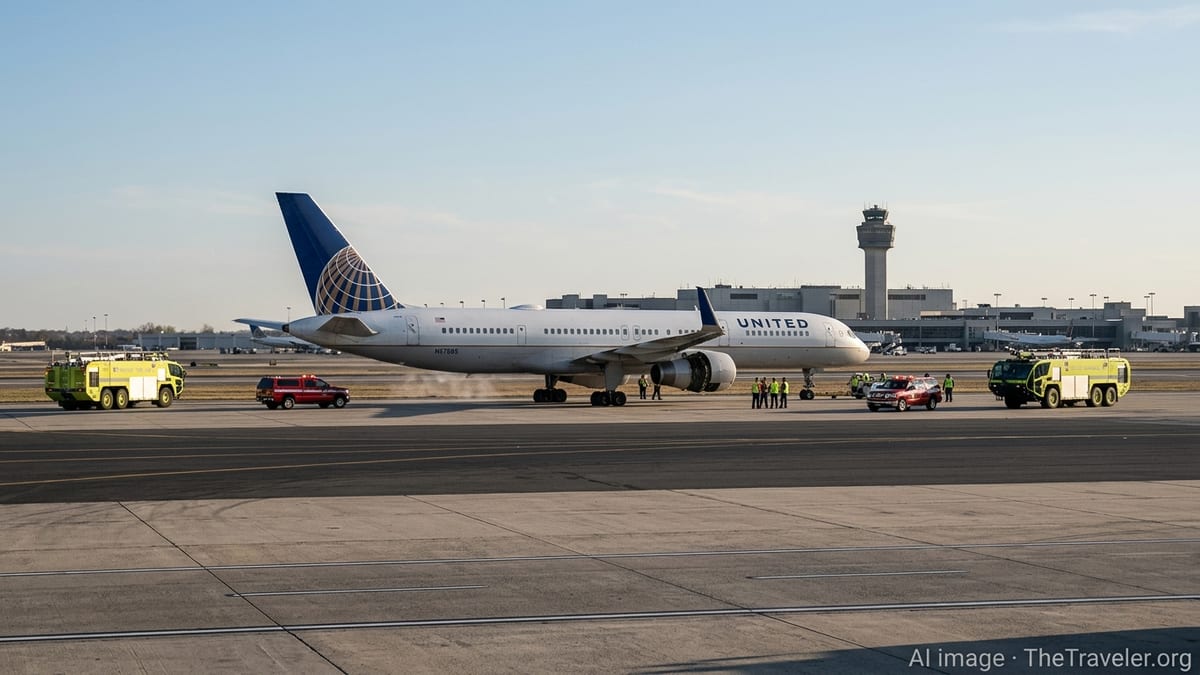
Calm Single-Engine Landing Marks Successful End to In-Flight Scare
Publicly available flight data and passenger accounts indicate that the Boeing 757, operating a United Airlines service into Newark, experienced an engine-related alert while in flight, leading the cockpit crew to secure the affected engine as a precaution and continue toward the airport on the remaining powerplant.
Single-engine operations are a core part of the design and certification standards for twin-engine airliners such as the 757, and initial information from tracking platforms suggests the aircraft maintained a stable altitude and speed profile while proceeding back to the New Jersey hub. Aviation reference data shows that comparable Boeing 757 services into Newark routinely follow established contingency routes that keep them within a safe diversion window.
Passenger descriptions shared on social platforms describe a controlled descent and routine touchdown, albeit with emergency vehicles positioned along the runway and taxiways out of an abundance of caution. After the aircraft came to a stop, ground crews reportedly inspected the landing gear and brakes while the cabin remained secure, before the jet was towed to a gate for deplaning.
No injuries have been reported, and there are no indications of damage consistent with more serious engine failures such as uncontained debris or fire. The incident is being treated as an in-flight technical malfunction contained by standard procedures rather than a full-scale accident.
Coordinated Emergency Response at Newark Liberty
Newark Liberty International Airport, one of the busiest hubs in the United States, maintains detailed response plans for aircraft emergencies ranging from minor technical alerts to large-scale mass-casualty scenarios. Publicly available airport planning documents and case studies of past events involving United flights into Newark show that local fire, medical and police services are integrated into these protocols and are trained to stage rapidly along designated access routes.
Reports from aviation enthusiasts monitoring operations at Newark indicate that multiple airport fire and rescue vehicles were pre-positioned near the active runway ahead of the 757’s arrival, consistent with established procedures for an aircraft landing with a known technical issue. These vehicles are typically equipped with high-capacity foam systems, thermal imaging tools and medical support equipment, giving responders the ability to react quickly if smoke, fire or an evacuation were to occur.
Once the aircraft rolled to a stop and no signs of smoke or fuel leakage were apparent, responders appeared to transition from emergency posture to monitoring mode, allowing ground handling teams to take over. In similar Newark events documented in federal incident databases, this shift from emergency readiness to routine handling has been cited as a factor in minimizing disruption to other airport operations.
Runway and taxiway inspections following such landings are standard practice, with surface checks for tire debris, hydraulic fluid or other contaminants that might affect subsequent flights. Early indications suggest the runway was cleared for continued use after a brief inspection, underscoring how quickly the airport can rebound from a precautionary alert when the aircraft arrives intact.
United Airlines Training and Safety Culture in Focus
United Airlines, which operates a large Boeing 757 fleet from Newark, emphasizes engine-out and abnormal procedures in simulator training for flight crews. Regulatory training outlines for major United States carriers show that pilots routinely practice engine shutdowns shortly after takeoff, during cruise and on approach, followed by single-engine landings under a variety of weather and runway conditions.
Recent incident records involving United aircraft, including events at Newark and other hubs documented by federal safety databases and specialist aviation outlets, highlight that crews have repeatedly managed technical issues through methodical checklist use and conservative decision-making. These records show patterns of fuel dumping when necessary, holding to reduce landing weight, and opting for emergency services on standby even when cockpit indications remain stable.
Industry analysts note that events where an engine is shut down in flight but the aircraft lands without damage are categorized as “incidents” rather than “accidents” in official statistics, reflecting the expectation that properly trained crews and well-maintained aircraft can safely withstand the loss of one engine. The United 757 landing at Newark aligns with these expectations and contributes to a safety record in which successful precautionary returns far outnumber serious outcomes.
For passengers, such experiences can still be unsettling, but customer accounts shared after similar single-engine landings at United hubs often describe a cabin environment marked by clear announcements and measured reassurance, followed by coordinated assistance during rebooking and onward travel.
Engineering Redundancy and Certification Standards for the 757
The Boeing 757 was certificated under United States Federal Aviation Administration rules that require twin-engine jets to demonstrate the ability to continue safe flight and landing after the failure of one engine. Technical references for the type describe robust performance margins that allow the aircraft to climb, cruise and land on a single engine under defined weight and temperature limits.
In practice, when an engine is shut down, the crew adjusts power on the operating engine, reconfigures fuel and electrical systems, and often flies at a lower altitude or reduced speed to conserve performance margins. Historical data drawn from previous Boeing 757 incidents, including events departing or arriving at Newark documented in safety digests, indicate that the airframe has repeatedly demonstrated predictable handling characteristics in such scenarios.
Design redundancy extends beyond thrust. Critical systems such as hydraulics, electrics and flight controls are supplied by multiple independent sources, ensuring that the loss of one engine does not result in a cascade of other failures. This architecture is a cornerstone of how modern airliners, including the 757, are engineered to prevent technical problems from escalating into life-threatening emergencies.
While detailed technical findings on the Newark event will depend on internal inspections and any formal reporting that follows, the ability of the aircraft to land safely with one engine shut reflects these built-in safeguards operating as intended.
Ongoing Review and Impact on Travelers
According to published coverage of comparable airline incidents, operators typically initiate internal reviews immediately after a precautionary landing, examining cockpit data, maintenance records and crew reports to determine whether a component failure, sensor anomaly or procedural issue contributed to the event. Findings can lead to targeted inspections across a fleet, software updates or revised maintenance intervals.
For travelers, the immediate consequence is usually delay or cancellation as the affected aircraft is taken out of service for inspection. At a hub such as Newark, schedule resilience and spare aircraft availability help limit knock-on disruption, although some passengers can still experience missed connections or rebooked itineraries.
Industry statistics compiled by safety organizations show that events in which an engine is shut down in flight but the aircraft lands without injuries remain rare when compared with the enormous number of daily departures in the United States. Analysts often point to such outcomes as evidence that layered safeguards, from design standards to crew training and coordinated airport response, are functioning effectively.
As more details about the United Boeing 757 event at Newark emerge through official databases and future reporting, the incident is likely to be cited as another case study in how established protocols can turn a potentially serious technical issue into a controlled and injury-free conclusion for passengers and crew.