

United Airlines has thrown down a powerful challenge in the global premium travel market, unveiling next-generation Polaris business-class suites that will debut in 2026 and place the U.S. carrier in direct competition with Qantas, Singapore Airlines, ANA and Emirates as airlines race to redefine luxury air travel.
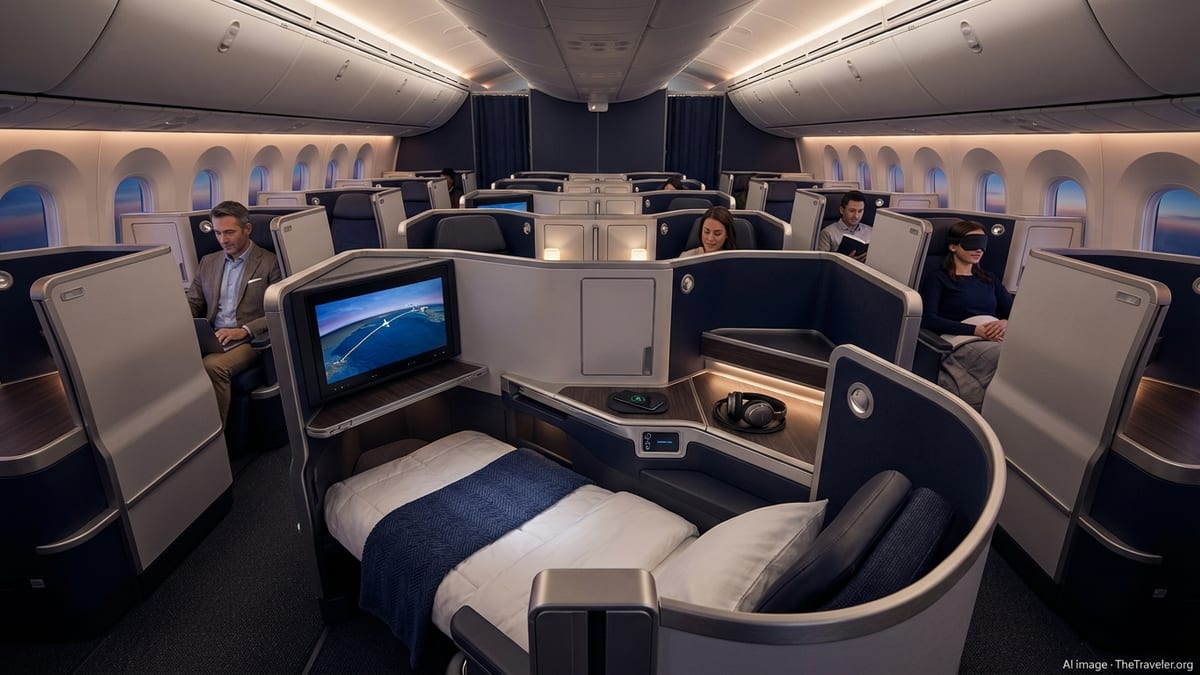
United’s 2026 Polaris Suite: A New Flagship For U.S. Business Class
United’s refreshed Polaris product, set to launch on new Boeing 787-9 Dreamliners from late 2025 and roll onto key long-haul routes in early 2026, marks the carrier’s most ambitious premium-cabin upgrade in nearly a decade. The new cabin centers on enclosed Polaris suites with sliding doors, significantly expanded personal space and a more residential design language that moves sharply away from traditional angled pods.
The headline feature is the Polaris Studio suite, a larger, front-row “business plus” product that United will sell as its top-tier business seat. These Studio suites offer up to 25 percent more space than standard Polaris, with a full-length lie-flat bed, an ottoman equipped with a seatbelt for companion dining, and a highly private shell designed to shield passengers from aisle traffic while still feeling open to the cabin environment.
United is pairing the hard-product overhaul with high-end inflight amenities that would have been unthinkable on a U.S. carrier just a few years ago. Studio passengers are set to receive Ossetra caviar service, Laurent-Perrier rosé champagne, upgraded pajamas and slippers, and amenity kits featuring premium skincare brands, as the airline courts a segment of travelers who might previously have defaulted to Asian or Gulf competitors.
Across the Polaris cabin, United is installing large 4K OLED seatback screens, Bluetooth audio, wireless charging and expanded power options, along with refreshed Saks Fifth Avenue bedding. It is also promising fast, free Wi-Fi through Starlink connectivity, part of a strategy to combine hotel-style comforts with a consistently online, work-friendly environment throughout the long-haul journey.
San Francisco to Singapore and London: United Targets Flagship Routes
The first aircraft fitted with United’s new Polaris suites are slated to operate from San Francisco to Singapore and London in early 2026, directly targeting two of the world’s most competitive premium corridors. The move positions United on head-to-head routes with Singapore Airlines and British Airways while also challenging one-stop itineraries via Gulf and Asian hubs operated by Emirates and others.
On the ultra-long San Francisco to Singapore route, where flight times routinely top 16 hours, the added privacy, larger sleeping surface and enhanced bedding are intended to offer meaningful rest rather than incremental comfort. United is clearly betting that a fully enclosed suite, combined with consistent Wi-Fi and upgraded dining, will persuade corporate contracts and high-yield leisure travelers to remain on a nonstop itinerary instead of routing through rival hubs.
The San Francisco to London deployment is equally strategic. London remains one of the most hotly contested premium markets globally, and United’s new suites are designed to appeal to both West Coast technology executives and financial travelers. With caviar tastings in the Studio suites and elevated menus throughout Polaris, the airline is leaning into a more experiential style of service at a time when many carriers have quietly trimmed soft-product touches.
United plans to take delivery of around 30 aircraft with the new interior by 2027, giving it sufficient scale to seed additional premium-heavy markets across the Pacific and Atlantic. While the carrier has not finalized the full route map, industry observers expect the enhanced cabins to appear on key Asian and European services where competition with the likes of ANA, Singapore Airlines and Emirates is most intense.
Qantas Project Sunrise: Boutique Suites for the World’s Longest Flights
United’s push into next-generation suites comes as Qantas prepares to introduce its much-publicized Project Sunrise cabins on a fleet of Airbus A350-1000 aircraft designed for nonstop flights from Sydney to New York and London from the second half of the decade. The Australian flag carrier has unveiled both first and business class suites that embrace a “mini hotel room” aesthetic aimed squarely at flights approaching 20 hours.
In business class, Qantas is rolling out fully enclosed suites with sliding doors, direct aisle access and expansive storage, along with flat beds stretching to around two meters in length. The airline has intentionally limited overall seat density, with just 238 passengers on its A350-1000s, to carve out more room for premium cabins and a dedicated wellbeing zone for stretching and movement between Australia and the Northern Hemisphere.
The design, crafted in partnership with Australian studio Caon Design and informed by sleep scientists at the University of Sydney’s Charles Perkins Centre, focuses heavily on circadian lighting, reduced noise and personalized space. Each business suite pairs a large high-definition screen with multiple charging solutions, including wireless induction pads, a cushioned ottoman and refined finishes intended to feel more like a boutique residence than a conventional aircraft seat.
For Qantas, which has long marketed itself as a pioneer of ultra-long-haul flying, the A350 cabins are a statement that the longest flights in the world can still feel indulgent rather than punishing. As United and others commission their own new-generation suites, Project Sunrise sets a benchmark in how far airlines are willing to go to transform long-haul business class into an experience more akin to first class of old.
Singapore Airlines, ANA and Emirates: Early Pioneers of the Suite Age
While United’s upcoming Polaris suites may be grabbing headlines in North America, the concept of a fully enclosed, apartment-style seat has been maturing in Asia and the Middle East for years. Singapore Airlines, often cited as a benchmark in premium travel, has already deployed its spacious A380 Suites on select long-haul routes, and is now extending the product to Dubai from March 2026, bringing one of the world’s most exclusive flying experiences onto one of aviation’s highest-profile city pairs.
The Singapore Airlines Suites concept, though technically positioned above business class, has reshaped expectations across the premium cabin spectrum. With sliding doors, standalone beds, separate reclining chairs and an emphasis on privacy and personalized service, it has encouraged carriers to push business class ever closer to a suite-based model, particularly on widebody aircraft deployed on strategic routes.
Japanese carrier ANA’s “The Room” business class, introduced on select Boeing 777-300ER aircraft, has also been a bellwether. The product features wide, box-like seats with doors, almost sofa-like width in some configurations and a minimalist, residential aesthetic. Its success in the Japan–North America and Japan–Europe markets has demonstrated that passengers will go out of their way, and pay a premium, for hard products that feel significantly more private than the classic staggered or herringbone layouts.
Emirates, meanwhile, has consistently used opulent cabins and high-touch service to differentiate itself in the global market, from its first class suites to showers and lounges on the A380. Although much of the attention has centered on first class, Emirates’ steady push to refine its business class and retrofit aircraft with more advanced seats has helped popularize the idea that a premium cabin should be a sanctuary, not just a reclining seat with better food.
What Makes the New Suites Different From Traditional Business Class
The collective shift by United, Qantas, Singapore Airlines, ANA and Emirates points to a clear redefinition of what “business class” means. Where the last generation was defined by the move to lie-flat seats and direct aisle access, the emerging standard is all about full or near-full enclosure, greater width for side-sleeping, and layered, residential-style details usually associated with boutique hotels.
United’s upcoming Polaris suites follow this pattern with full-height partitions and sliding doors designed to offer a sense of retreat without feeling claustrophobic. The use of warmer materials, wood-grain accents, fabric textures and soft ambient lighting is meant to soften the industrial feel of metal and plastic that characterized many earlier designs. The airline is also investing heavily in digital controls and seat customizability, recognizing that passengers increasingly expect smartphone-like interfaces instead of physical buttons alone.
Across the competing products, there is a similar focus on ergonomics and personalization. Adjustable privacy wings, multiple lighting modes, larger and more intuitive storage spaces, and dedicated areas for laptops, tablets and personal items are becoming standard. Suites are being designed to adapt from a work-friendly mini office with large tables and power access to a tranquil sleeping space with turndown service and thick mattresses.
Catering is being used as a major differentiator. Caviar and fine champagne in United’s Polaris Studio suites, chef-driven menus at Qantas, and bespoke, multicourse offerings at Singapore Airlines and Emirates all underline how airlines are repositioning these cabins as holistic luxury experiences rather than simply more comfortable ways to cross an ocean.
Technology, Connectivity and the New Definition of Comfort
In the 2026 wave of premium cabins, technology is just as critical as seat design. United’s new Polaris aircraft are expected to offer fast, free Wi-Fi powered by satellite connectivity, matching or exceeding the connectivity levels that high-value travelers experience in their offices on the ground. Passengers will see larger, higher-resolution entertainment screens, almost universally offering 4K or near-4K quality, paired with Bluetooth connections to personal headphones and, in some cases, smartphone control of the interface.
Qantas and other carriers are integrating mood lighting systems with multiple scenes that track circadian rhythms, subtly shifting color temperature and brightness to align with destination time zones and reduce jet lag. Paired with curated wellbeing content and dedicated movement spaces on ultra-long flights, these systems indicate a move away from simply making cabins more glamorous toward making them genuinely healthier places to spend fifteen or more hours.
Charging options are also evolving rapidly. Wireless induction charging pads are beginning to appear next to traditional AC outlets and USB-C ports, acknowledging that premium passengers are often juggling multiple devices. Well-placed storage cubbies, often within arm’s reach and sometimes with soft-close doors, help keep work devices and personal items secure without cluttering the limited flat surfaces available in a suite.
Together, these technological enhancements are intended to make long-haul business class feel less like a compromise and more like an extension of a traveler’s home and office. For airlines, the challenge will be maintaining these systems reliably over the lifespan of an aircraft while continuing to update software and services at the pace of consumer tech.
A 2026 Tipping Point in the Global Premium Travel Market
As United’s Polaris suites enter service alongside Qantas’ Project Sunrise cabins and ongoing premium innovations from Singapore Airlines, ANA and Emirates, 2026 is shaping up as a tipping point in the global business class market. The period will mark the first time that a major U.S. airline competes head-on in the top tier of suite-style products, rather than trailing leading Asian and Middle Eastern carriers by a full generation of design.
This intensifying competition is likely to influence aircraft ordering and retrofit decisions across the industry. Carriers that still operate older-angle lie-flat seats or dense, non-suite business cabins on key routes may find themselves under pressure from corporate clients and alliance partners to accelerate upgrades. At the same time, airlines must balance the cost and complexity of fitting doors, larger shells and heavier privacy structures with the need to manage weight, fuel burn and overall seat counts.
For travelers, the emerging suite era promises a wider range of choices and a clearer distinction between basic business class and the upper end of premium cabins, where products like Polaris Studio and Qantas’ front-row business seats blur into a quasi-first-class experience. As the market moves toward 2026, the contest among United, Qantas, Singapore Airlines, ANA and Emirates will not just be about who has the most luxurious seat, but who can deliver a consistently seamless, restful and high-touch journey from door to door.
What is already clear is that the definition of luxury at 35,000 feet is changing rapidly. Privacy, personal space, technological sophistication and wellness are now central pillars of the premium proposition, and airlines not participating in this suite-led revolution risk being left on the sidelines of the most lucrative segment of long-haul travel.