

More news on this day
United Airlines is preparing to reshape the long-haul economy experience with the planned introduction of “United Relax Row,” a new spacious seating concept set to roll out across its Boeing 787 Dreamliner and Boeing 777 fleets in the coming years.
Get the latest news straight to your inbox!
A New Take on Stretching Out in Economy
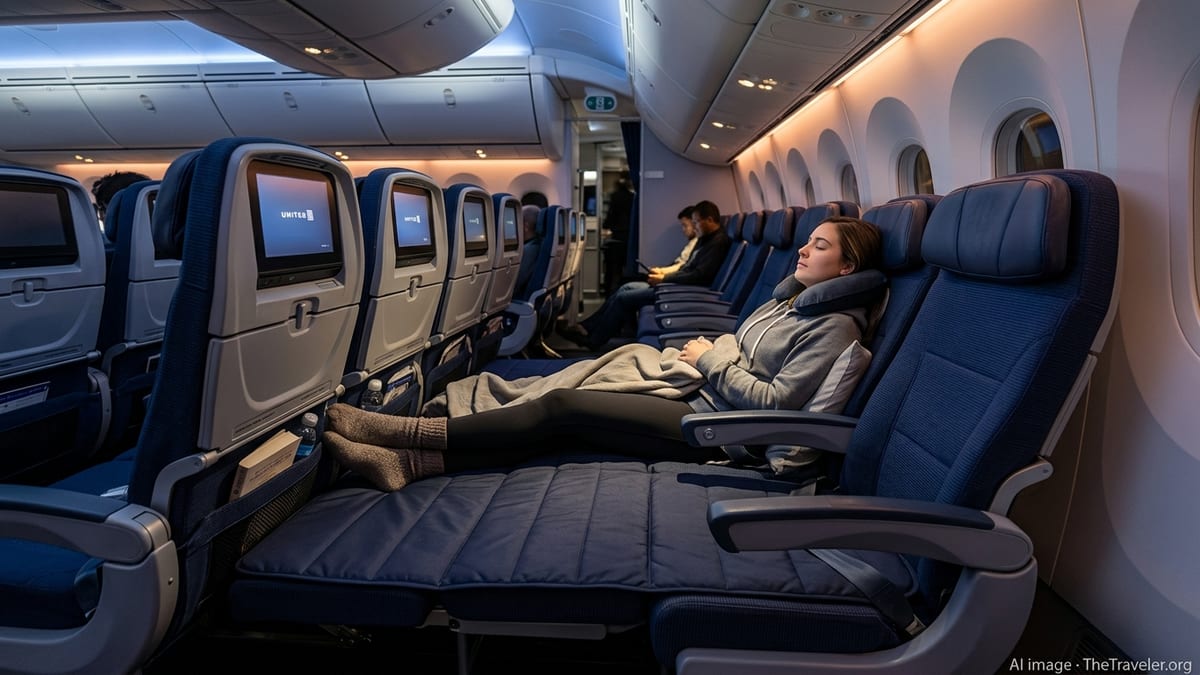
According to recent industry reports and aviation community coverage, United Relax Row is designed as a dedicated section of economy seats that can be converted into an expanded lounging area on long-haul flights. The concept is positioned as a hybrid between a traditional economy row and a simplified lie-flat surface, giving travelers the option to stretch out horizontally without moving to a premium cabin.
Publicly available descriptions indicate that multiple adjacent seats in a Relax Row section can be configured as a shared surface, with leg rests and extended cushions creating a couch-like space. The rows are expected to remain structurally similar to standard economy seating for takeoff and landing, but offer an alternate layout once the aircraft is in cruise.
The product is being framed as a response to growing demand for more comfort on ultra-long sectors where passengers often spend 10 hours or more in the air. United’s widebody network, built around transatlantic, transpacific, and deep South America routes, presents numerous opportunities for this type of flexible rest space in the cabin.
Early information circulating in aviation forums also suggests that Relax Row will be marketed primarily to leisure travelers, couples, and families who value the extra space but prefer to remain in the broader economy cabin instead of upgrading to premium economy or business class.
Deployment Across Boeing 787 and 777 Fleets
United plans to focus the new product on its twin-aisle Boeing 787 and Boeing 777 aircraft, which together form the backbone of the airline’s long-haul operation. Public fleet data shows that the carrier already operates dozens of 787 variants and 777-200 and 777-300ER models, with additional 787s on order as part of its long-term fleet renewal.
Reports circulating in aviation circles describe a phased introduction beginning later this decade, with United Relax Row sections gradually incorporated as cabins are refurbished or as new aircraft are delivered. On fully retrofitted aircraft, there could be up to a dozen Relax Row sections available, depending on the exact seating layout chosen for each subtype.
Industry commentary notes that the 787’s slightly narrower fuselage compared to the 777 may lead to subtle differences in how the Relax Row sections feel on board. The 777’s wider cabin could allow a marginally broader couch-style surface, while the Dreamliner’s lower cabin altitude and higher humidity levels may add to overall rest quality even with a similar seating footprint.
United’s broader interior modernization strategy, which includes new seating, updated inflight entertainment, and enhanced connectivity on long-haul jets, provides the framework into which Relax Row will be integrated. The product is expected to sit alongside existing economy and premium offerings as an optional paid upgrade.
How United Relax Row Fits into a Competitive Landscape
Airlines globally have experimented in recent years with lie-flat or couch-style options in economy, particularly on long sectors where overnight rest is essential. New Zealand-based carriers and several European airlines have trialed or introduced similar concepts, positioning them as a middle ground between standard economy and more expensive cabins.
According to published airline product coverage, United Relax Row would make United one of the first major North American airlines to commit to a scaled, branded implementation of this kind of seating across a large widebody fleet. Observers suggest the move reflects competitive pressure on long-haul routes, where comfort can be a decisive factor in airline choice.
Travel analysts note that such products allow carriers to increase revenue per square foot without extensively reconfiguring entire cabins. By designating specific rows as Relax Rows that can be dynamically priced, airlines can tap into demand from travelers seeking more space while preserving a conventional seat map for most of the economy cabin.
At the same time, the move underscores an industry trend toward more granular cabin segmentation, where passengers can pay for incremental comfort features such as extra legroom, quieter zones, or in this case, the option to lie down. United Relax Row appears set to become one more layer in that evolving hierarchy of choices.
What Long-Haul Travelers Can Expect On Board
While final details may vary by aircraft type, descriptions shared in aviation communities point to several likely features of a typical Relax Row section. These include adjustable leg and foot rests that fold out to meet the seat cushions, supplemented by additional padding that bridges the gaps between seat bases, creating a more continuous surface.
For safety reasons, passengers would still be required to sit upright with seat belts fastened for taxi, takeoff, landing, and turbulence. Once the seat belt sign is off, the Relax Row could be used for reclining or reclining-plus-stretching, depending on the number of occupied seats in the row and any specific usage guidelines outlined by the airline.
Observers expect that bedding elements such as blankets and pillows will play an important role in how comfortable the Relax Row feels in practice, particularly on overnight transoceanic flights. Soft furnishings can help smooth out transitions between cushions and armrests, making the space more suitable for side-sleeping or semi-reclined positions.
The product is also likely to be most attractive on routes with long cruise segments, such as flights across the Pacific or to deep South America, where passengers have extended time to benefit from the extra space. On shorter long-haul sectors, travelers may still find value in the ability to spread out, even if full sleep is less of a priority.
Pricing, Availability, and Booking Considerations
Specific pricing for United Relax Row has not yet been formally detailed, but reporting from airline product watchers suggests that the upgrade will be offered as a paid add-on, either during booking, at check-in, or at the gate when space permits. Dynamic pricing models used for extra-legroom and preferred seats elsewhere in the cabin may serve as a template.
Travel industry analysts anticipate that families and couples could be among the earliest adopters, particularly those looking to secure contiguous space without stepping up to premium cabins. Solo travelers seeking a more restful overnight flight may also view the product as an alternative to traditional extra-legroom seats if they can secure an entire Relax Row section.
Because Relax Row will be limited to specific rows on 787 and 777 aircraft, availability could vary considerably by route and date. Travelers comparing itineraries may find it useful to check aircraft type and seat map details as part of their planning, especially on routes where multiple widebody types rotate through the schedule.
Industry commentary points out that the success of United Relax Row will depend on execution in several areas, including clear booking pathways, transparent pricing, and consistent onboard setup. If implemented as described, the concept has the potential to shift expectations of what is possible in long-haul economy travel on United’s flagship widebody fleet.