

More news on this day
United Airlines has escalated its battle for dominance at Chicago O’Hare International Airport, forecasting that rival American Airlines could suffer a $952 million loss in 2026 as both carriers pour capacity and capital into a contentious expansion of one of the United States’ most valuable aviation hubs.
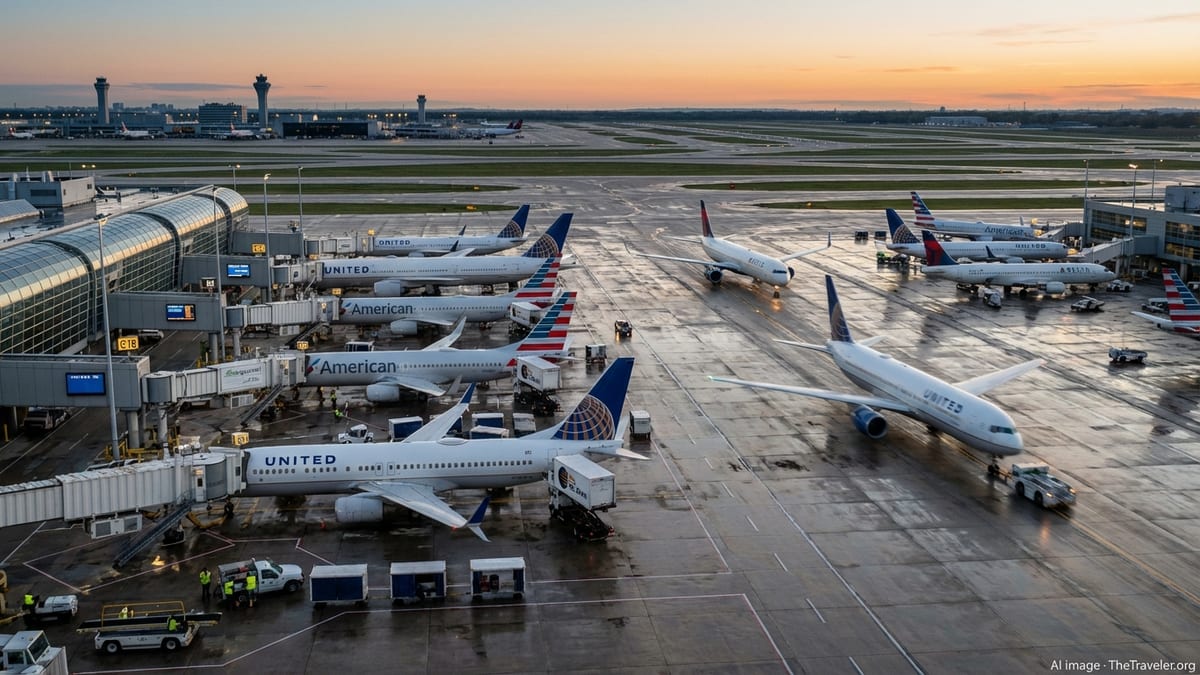
United’s Bold Forecast Raises the Stakes in Chicago
United’s projection of a $952 million setback for American Airlines crystallizes a rivalry that has been building for years at Chicago O’Hare. In a presentation shared with investors and industry analysts, United executives outlined a scenario in which American’s aggressive capacity build-up at the airport triggers steep financial losses, even as United insists it can grow profitably. The figure, while a forecast rather than formal guidance, is designed to underscore what United characterizes as the risks of overexpansion in an already crowded market.
The projection, highlighted in coverage by specialist aviation outlets, comes as both airlines are racing to secure gates, expand schedules and court lucrative corporate travel accounts in Chicago. United, headquartered in the city, now frames the contest not only as a commercial competition but as a referendum on which carrier has the stronger business model in a mature hub. By publicly attaching a nearly one billion dollar number to its rival’s potential losses, United is signaling confidence in its own strategy and challenging investors to question American’s.
American has not publicly endorsed United’s view of the numbers and continues to promote Chicago as a core pillar of its domestic network. But the very fact that United has made such an explicit forecast has injected fresh tension into an already fraught dispute over the future shape, size and economics of O’Hare’s expansion.
Capacity Race at a Premier Midwestern Hub
Chicago O’Hare is among the most strategically important airports in the United States, serving as a central connecting point between coasts and as an anchor for Midwestern business travel. United has been on a multiyear growth trajectory at the airport, recently announcing that it expects to operate a record 750 daily flights this summer, including more than 370 mainline departures and nonstop service to more than 220 destinations. That schedule would give United roughly 200 more daily flights than its nearest competitor and reinforce O’Hare’s role as one of its largest hubs.
American, for its part, has been rebuilding its Chicago presence after years of underperformance relative to United. The carrier has added destinations from O’Hare and leaned on the hub as a connecting point for both domestic and transatlantic traffic, with seasonal routes to leisure markets helping fill its banks of flights. Industry reports indicate American is operating hundreds of daily departures to around 160 destinations from Chicago, with ambitions to lift that number further as new gates and runway configurations come online.
The result is a capacity race that risks flooding the market with seats. United argues that its own additions are disciplined and supported by corporate demand, strong connectivity and a premium-heavy onboard product, while describing American’s expansion as far more speculative. The 952 million dollar loss figure is rooted in assumptions that American will struggle to fill new flights at profitable fares, especially if United responds with targeted capacity and fare moves of its own.
Gate Control, Legal Maneuvers and the O’Hare Expansion Plan
Behind the capacity duel sits a quieter but equally consequential struggle over gates and long-term access to O’Hare’s infrastructure. Gate control is a critical asset at any hub, dictating how many flights an airline can operate and how flexibly it can schedule banks of arrivals and departures. United currently operates a larger gate portfolio at O’Hare than American and has been pushing to lock in additional positions as part of the airport’s multi-billion-dollar expansion and modernization plan.
Recent decisions by Chicago officials to allocate new or reconfigured gates to United have drawn sharp objections from American, which has challenged aspects of the process in court. American has argued that certain allocations were premature or inconsistent with earlier agreements tied to a 2018 expansion deal, warning that skewing gates toward one carrier could entrench a long-term competitive imbalance at the hub. A request for preliminary relief was rejected, but appeals and negotiations over how new gates are divided will continue to shape the growth trajectory of both airlines.
United executives, including chief financial officer Michael Leskinen, have spoken openly about what they describe as the “gate calculus” in Chicago, suggesting that securing permanent access now is vital to defending the airline’s hometown position. They argue that incremental gates can support multiple additional departures each day, magnifying their impact on connectivity and revenue. For American, every gate decision that tilts toward United narrows the room to expand and forces harder choices about where to deploy aircraft in coming years.
Sharp Rhetoric: “Temporary Hub” and Talk of Empty Planes
The dispute over O’Hare has been marked by unusually sharp public rhetoric, underscoring how emotionally and financially charged the contest has become. At an investor conference this month, United CFO Michael Leskinen referred to American’s Chicago operation as a “temporary hub,” implying that recent performance trends and capacity decisions could eventually make it unsustainable. In the same appearance, he quipped that American could “fly around some empty airplanes,” suggesting that the rival carrier was prioritizing size over profitability.
Those comments followed earlier remarks by United chief executive Scott Kirby, who has described Chicago as United’s home turf and vowed not to “cede a single gate” to American. The airline has repeatedly emphasized its higher reported margins at O’Hare relative to its competitor, citing external analysis that pegs United’s Chicago operation as comfortably profitable while portraying American’s as loss-making. The 952 million dollar forecast for 2026 takes that line of argument further, painting American’s strategy as not only risky but potentially destructive.
American has responded more cautiously, focusing its public messaging on broader network strengths, operational resilience and upcoming customer improvements at O’Hare, including lounge upgrades. While it contests the notion that its hub is in jeopardy, it has largely avoided matching United’s combative tone in public forums. That leaves United’s narrative dominating the conversation, at least for now, even as analysts caution that real outcomes will depend on demand, fares and cost management over the next several years.
Profitability, Labor Costs and Investor Perception
The clash in Chicago is unfolding against a backdrop of diverging financial trajectories among the major U.S. network carriers. Delta continues to lead on profitability, with United working to close the gap and American striving to demonstrate that years of restructuring and cost cuts can finally translate into durable margins. Recent results show United and Delta well ahead of American on pre-tax earnings, a gap that has shaped investor expectations and amplified scrutiny of American’s strategic bets at its hubs.
United’s argument about a 952 million dollar hit to American at O’Hare leans on this context. By presenting Chicago as a microcosm of a broader pattern, United positions itself as the disciplined grower and American as the carrier willing to sacrifice profitability for market share. However, some analysts note that United’s own margins benefit from a temporary labor cost advantage tied to contracts that have yet to be fully updated. When that gap narrows, United’s lead over American could look smaller than headline figures suggest, complicating any straight-line projections about which airline has the sturdier model.
For investors, the Chicago battle raises key questions about how much short-term pain is acceptable in pursuit of long-term hub dominance. If both carriers add more capacity than the market can profitably absorb, yields could fall and margins could suffer across the board. That possibility tempers some of the more aggressive predictions and has prompted calls for both airlines to show restraint, even as each insists that its own growth is justified by demand.
Operational Reliability and Customer Experience as Differentiators
Beyond capacity and gates, United is betting that a stronger operational record and enhanced customer experience will tilt high-value travelers in its favor. The airline has highlighted its on-time performance at O’Hare and is investing in larger overhead bins, seatback entertainment, upgraded lounges and high-speed onboard connectivity for frequent flyers. Its latest Chicago schedule includes a heavy mix of mainline aircraft and a broad range of domestic and international destinations, designed to offer convenient one-stop options for both business and leisure customers.
American is making its own case to travelers, pointing to winter-weather resilience initiatives, refreshed lounge plans and a network that connects Chicago to dozens of domestic cities and key overseas markets. During recent periods of severe weather, the airline has emphasized improvements in de-icing operations and staffing that helped it sustain its schedule in difficult conditions. It also continues to lean on long-standing relationships with corporate accounts that value redundancy and competition at major hubs.
In practice, passenger behavior at O’Hare will be shaped by a mix of factors: schedule convenience, perceived reliability, loyalty program benefits and the quality of the onboard and ground experience. United’s assertion that “everybody is switching” from American is more rhetorical than literal, but the carrier clearly sees an opportunity to capture share among premium travelers who may be dissatisfied with their current options. American, meanwhile, is fighting to show that its Chicago hub is not only durable but essential to a balanced national network.
Implications for Travelers and the City of Chicago
For travelers, the near-term impact of the O’Hare expansion clash may be broadly positive. More flights and destinations can translate into better schedule options, more one-stop connections and, at least initially, competitive fares as the airlines jostle for market share. United’s record summer schedule promises expanded connectivity to smaller Midwestern cities and additional service on popular routes to both coasts, while American’s build-up supports new links between Chicago and secondary markets across the United States and beyond.
For the city of Chicago and its surrounding region, the rivalry reinforces O’Hare’s status as a premier global gateway and key economic engine. Airlines hiring thousands of workers, investing in lounges and maintenance facilities, and committing to long-term gate leases all support jobs and local tax revenue. City officials, however, must balance the benefits of a dominant hometown carrier with the advantages of preserving robust competition among airlines vying for travelers.
There are risks. Prolonged overcapacity could pressure both airlines to trim schedules or pull back from marginal routes if anticipated demand fails to materialize. Travelers might then face fewer choices after a period of abundance. Additionally, if the contest drives one carrier into sustained losses at O’Hare, it could ultimately reduce the intensity of competition that has historically benefited passengers.
2026: A Real-Time Test of Hub Economics
The year 2026 is shaping up as a real-time laboratory for hub economics at a large, mature airport. United’s forecast that American could lose 952 million dollars in Chicago is a bold bet that its own strategy, product and cost base will outmatch its rival’s in a challenging environment. American counters that its investments in Chicago are part of a broader plan to close the profitability gap with its peers and that it will not be deterred by competitors’ public pronouncements.
Key metrics to watch include load factors on new and existing routes, fare trends in overlapping markets, the evolution of corporate travel contracts and how both airlines manage fuel, labor and airport costs. If United can sustain healthy margins while upgauging aircraft and adding flights, its case for disciplined growth will strengthen. If American can demonstrate improving unit revenues and narrowing losses at O’Hare despite the added capacity, it will blunt the impact of United’s dire projections.
Ultimately, the outcome will matter far beyond Chicago. Network strategies at other hubs, from Dallas Fort Worth to Denver and New York, could be informed by what happens when two legacy carriers simultaneously double down on a single airport. United’s 952 million dollar warning is thus both a shot across a rival’s bow and a high-profile test of how far airlines can push a hub before the economics turn.