

More news on this day
Tokyo Narita is entering a new phase as a Pacific gateway as United Airlines begins deploying its latest Boeing 737 MAX 8 jets across a growing network of routes that link Japan with Micronesia, Mongolia, and Southeast Asia.
Get the latest news straight to your inbox!
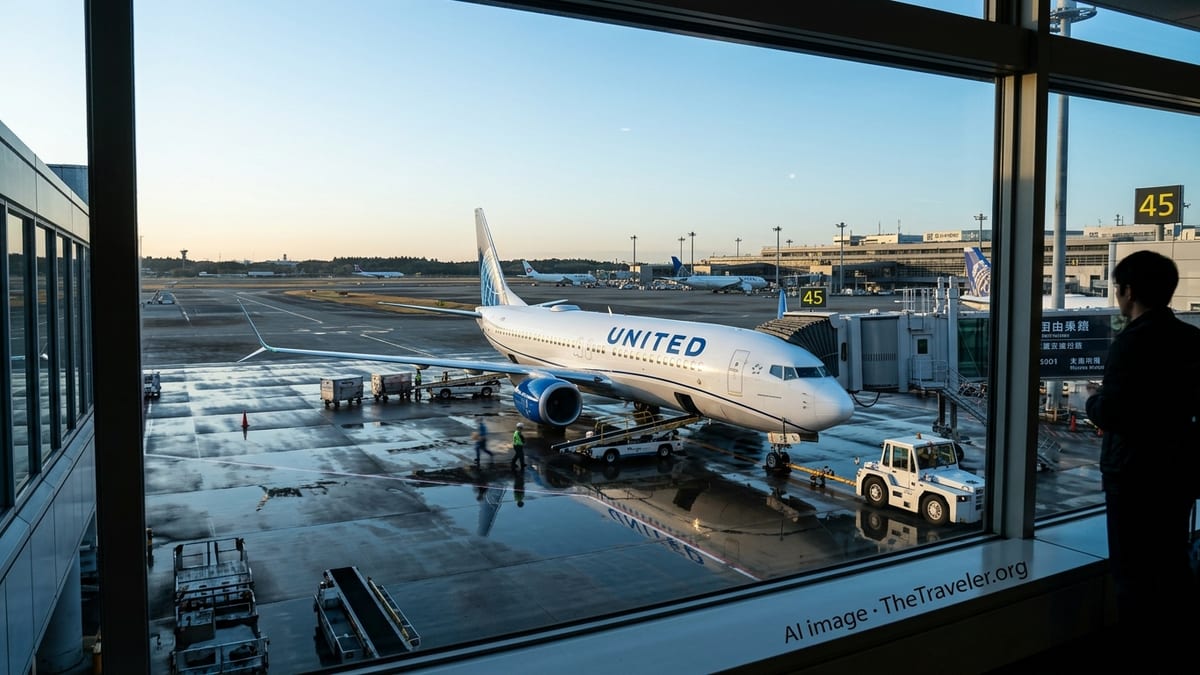
Narita’s Narrowbody Revival Enters the MAX Era
United has been rebuilding its presence at Tokyo Narita over the past two years by turning the airport into a hub for shorter regional flights using single-aisle aircraft. Publicly available information shows that this strategy is now shifting into a higher gear with the introduction of the Boeing 737 MAX 8 on key routes, positioning Narita as a connective bridge between the United States mainland and secondary destinations across the Western Pacific.
Industry schedules and specialist aviation coverage indicate that the first phase of MAX operations centered on United’s Guam base, with aircraft rotations threading through Narita on island-hopping and regional services. These flights, which previously relied on older 737-800s, are being progressively upgraded to the new MAX variant, bringing a different onboard experience and improved economics to a network that has traditionally relied on workhorse narrowbodies.
Analysts note that United’s choice to lean on narrowbody aircraft from Narita is part of a broader trend in long-haul airlines using smaller jets to reach thinner, mid-haul markets. In the case of Narita, the shift is especially visible because the airport once served primarily as a long-haul widebody hub, particularly during the decades when United inherited a large Pacific network from Pan Am.
New MAX 8 Routes Stitch Together the Western Pacific
Recent schedule updates compiled by aviation data sites show that from April 30, 2026, United plans to launch Boeing 737 MAX 8 service from Tokyo Narita to Guam and Ulaanbaatar, adding the new-generation jet to two of its most distinctive regional routes.
The Narita–Guam sector is a backbone of United’s Western Pacific operation, feeding leisure travel, local business demand, and onward connections to Micronesian islands. Deploying the MAX 8 on this route is expected to reduce fuel burn compared with the 737-800 while maintaining a similar overall seat count, allowing United to hold or grow capacity without the same cost exposure.
The seasonal Narita–Ulaanbaatar link to Mongolia’s Chinggis Khaan International Airport stands out as one of the more unconventional 737 markets in the region. Aviation outlets report that United has used narrowbodies on this roughly five-hour route since launch, and shifting it to the MAX 8 underlines the carrier’s confidence in running long, thin sectors from Narita with single-aisle aircraft rather than widebodies.
Other Narita routes in the same regional network include flights to Cebu in the Philippines, Kaohsiung in Taiwan, Saipan in the Northern Mariana Islands, and Koror in Palau. While many of these currently use 737-800s, industry commentary suggests they are candidates for future MAX upgrades as more aircraft arrive in the Guam and Narita pools.
Passenger Experience: Seatback Screens and Island-Hopping Comfort
United’s 737 MAX 8 cabins mark a significant step up from the interiors that have long characterized its Guam and Narita narrowbody fleets. Publicly shared fleet information indicates that these aircraft feature seatback entertainment screens at every seat, Bluetooth audio connectivity, enhanced overhead bins designed to fit one roll-aboard per customer, and expanded extra-legroom seating.
For travelers relying on Narita to connect between the United States and smaller Pacific destinations, these upgrades are likely to be noticeable. The intra-Asia and Micronesia segments that once felt like purely utilitarian add-ons at the end of a long transpacific flight are evolving into a more consistent product, with Wi-Fi, personal screens, and modern lighting found throughout the network.
At the same time, the MAX 8’s cabin layout allows United to maintain a familiar configuration of premium and economy seating similar to that on its 737-800s, balancing comfort expectations with operational flexibility. Aviation analysts point out that this consistency simplifies scheduling and crew deployment between Guam, Narita, and other Pacific points, which often see variable demand patterns driven by tourism seasons, government travel, and local commerce.
Although flight times on some of these routes approach medium-haul lengths, particularly between Narita and destinations like Ulaanbaatar or Cebu, airlines in the region increasingly see modern single-aisle aircraft as suitable for such missions. The MAX 8’s quieter engines and refined interiors may help ease concerns about spending several hours on a narrowbody after a long-haul sector.
Narita’s Role as a Reconfigured Pacific Gateway
Tokyo Narita’s position in the region is being reshaped by these developments. Research from Japanese transport institutes and airport operator announcements highlight Narita’s continued importance as a hub for Asia-Pacific connections, even as more premium-focused long-haul routes consolidate at Tokyo Haneda.
United’s choice to funnel a web of 737-operated routes through Narita effectively recasts the airport as a mid-haul gateway, linking major U.S. hubs such as San Francisco, Los Angeles, Denver, Houston, and Newark with smaller cities around Asia and the Pacific that are not served nonstop from North America. Passengers can connect at Narita between widebody transpacific flights and MAX-operated regional legs without backtracking through other Asian hubs.
Industry observers see this as a pragmatic way to rebuild scale in the Pacific network without relying solely on large twin-aisle aircraft. By pairing Narita’s established infrastructure and slot portfolio with right-sized narrowbodies, United can test and grow markets like Ulaanbaatar, Kaohsiung, and Palau while leveraging Japan’s sizable origin-and-destination demand and strong tourism flows.
This approach also differentiates Narita from nearby Haneda, where access is more constrained and traffic is tilted toward trunk business routes and joint-venture operations with Japanese partners. At Narita, United has more room to experiment with fifth-freedom and regional services that plug into its U.S. gateway network.
Competitive and Regional Implications Across Asia-Pacific
The expansion of United’s 737 MAX 8 operations at Narita arrives at a time when several carriers are recalibrating their Asia-Pacific strategies. Regional news reports describe a wave of new services from Japan to Southeast Asia and the Pacific islands, driven by tourism growth, shifting leisure patterns, and demand recovery after recent global disruptions.
By adding higher-efficiency MAX aircraft to its Narita and Guam bases, United strengthens its claim as a leading U.S. airline in the Pacific while responding to moves by Asian competitors that are also using new-generation narrowbodies to open niche markets. The ability to connect secondary destinations across Micronesia and Northeast Asia via Narita gives the airline a distinctive selling point compared with networks that focus solely on large metropolitan pairs.
For destinations such as Palau, Saipan, or Cebu, Narita’s upgraded role can translate into more reliable year-round connectivity, especially when paired with steady inbound demand from Japan and North America. Tourism boards and local businesses are watching these capacity shifts closely, as air service often has a direct impact on hotel occupancy, tour operations, and investment interest.
As additional 737 MAX 8 aircraft arrive and cycle through Guam and Tokyo, industry watchers expect United’s Narita schedule to continue evolving. The airport that once symbolized the era of jumbo jets and widebody trunk routes is now becoming an intricate narrowbody hub, with the MAX 8 at the center of a renewed push to knit together the Pacific’s far-flung points.