

More news on this day
United Airlines is rolling out its most premium Boeing 787-9 cabins yet to long-haul routes linking the United States with Singapore and the United Kingdom, but passengers eager to try the carrier’s new Polaris suites with privacy doors will have to wait a little longer for the full experience as the doors remain locked pending regulatory approval.
Get the latest news straight to your inbox!
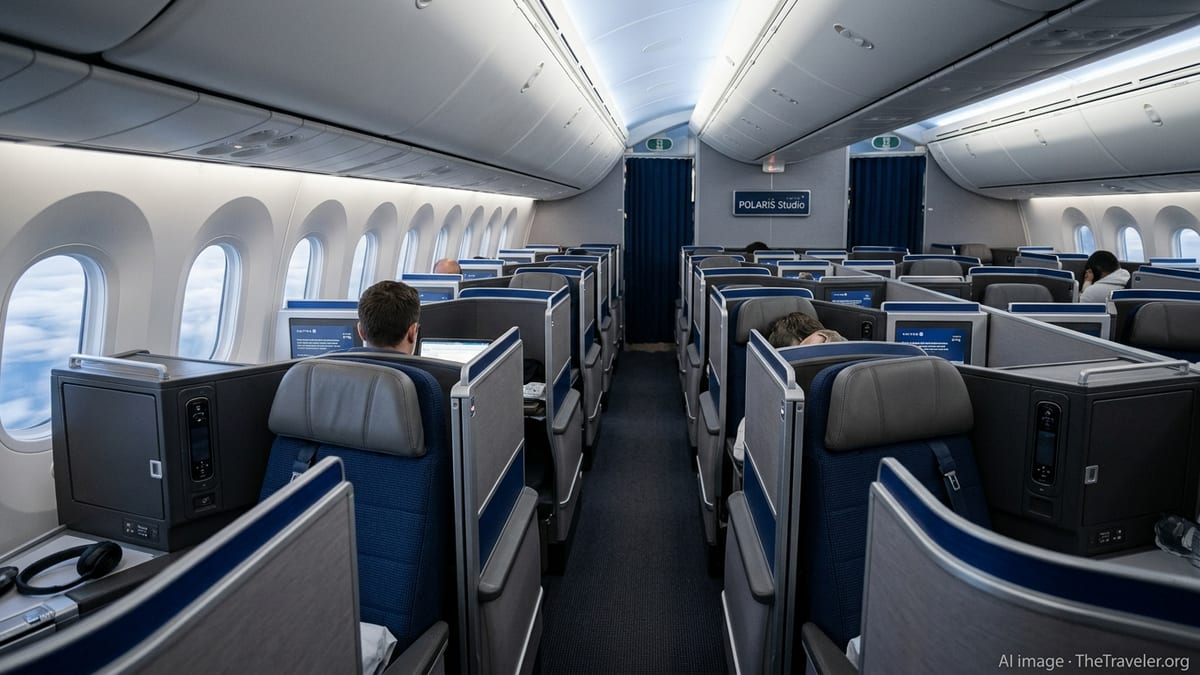
Polaris Studio and Suites Launch on Elevated 787-9
United is introducing an “Elevated” interior on a new batch of Boeing 787-9 aircraft configured with an expanded premium cabin, featuring refreshed Polaris business-class suites, branded Polaris Studio front-row mini-suites, a larger Premium Plus section and updated economy seating. According to publicly available information shared with employees and in trade coverage, these high-density premium 787-9s are designed to become the airline’s flagship for long-haul missions, with more business-class seats and upgraded cabin amenities.
The updated Polaris layout builds on United’s existing staggered 1-2-1 configuration by adding taller privacy surrounds, larger 4K seatback screens and added storage. In the first row of each Polaris cabin, United is marketing extra-large “Polaris Studio” suites with more space, larger ottomans, extra lighting and a dedicated guest seat for in-flight dining or conversation. These Studio seats carry a higher surcharge over standard Polaris, reflecting their positioning at the top of United’s long-haul product range.
Travel-focused discussion forums and early booking screens show that the first of these 787-9s are being scheduled on premium-heavy international routes, including services between major U.S. hubs and London, as well as ultra long-haul flights to Singapore. For travelers in those markets, the aircraft represents a notable step up from older widebodies and from earlier Dreamliner interiors that did not offer suite-style privacy.
Despite the hardware upgrade, one highly anticipated feature is not yet available to passengers: the sliding privacy doors installed at every new Polaris seat. While the doors are physically present in the cabins, public-facing seat information and customer reports indicate that they are currently secured in the open position and cannot be closed during flight.
Doors Installed but Locked Open Pending FAA Approval
United’s choice to fit doors but leave them disabled reflects a broader regulatory landscape in the United States. Under federal aviation regulations, any door installed between a passenger seat and an emergency exit path must meet specific safety criteria, and doors used to create mini-suites in business class typically require an exemption or special conditions. Publicly available regulatory documents for similar mini-suite products on other U.S. carriers show that the Federal Aviation Administration evaluates factors such as evacuation times, crew visibility and emergency access before authorizing the use of such doors in service.
Recent FAA filings and exemption texts related to mini-suite doors on Boeing 787-9 aircraft for other airlines outline the framework under which doors can be permitted. These documents describe partial-height doors that must be locked open for taxi, takeoff and landing, with cabin crew controlling when passengers are allowed to close them in cruise. The same materials emphasize that crew must retain adequate lines of sight into suites and must be able to rapidly unlock or open doors during an evacuation.
In United’s case, customer-facing terms and conditions for the new Polaris Studio product, as cited in traveler discussions, explicitly note that the “privacy door is unavailable” and that the door will remain locked in the open position until approval is granted. Public commentary from frequent-flyer communities suggests that the underlying seat structure is similar to other door-equipped suites already flying with foreign airlines, but that United, like its U.S. competitors, must go through its own FAA review process before enabling the doors in operation.
There is currently no publicly announced timeline for when the FAA may complete certification specific to United’s 787-9 Polaris doors. As a result, passengers booking the new cabins in the near term are being advised by travel commentators to expect an open suite with higher walls and more privacy than legacy Polaris seats, but without a functioning sliding door.
Impact on Premium Routes Linking the U.S., Singapore and the UK
The introduction of these enhanced 787-9s is particularly significant for routes where premium demand is strongest, notably transatlantic services to London and ultra long-haul flights to Singapore. Public schedules and booking tools show that United plans to deploy its high-premium 787-9s on flights from major U.S. hubs such as Newark and San Francisco to London Heathrow, as well as on the carrier’s lengthy U.S.–Singapore sectors where business travelers and high-yield leisure passengers place a premium on rest and privacy.
On these routes, the new Polaris suites are positioned to compete directly with British Airways, Singapore Airlines and other global carriers that already offer enclosed or semi-enclosed business-class products on comparable flights. Many of those foreign competitors operate suites with fully functioning doors, giving travelers a sense of a private room in the sky. United’s move to install doors but operate them locked open in the short term narrows but does not fully close that competitive gap.
Travel industry analysts have noted that even without operable doors, the elevated 787-9 interior gives United a stronger premium proposition than its older cabins. Features such as Bluetooth connectivity at every seat, wireless charging in business class, improved mood lighting and updated finishes are designed to appeal to tech-savvy corporate travelers flying regularly between the United States, the United Kingdom and Asia. However, expectations among frequent flyers are high, and some commentary points to disappointment that the centerpiece privacy feature is not yet functional.
For passengers booking from cities such as New York, Chicago, San Francisco and Houston to London or Singapore, this means carefully reading cabin descriptions and managing expectations. While the seats recline fully flat and the surrounding shells offer more seclusion than previous versions, those seeking a fully enclosed suite will not experience a closing door until regulatory steps are completed and United activates the feature.
Passengers React to a Partial Rollout of the Suite Experience
Reaction from travelers in online forums and social media discussions has been mixed, reflecting both enthusiasm for the new aircraft and frustration over the incomplete suite functionality. Some frequent flyers view the current situation as a reasonable interim step, arguing that larger monitors, improved storage and updated finishes deliver most of the day-to-day comfort benefits regardless of whether the door slides shut. Others see the locked doors as a reminder that the advertised product is not yet fully realized.
Comments from self-described business travelers suggest that on overnight services between the United States and Singapore or the United Kingdom, even incremental privacy improvements can make a difference. Taller sidewalls, less direct line of sight from the aisle and better control over lighting help create a more restful environment, particularly on flights exceeding 12 hours. From this perspective, the elevated Polaris cabin is still a meaningful upgrade compared with earlier Dreamliner interiors.
At the same time, some travelers report adjusting their purchasing decisions accordingly. Discussions on enthusiast boards reference passengers reluctant to pay premiums for the Studio seats until the doors are operational, while others state that they would not choose a longer routing or different departure time solely to experience a suite with a door. The lack of a firm certification date has added to the uncertainty, with prospective passengers unsure whether flights later in 2026 or beyond will offer the fully functional door feature.
For now, customers in the United States, Singapore and the United Kingdom booking United’s new 787-9 Polaris cabins are effectively beta-testing the hardware in an interim configuration. They receive the benefit of modernized seats, technology and design, but the symbolic marker of a next-generation business-class suite, the sliding privacy door, remains tantalizingly out of reach until regulators complete their review and the airline activates the feature in regular operation.
Regulatory Context and What Comes Next
The situation highlights how the race to install business-class suites with doors has outpaced the speed of regulatory review in some markets. Airlines in regions overseen by other aviation authorities have been operating door-equipped suites for several years, setting new benchmarks for privacy on long-haul flights. In the United States, by contrast, airlines introducing similar products on the Boeing 787-9 and other widebody types must align with federal safety regulations that were originally drafted with open cabins in mind.
Public regulatory filings show that U.S. carriers seeking to operate mini-suite doors on 787-9 aircraft typically request targeted exemptions or special conditions addressing specific rules about doors in passenger cabins. These documents detail engineering analyses, evacuation testing and operational procedures that carriers must demonstrate to regulators, from ensuring that doors do not impede egress during emergencies to confirming that crew can monitor passenger well-being even when doors are closed.
Industry observers expect that once one or more U.S. airlines obtain full approval to use mini-suite doors on the 787-9, subsequent certifications may proceed more quickly, as regulators and manufacturers will already have data and precedent to reference. For United, that could pave the way for activating the doors across its fleet of elevated 787-9s, including aircraft serving Singapore and London, turning today’s locked-open partitions into the fully enclosed suites marketed in early renderings and promotional materials.
Until that point, the airline’s newest Dreamliners sit at an interesting crossroads in the evolution of premium travel. They embody much of what travelers expect from a contemporary long-haul business-class product, from direct aisle access and lie-flat beds to modern connectivity and thoughtful cabin design, yet they are still waiting on a final regulatory signoff that will determine whether Polaris can truly join the ranks of fully enclosed suite experiences already flying between the United States, the United Kingdom and Southeast Asia.