

More news on this day
U.S. airports are confronting a new phase of travel disruption as Transportation Security Officers continue working without pay during an extended Department of Homeland Security shutdown, fueling record security lines, mounting flight delays, and renewed questions about how long the system can hold.
Get the latest news straight to your inbox!
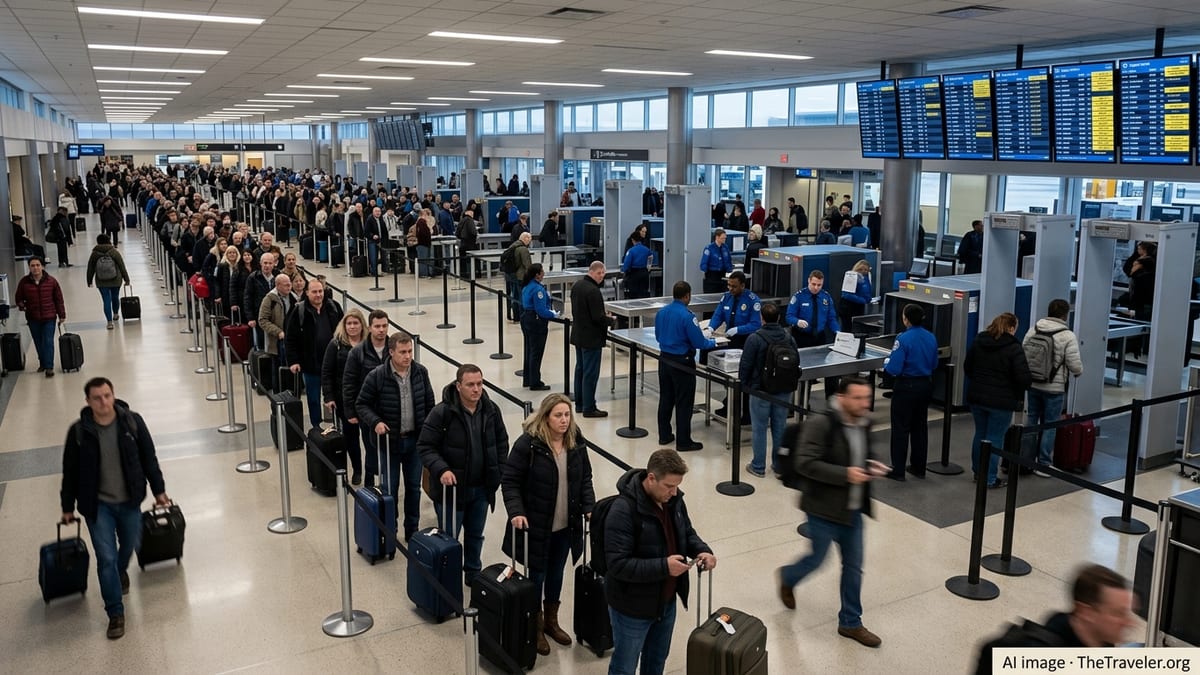
Escalating Delays at Major U.S. Hubs
Operational strain is mounting at some of the country’s busiest gateways as the funding lapse for the Department of Homeland Security extends into late March. Publicly available wait-time dashboards, airline alerts, and media coverage indicate that passengers at hubs such as Atlanta, Denver, New York, and Los Angeles are encountering unpredictable security queues that can stretch well beyond normal peak levels, particularly in early morning and late afternoon bank periods.
Reports from recent days describe periods when individual checkpoints have been temporarily closed or consolidated after staffing rosters fell short, forcing travelers into fewer lanes and pushing lines deep into terminal concourses. While conditions vary by airport and time of day, the pattern is one of volatility: some travelers are still moving through screening in under half an hour, while others face waits of an hour or more as unpaid screeners juggle growing volumes.
Flight operations are beginning to feel the knock-on effects. Industry data trackers and airline updates show an uptick in departure delays attributed to late-arriving passengers from security, as carriers hold boarding for customers trapped in extended lines. In a sector already sensitive to weather and airspace constraints, the added uncertainty around checkpoint throughput is complicating crew scheduling and connection planning.
Travel advisories from airlines, airports, and consumer outlets are increasingly urging passengers to arrive significantly earlier than usual, in some cases recommending a three-hour buffer even for domestic departures. The guidance reflects concern that, with unpaid staff and fluctuating attendance, historic norms for screening times no longer reliably apply.
Unpaid Workforce at the Center of the Crisis
The immediate pressure point is the tens of thousands of Transportation Security Officers who are legally classified as essential and therefore required to report for duty even when DHS appropriations lapse. According to publicly available federal workforce guidance, these employees are guaranteed back pay once Congress restores funding, but they are not receiving regular paychecks during the shutdown period.
Recent reporting notes that TSA screeners have now spent a substantial portion of the past several months either waiting on delayed paychecks or working without current pay, as multiple shutdown episodes and funding lapses have overlapped. Union statements and travel industry briefings describe officers leaning on food banks, emergency grants, and community drives to cover basic expenses while continuing to staff airport checkpoints.
Attrition is emerging as a serious concern. Coverage of internal agency data and union assessments suggests that resignation rates rose after earlier shutdowns, when prolonged uncertainty pushed experienced screeners into better-paying or more stable private-sector roles. Analysts warn that a similar trend during the current standoff could deplete already thin staffing benches and lengthen the recovery once funding resumes.
The situation is complicated by post-pandemic travel patterns, which have pushed leisure demand to record or near-record levels on many routes. A workforce that is larger and somewhat better compensated than during the 2019 shutdown is now tasked with handling heavier passenger volumes, but without the assurance of timely pay.
Shutdown Politics Spill Into the Travel System
The shutdown itself centers on a funding impasse for the Department of Homeland Security, with disputes over immigration and border enforcement once again halting a full-year spending bill. Legislative trackers and political reporting show that competing proposals have circulated in Congress, including efforts to fund TSA and other non-immigration DHS components separately, but none has yet cleared both chambers.
As the standoff stretches past the point when TSA employees miss full paychecks, pressure from travel and tourism interests has intensified. Trade associations representing airports, airlines, and travel businesses have issued public warnings that prolonged disruption at checkpoints could ripple across the broader economy, citing earlier shutdowns that coincided with thousands of delayed or canceled flights and multibillion-dollar losses.
High-profile political interventions have further underscored the stakes. Recent coverage detailed offers from private figures to underwrite TSA salaries temporarily and floated ideas such as deploying personnel from other federal agencies to bolster airport security. Legal and human resources experts note, however, that such measures would face practical and regulatory hurdles, and would not resolve the core issue of lapsed appropriations.
In the meantime, the burden rests on frontline staff and travelers. Messages circulating on worker forums and in public advocacy campaigns highlight unpaid federal employees appealing directly to Congress for a clean funding bill, while passengers take to social media to document hours-long waits and missed flights. The travel system has once again become an arena where the abstract politics of the federal budget are felt in very concrete terms.
Security, Safety, and Morale Under Strain
Airport leaders and aviation analysts are increasingly focused on what the shutdown means for security and safety over time. While there is no public evidence of a systemic lapse in screening standards, subject-matter experts point out that chronically fatigued and financially stressed officers raise questions about long-term performance in a job that depends on sustained vigilance.
Studies of previous shutdown periods, as well as official after-action reviews, have highlighted a combination of higher sick-call rates, overtime fatigue, and training disruptions when pay stops flowing. With TSA already grappling with retention and recruitment challenges, the current funding lapse risks reversing recent gains in staffing stability and experience levels, especially at high-cost urban airports where officers face steep living expenses.
Morale is another critical variable. Public comments from unions and workforce advocates describe a sense of frustration among screeners who are reminded that their roles are essential for national security, yet repeatedly asked to work without timely compensation. Some aviation consultants warn that if even a fraction of the workforce ultimately chooses to leave after the shutdown ends, the agency could face a prolonged rebuilding period marked by longer lines and heavier reliance on new, less experienced screeners.
Existing legal protections, including statutes that guarantee retroactive pay following shutdowns, offer some reassurance that officers will eventually be compensated. However, those safeguards do not address the immediate cash-flow crunch faced by households living paycheck to paycheck, nor do they mitigate the psychological toll of returning to work amid uncertainty about when the next funding lapse might occur.
How Travelers Can Navigate the Turbulence
For passengers planning trips in the coming days, the most visible manifestation of the shutdown is likely to be at the checkpoint entrance. Airport and airline advisories, along with consumer travel guidance, broadly converge on the recommendation to arrive earlier than usual, monitor security wait times via official channels and third-party apps, and build in extra buffers for tight connections.
Travel experts suggest that travelers departing from major hubs or during peak periods should take particularly conservative approaches to timing, as staffing fluctuations can cause conditions to change quickly. Selecting flights earlier in the day, when schedules are less backed up, may help reduce the risk of cascading delays, although some of the sharpest recent lines have also occurred in early morning departure waves.
Passengers with flexibility are being encouraged to consider nonstop routes where possible, reducing the chances that a long security line at one airport will cause missed connections at another. Those who hold TSA PreCheck or similar trusted traveler credentials face their own uncertainty, after DHS signaled that expedited screening programs could be curtailed or paused as resources are reallocated during the shutdown.
Despite the disruption, publicly available reports continue to emphasize that the vast majority of screeners are still reporting for duty, keeping the system functioning under unusually difficult circumstances. For travelers, recognizing that reality translates into practical steps: budgeting more time, preparing for uneven service, and, for many, expressing appreciation to officers who are working through one of the most challenging periods the U.S. aviation security system has faced in years.