

More news on this day
Ural Airlines is accelerating investment in its in-house maintenance, repair and overhaul capabilities for Airbus A320-family and future Boeing 737 aircraft in Russia, positioning its technical base as a cornerstone of fleet reliability at a time when Western sanctions are reshaping the country’s aviation landscape.
Strategic MRO Expansion Under Sanctions Pressure
The decision by Ural Airlines to expand its Airbus A320-family and Boeing 737 maintenance capabilities reflects a broader shift across Russian aviation, where access to Western parts and support has been sharply curtailed since 2022. With foreign maintenance centers and OEM-backed overhaul shops harder to reach, the Yekaterinburg-based carrier is moving to do more of the heavy technical work at home. Executives describe the push as a measured but necessary step to preserve operational flexibility while keeping aircraft flying within safety requirements.
While Ural Airlines currently operates an all-Airbus single-aisle fleet, dominated by A320 and A321 variants, the airline’s long-term fleet plans have consistently referenced Boeing 737 MAX aircraft as part of its growth trajectory. As far back as the mid-2010s, the carrier signaled its intention to build maintenance capabilities for both Airbus and Boeing narrowbodies, including landing gear and structural work for the A320 family with an explicit plan to extend that know-how to the 737. That roadmap is now taking on new urgency as sanctions accelerate the need for domestic solutions.
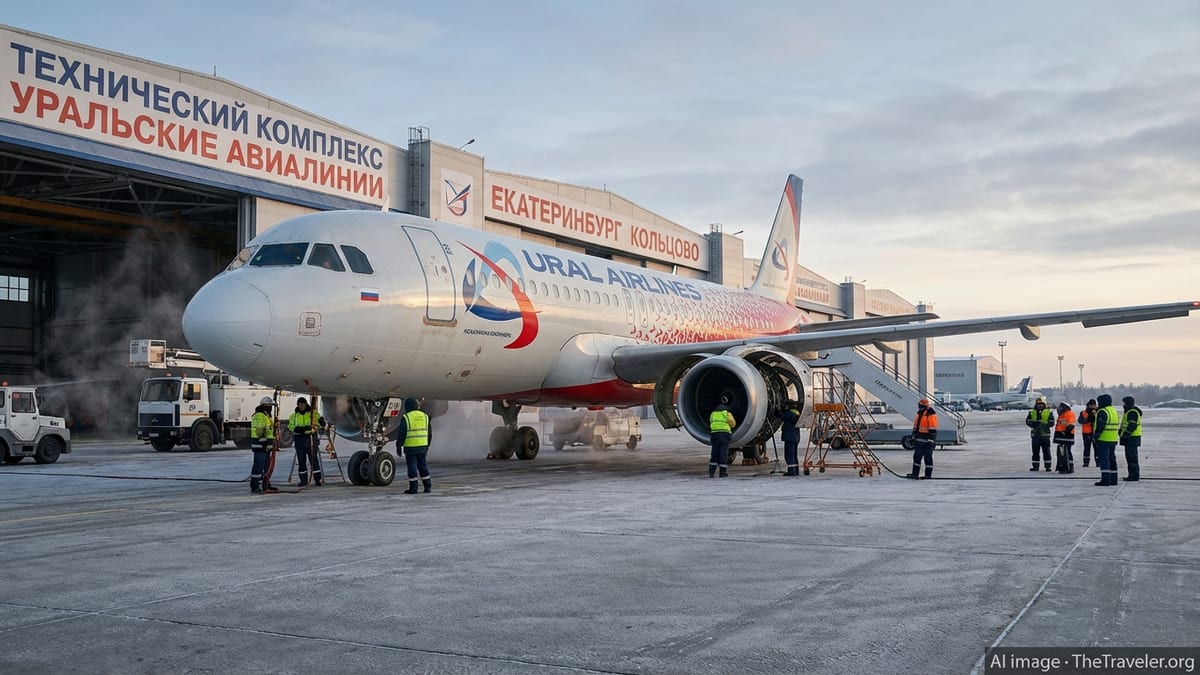
The airline’s technical base at Koltsovo Airport in Yekaterinburg already functions as a multi-purpose MRO hub, conducting line, base and heavy maintenance for its own fleet and select third-party customers. A second base at Moscow Domodedovo and smaller outstations at regional airports supplement the main facility, allowing Ural Airlines to centralize major structural and systems work while supporting day-to-day line maintenance across its network. The current expansion drive is expected to deepen that specialization, particularly in life-extension and component-repair activities for A320-family aircraft, with capabilities that can be adapted for 737 platforms.
Industry analysts note that this strategy mirrors a wider trend among Russian carriers, including Aeroflot, which are investing heavily in local engine and airframe overhaul capacity. In the absence of routine manufacturer-backed support, airlines have turned to a mix of part harvesting, domestic engineering and in-house development to keep their Airbus and Boeing fleets airworthy. Ural Airlines’ decision to push its MRO center to what it calls a new level of technical independence is a prominent example of that shift.
A320 Life-Extension Program Breaks New Ground
The centerpiece of Ural Airlines’ current MRO agenda is an ambitious program to extend the operational life of its Airbus A320-family aircraft beyond 96,000 flight hours. Announced in February 2026, the initiative has been billed by the airline as the first comprehensive domestic scheme of its kind in Russia, involving full structural disassembly, detailed inspection, repair and reassembly of aging narrowbodies. Extensive work is due to begin in the autumn of 2026, using the carrier’s existing maintenance center as the main platform for the heavy checks.
According to the airline, the project is designed as a logical continuation of its technical development over the last decade, rather than a sudden departure from established practices. Ural Airlines’ MRO unit has already built up experience in complex structural work, including major C and D checks, non-destructive testing and corrosion control on A320-family jets. The new life-extension program formalizes those activities into a structured package intended to push the certified life of each airframe beyond thresholds that were previously seen as practical limits for the Russian market.
The life-extension effort is closely tied to the carrier’s broader goal of maximizing the useful life of its Airbus fleet amid uncertainty over future deliveries. With imports of new aircraft constrained, stretching the service life of existing jets offers a way to stabilize capacity without relying solely on domestically produced models that remain in limited supply. For passengers, the airline emphasizes that the program will focus on structural integrity and reliability, with reassembled aircraft undergoing rigorous testing and inspection before returning to service.
However, the initiative has drawn scrutiny from some independent aviation specialists, who warn that extending aircraft life at centers not supported by original manufacturers could add distance from international safety benchmarks. Ural Airlines counters that its engineering teams are working to established maintenance standards, using accumulated data from years of operating the A320 family. Regulators and industry observers will be watching closely as the first life-extension checks get under way, viewing the program as a test case for how far Russian carriers can safely push their existing Western-built fleets.
From Field Dismantling to Structured Component Expertise
Ural Airlines’ current MRO expansion also builds on hard-won experience from high-profile emergencies. In 2023, one of the airline’s Airbus A320s made a widely reported emergency landing in a wheat field in the Novosibirsk region after hydraulic failure and fuel exhaustion forced the crew to bring the aircraft down short of the diversion airport. Initially, there were plans to recover the jet intact, but by 2024 the carrier had accepted that it would be dismantled on site, with salvageable parts removed and reused elsewhere in the fleet.
The painstaking dismantling of the stranded aircraft, which began in earnest in 2024 and continued in stages, gave Ural Airlines’ engineering team unusual hands-on exposure to complete airframe disassembly outside a traditional hangar environment. Technicians removed structural elements, systems and cabin components under challenging field conditions, then transported them for further evaluation and reuse or repair. The airline has since pointed to this experience as contributing to the know-how underpinning its new life-extension and component repair programs.
In public statements, Ural Airlines has said that parts recovered from the field aircraft would be fully re-tested before being installed on other jets, and that damaged components would be repaired using approved techniques where possible. While such part harvesting is not unique to Russia, the high-profile nature of the incident underscored the extent to which carriers are now relying on every available source of spare parts to manage their fleets. The technical lessons from that operation are feeding directly into Ural’s wider efforts to reinforce its component management and repair capabilities.
For regulators and passengers, the key question remains how these experiences are codified into formal procedures, training and quality assurance systems. Ural Airlines’ decision to frame its upcoming life-extension work as a structured, documented program suggests a recognition that ad hoc problem solving is not enough. Instead, the airline is seeking to convert improvised experience into standardized processes that can stand up to regulatory scrutiny and provide a predictable framework for ongoing A320 and future 737 maintenance.
Developing New Workshops for Critical Systems
Alongside structural life-extension, Ural Airlines is investing in a network of specialized workshops for critical aircraft systems. The carrier has announced plans to enhance its capabilities in the repair of fuel, hydraulic and pneumatic systems, all of which are vital to the safe operation of both Airbus and Boeing narrowbodies. Designing and equipping these workshops involves acquiring test benches, tooling and diagnostic equipment that can replicate, as far as possible, the functionality once provided by overseas maintenance partners.
Some of this work has already taken shape in the form of an A320 landing-gear maintenance facility established in 2023, which offers services not only to Ural Airlines but also to third-party operators. The airline has signaled that this facility will be extended to include Boeing 737 landing gear as well, effectively creating a shared competence center for narrowbody landing-gear overhaul within Russia. For an industry grappling with supply-chain challenges, that expansion holds the potential to alleviate bottlenecks in one of the most safety-critical areas of aircraft maintenance.
Fuel, hydraulic and pneumatic components present a more complex challenge, as they depend on precise manufacturing standards and, in many cases, intellectual property controlled by Western suppliers. Ural Airlines has indicated that it is working to develop repair schemes that stay within regulatory frameworks while making greater use of domestic expertise and reverse-engineered solutions where permitted. The airline stresses that each workshop will be subject to internal and external audits, and that components will undergo multiple rounds of testing before being cleared for flight.
These workshops are also expected to support other Russian carriers in the medium term, furthering the carrier’s role as a regional MRO provider. As more airlines look to shift heavy maintenance and component work onshore, Ural Airlines is positioning itself as part of the solution, leveraging its experience with the A320 family to build services that can be adapted to future Boeing 737 fleets and, potentially, to domestically produced narrowbodies as they enter wider service.
Koltsovo Technical Center as a Regional MRO Hub
At the heart of Ural Airlines’ strategy is its Koltsovo-based technical center, which has grown steadily over the last decade from a conventional in-house maintenance unit into a fully fledged MRO provider. The facility already includes a large hangar capable of accommodating multiple A320-size aircraft simultaneously, along with workshops for wheels, brakes, composites and cabin interior equipment. Earlier investments in storage infrastructure and tooling laid the groundwork for the current expansion, allowing the airline to stock critical parts and manage complex checks with shorter turnaround times.
Koltsovo’s central role is complemented by a base at Moscow Domodedovo and technical stations at airports such as Samara and Chelyabinsk, which focus on line maintenance and lighter checks. This distributed model allows Ural Airlines to perform everyday servicing close to where aircraft operate, while channeling more intensive structural and systems work into Yekaterinburg. The model has been particularly important as the airline’s fleet has grown and diversified, with next-generation A320neo and A321neo jets flying alongside older A320ceo and A321 models.
The expansion of MRO capabilities for Boeing 737 aircraft is being planned with this network in mind. While 737s have not yet become a major presence in Ural Airlines’ operational fleet, technical managers have long worked on obtaining approvals and building general competencies that would be transferable between Airbus and Boeing platforms. Given the similarities in mission profile and size between the A320 and the 737, the airline expects to be able to reuse much of its existing infrastructure and experience, while still investing in type-specific tooling, training and documentation.
Regional competitors are watching these developments closely, as carriers across Eastern Europe and Central Asia pursue similar strategies to increase local maintenance capacity. For Ural Airlines, the challenge will be balancing its internal needs for A320 and future 737 support with the potential revenue streams from third-party work. If managed effectively, Koltsovo could emerge as one of the key independent MRO hubs for Western-built narrowbodies still operating in Russia and neighboring markets in the coming years.
Digital Tools and Process Control for Heavy Maintenance
Behind the physical expansion of hangars and workshops, Ural Airlines has spent several years modernizing the digital backbone of its maintenance operations. The carrier adopted a modern MRO and engineering software suite to replace legacy systems, enabling better planning, tracking and documentation of maintenance events across its fleet. That platform, tailored to the needs of airlines that both operate and maintain aircraft for third parties, provides integrated tools for managing work packages, materials, labor and regulatory compliance.
The implementation of this software has allowed Ural Airlines to consolidate previously fragmented maintenance records into a single digital environment. Engineers and planners now have real-time visibility into scheduled and unscheduled work, component histories and airworthiness directives affecting the A320 family. As the airline moves into more intensive life-extension and component repair activities, such traceability is essential for demonstrating that each aircraft and major component has been maintained in accordance with approved procedures.
Digitalization also supports the airline’s ambitions to serve as an MRO provider for other operators of A320-family and, eventually, 737 aircraft. Customers increasingly expect electronic work cards, integrated reliability reporting and seamless data exchange with their own systems. By investing early in modern IT tools, Ural Airlines has positioned its technical center to meet those expectations, while also freeing in-house staff to focus on engineering and product development rather than manual paperwork.
For regulators, robust digital process control can help offset concerns about the absence of OEM-backed oversight, provided that systems are configured to enforce maintenance intervals, capture deviations and flag anomalies. Ural Airlines has portrayed its IT modernization as part of a broader effort to align processes with international best practices, even as it adapts to a more insular maintenance environment shaped by sanctions.
Balancing Safety, Independence and International Standards
The expansion of Ural Airlines’ MRO capabilities for A320 and future Boeing 737 operations is unfolding against a backdrop of heightened safety scrutiny. Independent experts and some industry observers warn that the push for technical self-sufficiency must not come at the expense of adherence to global maintenance standards, especially when life-extension and component repair work is conducted without direct manufacturer support. The airline, for its part, insists that its initiatives are grounded in recognized engineering practices and subject to continuing oversight by Russian authorities.
Maintaining passenger confidence will require transparent communication about how aircraft are maintained, what additional checks are introduced as jets age, and how components repaired domestically are tested and certified. Ural Airlines has described its new programs as a step forward for the domestic aviation industry, emphasizing the depth of experience within its engineering teams and the structured nature of the upcoming life-extension work. Industry observers note that the carrier’s track record of running a large A320-family fleet provides a substantial data set for reliability analysis and maintenance planning.
At the same time, the carrier’s evolving MRO capabilities highlight a broader debate over the long-term sustainability of operating Western-built fleets in a restricted environment. Russia has pledged to accelerate the production and deployment of domestically produced aircraft, but progress has been slower than planned and Western types continue to account for the bulk of capacity at many airlines. In this context, Ural Airlines’ technical center is both a symbol of resilience and a reminder of the structural constraints the sector still faces.
For travelers watching developments from afar, the story is less about the minutiae of workshop tooling and more about whether the aircraft they board will continue to meet rigorous safety expectations. As Ural Airlines moves ahead with life-extension work on the A320 family and prepares to broaden its expertise to Boeing 737s, its ability to combine engineering ambition with transparent, verifiable safety practices will determine how its MRO expansion is perceived both inside Russia and across the wider aviation community.