

More news on this day
Uruguay has confirmed that the Mexican resort town of Playa del Carmen will serve as the national team’s “home away from home” during the group stage of the 2026 FIFA World Cup, a choice that blends elite sporting infrastructure with one of the most powerful tourism brands in the Caribbean.
The decision, ratified in mid January after FIFA approved the facilities, is already rippling through the travel and hospitality sectors of Mexico’s Riviera Maya, positioning the region as one of the off pitch centers of gravity for the tournament that will be co hosted by the United States, Canada and Mexico.
More News
- TSA Rolls Out $45 ConfirmID Fee for Travelers Without REAL ID at Security
- Flying Blue Launches February 25% Promo Rewards on Transatlantic and Regional Routes
- United Fast-Tracks Starlink Wi‑Fi Across Fleet, Free for MileagePlus Members
Strategic Choice: Why Uruguay Looked to the Riviera Maya
For the Uruguayan Football Association, the selection of Playa del Carmen was the result of a structured technical process rather than a branding exercise. Officials evaluated several potential base camp sites across North America before settling on the Mexican Caribbean, weighing logistics, climate, training conditions and the ability to cocoon the squad in a controlled, high performance environment. Sources within the federation describe Playa del Carmen as the only candidate that fully met all predefined criteria.
The choice is also shaped by the profile of Uruguay’s head coach, Marcelo Bielsa, whose reputation for meticulous planning extends far beyond tactics. Since taking charge in 2023, Bielsa has insisted that travel times, recovery routines, and the psychological comfort of players are as decisive as formations and pressing triggers. A base that combines short flight connections with stable weather, modern medical facilities and minimal external distractions aligned closely with his philosophy.
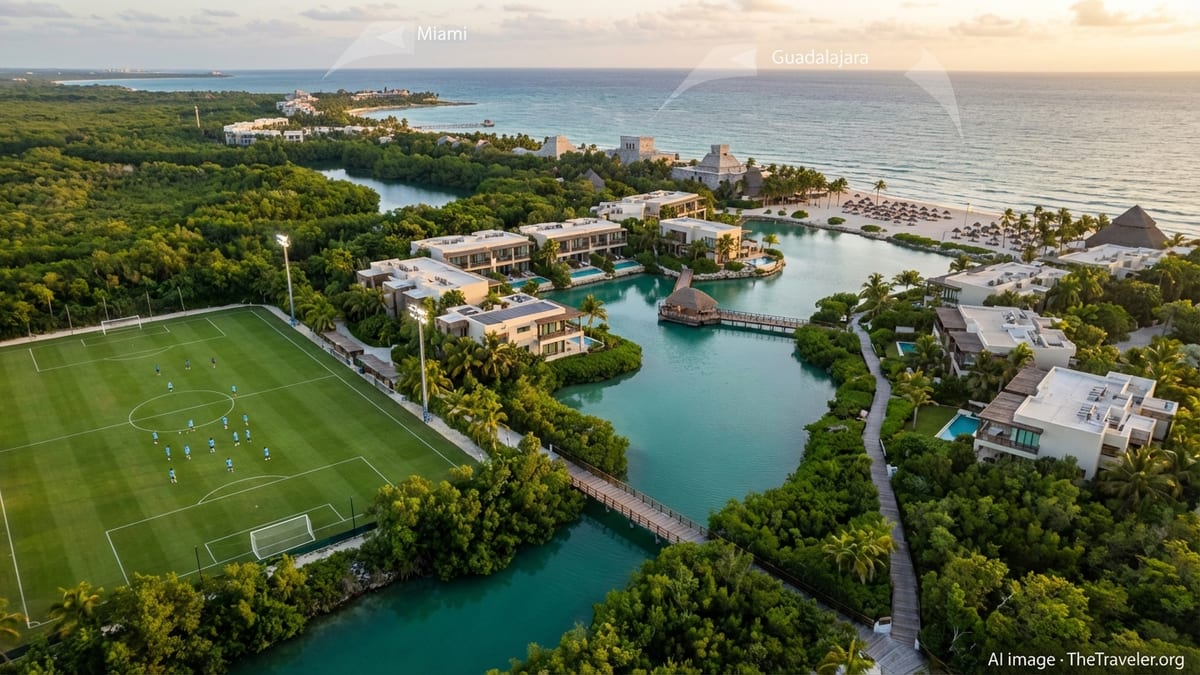
Geography played to Playa del Carmen’s advantage. Uruguay’s opening two group matches will be staged at Hard Rock Stadium in the Miami area, with a final group game in Guadalajara. Direct flights from nearby Cancún offer journey times of around 80 minutes to Miami and just over two hours to Guadalajara, allowing the team to train and rest in one location while avoiding the fatiguing city to city hopping that has hampered past campaigns.
Inside Uruguay’s Base: Fairmont Mayakoba and Mayakoba Training Centre
At the heart of Uruguay’s World Cup setup is the Fairmont Mayakoba, a luxury resort nestled amid mangroves, lagoons and Caribbean coastline within the gated Mayakoba development. The property has been vetted and cleared by FIFA as an official Team Base Camp for 2026, one of only two such sites in Quintana Roo, underscoring the level of infrastructure and security demanded for top national sides.
The hotel will be configured as a high security enclave for the Uruguayan delegation, with entire wings reserved for players, coaching staff and support teams. Meeting rooms will double as tactical analysis suites, while spa and wellness areas are being integrated into daily recovery protocols. The objective is to merge five star comfort with the rhythm of an elite training camp, rather than a leisure resort.
Training sessions will take place at the nearby Mayakoba Training Centre Cancún, an installation designed specifically for high performance sport. The facility is equipped with FIFA standard pitches, advanced lighting for evening sessions, strength and conditioning gyms and specialist spaces for tactical drills. Medical and rehabilitation areas, including hydrotherapy pools and treatment rooms, are embedded within the same complex, cutting down transit times and allowing staff to manage workloads in fine detail.
By consolidating accommodation, training and medical support in a single integrated ecosystem, Uruguay is seeking to avoid the fragmented setups that national teams often face at major tournaments. The ability to move from hotel room to training ground to recovery suite without leaving a controlled zone is viewed internally as a competitive advantage in a month long competition.
Defeating U.S. Cities: The Bidding Battle Behind the Decision
Uruguay’s presence on the Riviera Maya is particularly significant given that several high profile U.S. cities were on the original shortlist. Tampa, Atlanta, Boca Raton and Austin were all evaluated as possible bases, reflecting the initial expectation that a South American side drawn to play in the United States might prefer to camp on U.S. soil. Each offered strong stadium facilities, established training centers and robust air links.
In the end, these contenders fell short on one central metric: integration. For federation officials, having to mix separate hotels, municipal training grounds and off site recovery services created logistical friction. Even when distances were short on paper, factors such as traffic patterns, availability of exclusive use, and the need for enhanced security perimeters weighed against an urban U.S. base.
Playa del Carmen, by contrast, provided a master planned environment where accommodation, training pitches, gymnasiums and medical resources could all be brought under a single operational umbrella. For Bielsa and his staff, reducing variables in the daily routine was more important than the symbolism of basing in a host country where group matches are played. The decision reflects a broader shift at World Cups, where national teams increasingly treat base camps as performance laboratories rather than simple hotels.
Tourism and Hospitality Windfall for Playa del Carmen
Confirmation that Uruguay will anchor itself in Playa del Carmen has been greeted enthusiastically by local tourism authorities and hotel operators. The Riviera Maya is already one of Mexico’s most visited regions, known for its all inclusive resorts, beaches and archeological sites, but the World Cup adds a new layer of global exposure. Having a two time world champion and one of South America’s most followed teams in residence amplifies the destination’s brand across sports media as well as traditional travel outlets.
While the Uruguayan squad and staff will be cloistered inside a secure bubble, their presence is expected to attract a significant contingent of supporters, particularly during the group stage. Many fans are likely to split their stays between Miami, Guadalajara and Quintana Roo, using Playa del Carmen as a leisure base before and after matches. Operators anticipate increased demand not only for hotels, but also for excursions to nearby cenotes, Mayan ruins and reef tours.
Local businesses are already preparing for a month characterized by national colors, fan events and televised match screenings. Bars, beach clubs and restaurants are positioning themselves as unofficial fan hubs, while tour companies expect to bundle World Cup themed packages that combine viewing parties with day trips along the coast. For Playa del Carmen, the event is less about stadium construction and more about maximizing the soft power of hosting a high profile team.
The impact will likely extend beyond July 2026. In similar cases from previous World Cups, destinations that hosted teams have continued to leverage that association in their marketing long after the final whistle. Imagery of players training on Riviera Maya pitches or relaxing by Caribbean lagoons can easily be repurposed into campaigns targeting Latin American and European travelers, markets where Uruguay’s national team commands passionate followings.
Balancing Privacy, Security and Fan Access
Hosting a World Cup team in a major tourism corridor raises complex questions about privacy and crowd management. The Fairmont Mayakoba and the wider Mayakoba development offer clear advantages in this area, with controlled access points, private internal roadways and ample space to create secure perimeters without disrupting other guests. Dedicated security personnel, in coordination with local authorities and FIFA protocols, will manage access to the team’s residential and training zones.
This does not mean that Uruguay’s presence will be invisible. Experience from previous tournaments suggests that team buses, escorted arrivals at airports, and occasional open training sessions can become attractions in their own right. The challenge for organizers in Quintana Roo will be to curate moments where supporters and media can engage with the team while ensuring that player routines remain uninterrupted and that crowd flows do not overwhelm local infrastructure.
For travel planners and tour operators, this balance is critical. Packages built around the idea of “sharing a city” with Uruguay must be transparent about the limits of access to players and official events, focusing instead on atmosphere, shared public screenings, and the wider festival of football. Clear communication will help avoid unrealistic expectations and ensure that visitors’ experiences are framed around the destination rather than backstage glimpses of elite athletes.
Riviera Maya’s Rising Profile in Global Sports Tourism
Uruguay’s decision arrives at a moment when the Riviera Maya is consolidating its position as a serious player in global sports tourism. Over the past decade, the region has hosted professional golf tournaments, international tennis exhibitions and mass participation endurance events, using its combination of climate, connectivity and hospitality capacity as a selling point for organizers.
Being selected as a World Cup Team Base Camp marks a step change in that trajectory. FIFA’s technical requirements for pitches, medical facilities, accommodation standards and security are stringent, and passing that audit sends a powerful signal to other federations, confederations and clubs considering overseas training camps. The same features that appeal to a national side preparing for a World Cup can attract pre season tours, youth academies and corporate sports retreats.
Local authorities in Quintana Roo are keenly aware of this leverage. Positioning the state as a specialist in hosting high performance environments opens the door to diversification beyond sun and beach tourism. Over time, investment in training infrastructure can serve residents as well, from local clubs to community sports programs, reinforcing the idea that mega events should leave more than just a marketing legacy.
What This Means for Traveling Fans
For supporters plotting their World Cup itineraries, Uruguay’s base camp adds a compelling option to the mix. Fans who secure tickets for the Miami and Guadalajara fixtures will likely pass through major hubs in the United States, but many are expected to incorporate a Riviera Maya segment into their plans. With international flights into Cancún and robust ground links to Playa del Carmen, it is relatively straightforward to design multi stop trips that combine urban match days with coastal downtime.
Travel advisors are already emphasizing considerations such as June heat and humidity, both in Florida and on the Caribbean coast, urging visitors to build in rest days and prioritize hydration and shade. The climatic similarities between Miami and Playa del Carmen, which are seen as an advantage for player acclimatization, also apply to fans who may not be used to high temperatures around afternoon and early evening kick offs.
Accommodation strategies will vary. Some supporters may choose to remain in Miami for the duration of the group stage, taking a shorter post tournament break in Mexico. Others will invert that pattern, using Playa del Carmen as the main base and flying into the United States for matches before returning to the coast. In all cases, early booking is likely to be rewarded, particularly at mid range hotels near public transport and key fan gathering areas.
FAQ
Q1: Why did Uruguay choose Playa del Carmen as its base for the 2026 World Cup?
Uruguay selected Playa del Carmen because it offers an integrated environment where hotel, training facilities, medical services and security can be managed within a single, controlled complex, reducing travel fatigue and logistical complications for players and staff.
Q2: Where exactly will the Uruguayan team stay during the tournament?
The national team will be based at the Fairmont Mayakoba, a luxury resort inside the Mayakoba development near Playa del Carmen, which has been certified by FIFA as an official Team Base Camp for the 2026 World Cup.
Q3: Where will Uruguay train while based in Playa del Carmen?
Training sessions and preparation work will take place at the Mayakoba Training Centre Cancún, a high performance facility equipped with FIFA standard pitches, gymnasiums and dedicated recovery areas tailored to elite football.
Q4: How close is Playa del Carmen to Uruguay’s group stage venues?
From nearby Cancún International Airport, flight times are roughly 1 hour and 20 minutes to Miami, where Uruguay’s first two matches will be played, and a little over two hours to Guadalajara, where the team will close out its group schedule.
Q5: Which other locations were considered before Playa del Carmen was chosen?
The Uruguayan Football Association evaluated several U.S. cities, including Tampa, Atlanta, Boca Raton and Austin, but ultimately judged that Playa del Carmen provided a more cohesive and controllable base camp environment.
Q6: Will fans be able to visit the team’s hotel or training sessions?
Access to the hotel and training center will be heavily restricted for security and performance reasons, with the area around the team base operating as a closed camp. Any open events or public training sessions would be specifically announced closer to the tournament.
Q7: How will Uruguay’s presence affect tourism in Playa del Carmen?
The team’s residency is expected to attract additional visitors, particularly Uruguayan and South American supporters, boosting demand for hotels, restaurants, excursions and fan experiences throughout the Riviera Maya during the tournament period.
Q8: Is Playa del Carmen an official World Cup host city?
Playa del Carmen is not a match host city, but it has been designated by FIFA as a Team Base Camp location, meaning it will serve as an operational and training hub for Uruguay during the group stage of the 2026 World Cup.
Q9: Why is Marcelo Bielsa seen as influential in this decision?
Head coach Marcelo Bielsa is known for meticulous attention to detail and has long argued that logistics, rest and recovery are fundamental to performance, so the selection of a highly integrated, low friction base aligns closely with his technical and conditioning priorities.
Q10: What should traveling fans know if they plan to include Playa del Carmen in their World Cup trip?
Fans should anticipate hot and humid June conditions, book accommodation early, and factor in flight connections between Cancún, Miami and Guadalajara, allowing time for rest days on the coast to balance intense match day experiences with the destination’s beach and cultural offerings.