

More news on this day
U.S. air travel is bracing for deeper disruption as a partial federal government shutdown stretches into its fourth week and chief executives at major airlines issue stark warnings that the standoff in Washington could push the nation’s aviation system toward full-scale chaos.
Get the latest news straight to your inbox!
CEOs Sound Alarm Over Mounting Shutdown Risks
Leaders of several large U.S. carriers are publicly pressing Congress to restore funding for key aviation and security agencies, warning that the current partial shutdown has already strained the system and could soon trigger cascading operational failures. According to published coverage of a joint appeal delivered on Sunday, March 15, airline chiefs urged lawmakers to move quickly to pay tens of thousands of airport security officers and other federal workers who have been reporting for duty without pay for nearly a month.
Reports indicate that executives are particularly concerned about the Transportation Security Administration and other Department of Homeland Security functions that underpin airport screening and border operations. With federal paychecks disrupted since mid-February, analysts note that continued financial uncertainty for front-line staff increases the risk of higher absenteeism, longer passenger queues and reduced capacity just as the spring break travel surge accelerates.
Aviation trade associations have spent the past year warning that repeated funding lapses are eroding the resilience of the system. Industry letters to Congress in 2025 highlighted that air travel and related tourism contribute more than a trillion dollars to the U.S. economy annually, and argued that even short shutdowns reverberate through airlines, airports, hotels and local businesses long after government operations resume.
Long Lines, Flight Cuts and Stranded Travelers
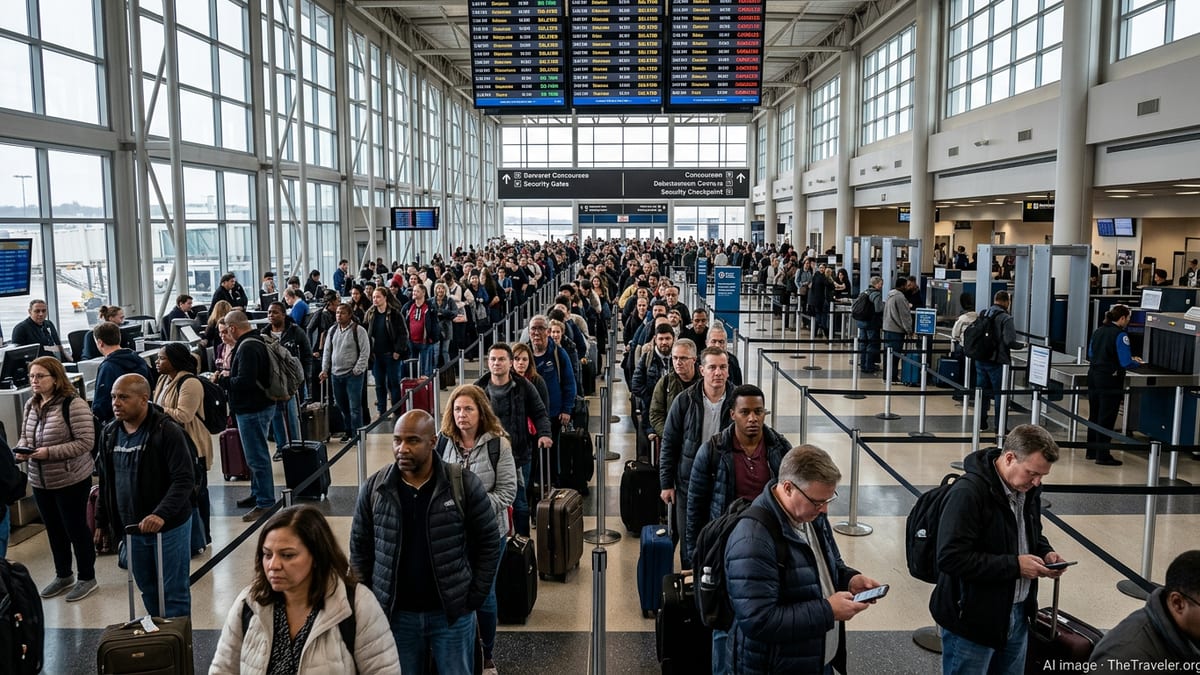
Travelers are already seeing the impact at airports nationwide. Recent coverage from multiple outlets describes security lines stretching into parking structures and baggage halls, with reported waits of up to five hours at some hubs as the shutdown squeezes staffing and overtime. Airport officials have warned that these scenes could become more common if the impasse continues and more federal workers decide they cannot keep working without pay.
At the same time, previously issued Federal Aviation Administration directives tied to the broader budget turmoil have mandated capacity reductions at dozens of high-traffic airports. During the 2025 shutdown, the FAA ordered airlines to cut several percentage points of daily flights at major hubs to ease pressure on short-staffed air traffic control centers. Analysts note that a similar pattern is beginning to re-emerge, with flight reductions and schedule thinning used as tools to maintain safety even as demand remains strong.
For passengers, the practical effect is fewer available seats and more crowded remaining flights, making it harder to rebook when cancellations occur. Consumer advocates point out that when disruptions stem from government actions rather than airline operations, carriers are generally required to refund canceled tickets but are not obligated to cover hotel stays or meals, leaving many travelers to absorb additional costs.
Essential Workers Under Strain Across TSA and FAA
Under current shutdown rules, most employees at the TSA and FAA are classified as essential, meaning they must continue working even when appropriations lapse. Publicly available information shows that screeners, air traffic controllers, federal air marshals and safety inspectors are still on duty, but new hiring, much of the training pipeline and a range of back-office functions are either paused or sharply curtailed.
Union statements and previous government contingency plans indicate that more than 50,000 TSA officers, along with thousands of FAA personnel, are affected by delayed pay. During the 2025 funding lapse, similar conditions led to spikes in unscheduled absences among security officers and increased fatigue among air traffic controllers, contributing to a rise in delays and occasional ground stops at busy airports. Industry observers warn that a repeat of those trends this spring could overwhelm already tight schedules.
Beyond immediate staffing concerns, aviation groups have emphasized that prolonged shutdowns stall critical long-term work, including air traffic control modernization, new controller training at the FAA Academy and safety inspections of aircraft and facilities. Business aviation advocates and airline lobbyists have cautioned that each week of lost training time creates backlogs that can take months to clear, keeping the system more fragile even after funding is restored.
Economic Stakes for Airlines, Tourism and Local Communities
The economic consequences of extended disruption are substantial for both carriers and the wider travel sector. During the 43-day funding lapse in 2025, airlines and tourism businesses tallied losses in the billions of dollars as capacity cuts, weaker bookings and passenger uncertainty rippled across the country. Reports from that period show that some major airlines trimmed schedules at key hubs, suspended certain routes and saw reduced demand from business travelers wary of getting stranded.
Travel industry estimates at the time suggested that a nationwide shutdown impacting aviation could drain roughly a billion dollars a week from the broader economy, a figure that encompasses not only ticket revenue but also hotel stays, restaurant spending, ground transportation and related services. With today’s shutdown coinciding with the start of the peak spring break season, tourism boards in popular destinations are closely watching booking patterns for any sign that travelers are postponing or canceling trips.
Local economies that depend heavily on visitor spending are particularly exposed. Airport towns, coastal resorts and national park gateways can experience a rapid downturn when flight schedules are unstable or when lengthy security lines discourage last-minute travelers. Industry groups argue that this volatility underscores the importance of insulating aviation funding from broader political disputes to avoid using travel infrastructure as leverage in budget negotiations.
What Travelers Can Expect in the Weeks Ahead
For now, commercial flying in the United States continues, but passengers should prepare for a less predictable experience as long as the shutdown persists. Travel analysts expect rolling pockets of disruption rather than a single nationwide breakdown, with conditions varying widely by airport, time of day and local staffing levels. Some facilities that employ private contractors for screening under federal oversight may see fewer immediate impacts, while others reliant on federal staff could experience recurring surges in wait times.
Airlines are adjusting operations day by day, trimming flight frequencies in the most constrained markets and issuing travel waivers that allow customers to move trips without change fees when schedules shift. Published airline notices emphasize that safety remains the overriding priority, and that carriers are coordinating with federal partners to respond to capacity limits and route changes.
For travelers planning near-term journeys, experts recommend building extra time into itineraries, monitoring flight status closely and being prepared for rebooking if connections are tight. While the exact trajectory of the shutdown remains uncertain, the increasingly urgent messages from airline CEOs highlight a shared concern across the industry: unless a funding agreement is reached soon, the pressure on America’s air travel system could intensify sharply, turning localized headaches into the kind of nationwide chaos that millions of passengers remember from previous political standoffs.