

More news on this day
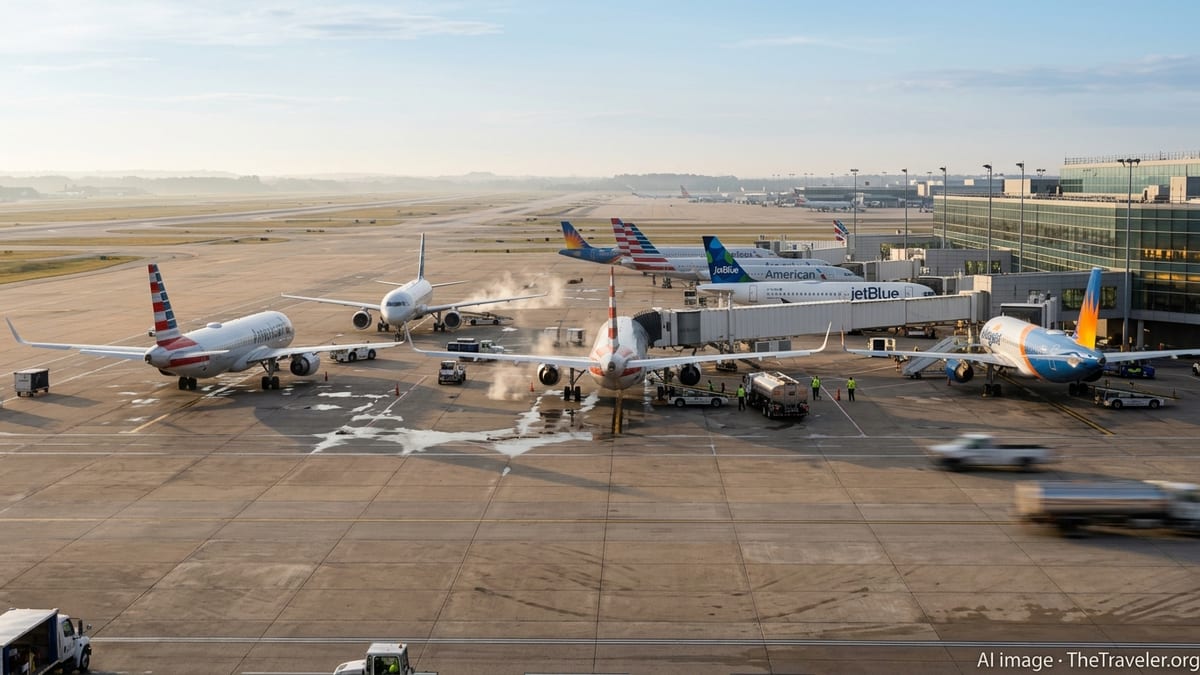
America’s biggest and mid-sized carriers are confronting a sharp rebound in jet fuel costs just as they emerge from several years of post‑pandemic rebuilding, pushing airlines including American, JetBlue and Allegiant to lean harder into aggressive fleet modernization plans designed to trim fuel burn and protect fragile profit margins.
Get the latest news straight to your inbox!
Fuel Costs Rebound as Travel Demand Stays Strong
Recent industry data and news coverage indicate that jet fuel prices have jumped in early 2026, driven largely by turmoil in global oil markets linked to renewed conflict in the Middle East. Reports describe traffic through key shipping chokepoints being disrupted, lifting crude benchmarks and, in turn, wholesale aviation kerosene costs just as airlines head into the peak summer planning period.
Jet fuel is typically one of the largest line items on a carrier’s income statement, often representing roughly a quarter of total operating expenses for United States passenger airlines. Publicly available government statistics for 2025 showed fuel sitting just behind labor as a share of costs, underscoring how even relatively small moves in per‑gallon prices can swing quarterly earnings for a low‑margin industry.
Analysts tracking the sector note that many airlines sold a significant portion of their 2026 capacity months ago, based on fuel assumptions that are now being tested by the latest spike. Research commentary from financial firms in mid March 2026 points to revised forecasts that build in higher fuel through at least the second quarter, warning that unanticipated jumps in costs can quickly erode thin operating margins if carriers are slow to pass them through to fares.
For now, consumer demand remains resilient. Coverage of recent investor presentations by major United States airlines, including American, describes record advance bookings and strong long‑haul traffic, which are helping offset higher fuel outlays. But with jet fuel now rising from the more benign levels seen for much of 2025, attention across the industry is turning back to structural ways to reduce consumption per seat, from denser cabins to new‑generation aircraft.
American Airlines Leans Into Fleet Renewal Amid Cost Pressures
American Airlines enters this fuel‑price upswing after several years of balance sheet repair and operational fine‑tuning, but its public filings and recent commentary still stress the sensitivity of its business to energy markets. In mid 2025 regulatory disclosures, the company highlighted that periods of high volatility in fuel costs or disruptions in supply could significantly affect its financial results, reiterating that fuel remains one of the “uncontrollable” variables it must plan around.
American has responded by advancing one of the most extensive fleet renewal programs among legacy United States carriers. The airline has been steadily retiring older, less efficient types while taking delivery of new Airbus A321neo and Boeing 737 Max family aircraft that promise double‑digit improvements in fuel burn per seat versus previous generations. Public information on manufacturer data and independent technical analysis suggests that such models typically deliver savings in the range of 15 to 20 percent relative to aging narrowbodies.
At the same time, American is investing heavily in digital tools and operational initiatives intended to squeeze more value out of each gallon. Trade association and industry reports describe the carrier using advanced forecasting to fine‑tune block times, crew scheduling and flight planning, measures that can trim minutes of flight time and incremental fuel consumption across a large network. These efforts are increasingly important as the airline seeks to shield its cost base without sacrificing schedule breadth that is critical to its hub‑and‑spoke strategy.
Still, higher fuel prices add another headwind to American’s efforts to restore consistent profitability after a period of elevated debt and wage inflation. Research notes and earnings summaries from late 2025 describe ongoing cost pressures even as fuel temporarily eased that year. With jet fuel now climbing again, American’s push to accelerate the replacement of older jets with more efficient aircraft looks set to remain at the center of its strategy.
JetBlue’s Cost Squeeze Meets an Overdue Fleet Overhaul
JetBlue Airways is feeling the fuel shock from a different position. In 2025 the carrier was already battling rising non‑fuel unit costs and operational constraints tied to engine inspections on part of its Airbus narrowbody fleet. Company results published in early 2026 for the fourth quarter of 2025 show that its cost per available seat mile excluding fuel increased more than 6 percent year over year, even as the airline worked to rein in spending under a multiyear transformation program.
The latest climb in fuel prices adds to that pressure and increases the urgency of JetBlue’s move to simplify and modernize its fleet. In late 2025 and early 2026, the airline disclosed definitive agreements to sell its remaining Embraer E190 jets, a small subfleet that has become expensive to maintain, while focusing around Airbus A320 family aircraft, including more fuel‑efficient A321neo variants. Industry analyses describe these newer models as offering substantial fuel savings alongside more seats, an attractive combination as the airline seeks to improve margins on transcontinental and leisure‑heavy routes.
JetBlue’s broad restructuring effort, branded internally as JetForward, aims to reset the cost base through a mix of fleet changes, network adjustments and overhead reductions. Public coverage indicates that the carrier is trimming underperforming routes, densifying some aircraft and investing in technology upgrades, including more modern cabins that can drive higher ancillary revenue per seat. All of this is happening against a backdrop of elevated fuel and financing costs, which make execution risk particularly high.
For travelers, the shift may be visible in fewer smaller jets on secondary routes and more high‑capacity, long‑range narrowbodies on core leisure corridors. The carrier has also announced plans to introduce a new domestic first‑class product on a portion of its fleet from 2026, a move that could help support yields as operating expenses, especially fuel, trend higher.
Allegiant Bets on Boeing 737 Max to Cut Fuel Burn
Ultra‑low‑cost carrier Allegiant Air is also in the midst of a significant fleet transformation that is explicitly tied to fuel efficiency. Historically reliant on older Airbus A319 and A320 aircraft acquired at low purchase prices, the airline built a business model around limited‑frequency, point‑to‑point flying from smaller United States cities to leisure destinations. That strategy kept ownership costs low but left Allegiant more exposed to swings in fuel prices, since its older jets burn more per seat than the latest generation of narrowbodies.
In recent years the company has shifted course, placing a large order for Boeing 737 Max 8‑200 aircraft and beginning deliveries in 2025. Trade publications and investor presentations describe early results as promising, with the new jets delivering fuel burn reductions of around 20 percent compared with Allegiant’s legacy Airbus fleet. The airline has been gradually increasing the number of 737 Max aircraft in service while accelerating retirements and sales of its oldest A319 and A320 airframes.
Allegiant has signaled through public statements and guidance that it expects the growing 737 Max subfleet to be a major earnings driver in 2026 and beyond, particularly if fuel prices remain elevated. Lower per‑seat consumption can translate into a meaningfully lower cost base on long, thin leisure routes, allowing the airline either to preserve rock‑bottom fares or to rebuild margins that have been pressured by rising labor, maintenance and airport costs.
Analysts also note that a younger fleet can improve reliability and enhance the customer experience, both of which support revenue at a time when travelers have more choice of low‑cost competitors. For Allegiant, the fuel spike reinforces the strategic logic of its large, long‑dated 737 Max commitment and its pivot away from a reliance on aging, inexpensive aircraft.
Industrywide Shift Toward Next‑Generation, Lower‑Carbon Fleets
The experiences of American, JetBlue and Allegiant are part of a broader pattern across the United States airline sector as companies respond to volatile fuel prices, tightening environmental expectations and evolving traveler preferences. Industry groups, manufacturers and lessors all report that demand for new‑generation narrowbodies such as the Airbus A320neo family and Boeing 737 Max remains strong, with airlines seeking double‑digit fuel savings and lower maintenance costs even as supply chain and engine issues complicate deliveries.
Fleet modernization is not only a hedge against fuel shocks but also a key tool in meeting emerging climate targets. Global aviation bodies estimate that sustainable aviation fuel will remain far more expensive than conventional jet fuel for years, making efficiency gains on the aircraft side one of the few immediately economical ways for airlines to reduce emissions per passenger. New aircraft typically pair improved aerodynamics and lighter materials with advanced engines, yielding both lower fuel burn and smaller carbon footprints.
At the same time, there are trade‑offs. New jets carry higher ownership or lease costs, and financing them in a higher‑interest‑rate environment can strain balance sheets. Airlines that commit to aggressive fleet renewal must manage cash flow, pilot training and operational complexity, particularly when multiple aircraft types and engine variants are in play. The latest fuel spike could encourage some carriers to double down on orders while deterring others that are more capital‑constrained.
For travelers, the combined effect of rising fuel costs and large‑scale fleet renewal may be felt in gradually higher base fares, more fees and denser cabins, even as onboard products become quieter, brighter and more technologically advanced. With fuel once again front and center, airlines across the spectrum, from full‑service giants like American to niche players such as JetBlue and Allegiant, are betting that newer, more efficient aircraft are the best defense against an unpredictable energy market.