

More news on this day
A dramatic emergency evacuation of a United Airlines Boeing 787 at Los Angeles International Airport is reverberating far beyond California, as regulators in the United States move in step with counterparts in the United Kingdom, Canada, and Australia to spotlight aviation safety and reassure a jumpy traveling public.
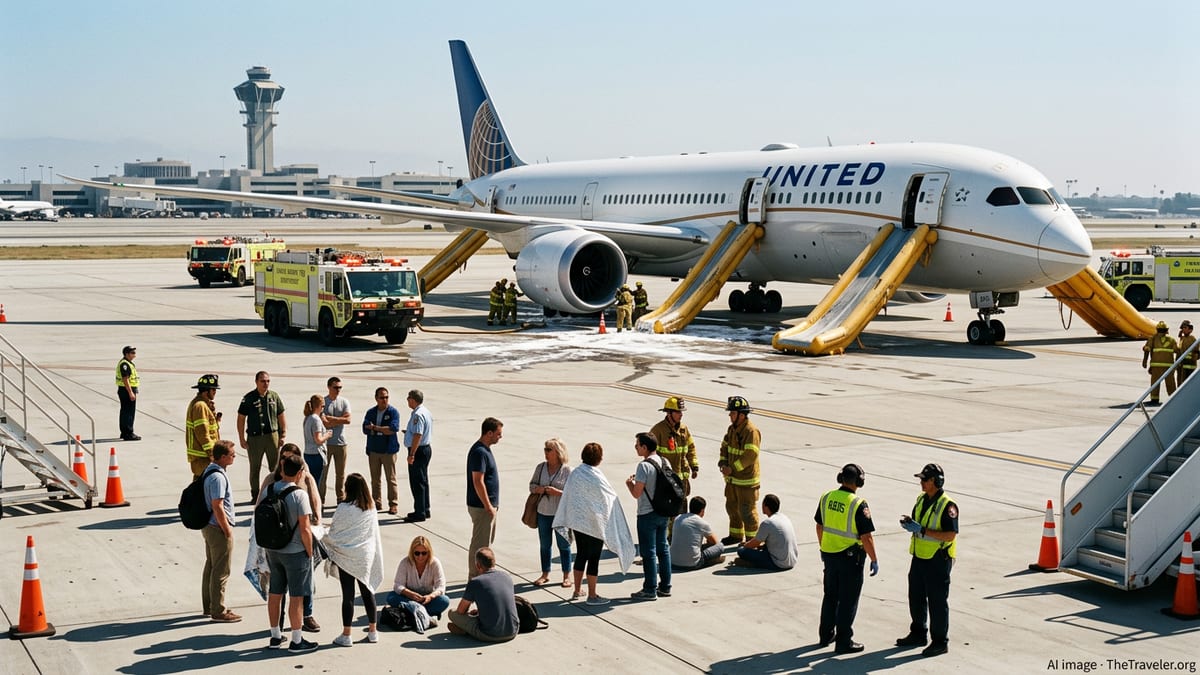
Emergency Return and Slide Evacuation at LAX
The incident unfolded on Monday, March 2, when a United Airlines Boeing 787-9 bound for Newark returned to Los Angeles International Airport about 40 minutes after departure following reports of a possible engine fire. The widebody jet, carrying more than 250 passengers and crew, landed safely and came to a stop on a taxiway while emergency services surrounded the aircraft.
Passengers were ordered to evacuate using inflatable slides and stairs as fire crews inspected the engine area and confirmed the fire was contained. According to airport and airline statements, there were no serious injuries, though several travelers reported burns and bruises consistent with high-speed slide evacuations, a reminder of the physical risks inherent even in successful emergency responses.
The Federal Aviation Administration briefly halted departures at LAX while the aircraft was brought back and passengers were moved to the terminal, creating knock-on delays across one of the world’s busiest international gateways. By late afternoon operations had largely normalized, but images of the steep yellow slides and passengers on the tarmac were already circulating widely on social media.
United said it is cooperating with an FAA and National Transportation Safety Board review into the suspected engine problem and the subsequent evacuation procedures. The Boeing 787-9 involved has been taken out of service for detailed inspection.
Regulators Use High-Profile Scare to Reassure Travelers
Within hours of the LAX evacuation, US officials framed the event as evidence that layered safety systems worked as designed: the crew identified a potential engine fire, returned promptly, firefighters contained the issue, and evacuation procedures cleared the cabin quickly. At the same time, Washington joined safety authorities in the United Kingdom, Canada, and Australia in emphasizing that such incidents will be examined for lessons that can further reduce risk.
In coordinated public messaging, the FAA, the UK Civil Aviation Authority, Transport Canada, and Australia’s Civil Aviation Safety Authority highlighted shared priorities around crew training, emergency equipment reliability, and clear communication with passengers during rare but high-consequence events. Officials stressed that modern long-haul jets such as the Boeing 787 are certified to rigorous international standards and routinely undergo additional scrutiny when an incident occurs.
Safety experts note that cooperation among the four countries, which collectively oversee some of the world’s busiest transatlantic and transpacific corridors, helps accelerate data sharing on mechanical trends and human-factor issues. Anomalies identified in one jurisdiction, from component wear patterns to slide deployment performance, can be flagged to others within days, prompting targeted inspections or advisories.
For travelers, the message is twofold: high-profile scares may be unsettling, but they trigger transparent investigations and often lead to incremental improvements that make already-safe flying even safer. Regulators are keen to underline that reality at a time when social media video can magnify the drama of any emergency landing or evacuation.
Focus on Evacuation Slides, Cabin Drills, and Crew Staffing
The LAX evacuation has revived debate over how quickly large twin-aisle aircraft can be cleared in an emergency and what that means for crew training and staffing. Certification rules require that jets be capable of a full evacuation in 90 seconds with half the exits unavailable, but real-world events are often complicated by luggage retrieval, passenger hesitation, language barriers, and injuries on the slides.
Investigators examining Monday’s event are expected to look closely at how rapidly the United 787 was emptied, whether passengers followed crew instructions about leaving baggage behind, and how effectively crew coordinated at each door. Early eyewitness accounts suggest compliance was generally high, with few people attempting to bring carry-ons onto the slides, an encouraging sign for safety professionals.
The incident also arrives amid industry discussion over minimum cabin crew levels on widebody aircraft. Unions in North America and Europe argue that any reduction in staffing per door can erode safety margins in exactly the sort of fast-moving scenario seen at LAX. Regulators in the US, UK, Canada, and Australia have all signaled that evacuation performance data from real incidents will continue to inform their decisions on acceptable staffing thresholds.
Emergency slides themselves are under the microscope, from deployment reliability to the risk of friction burns and sprains when passengers hit the tarmac. While the equipment performed its core function at LAX by allowing a rapid exit from the aircraft, images of shaken passengers at the base of the slides have fueled calls for renewed public education on what to expect in an evacuation and how best to descend safely.
Shared Lessons for the Transatlantic and Pacific Networks
The United 787 event is of particular interest to regulators and airlines in the United Kingdom, Canada, and Australia because it occurred on a type that is central to long-haul networks connecting their hubs with US gateways. The 787 family is heavily used on routes linking cities such as London, Toronto, Vancouver, Sydney, and Melbourne with Los Angeles and other American airports.
Officials in those countries are closely watching the technical investigation into the suspected engine problem and any subsequent Boeing or engine-manufacturer guidance. If trends emerge, authorities can coordinate airworthiness directives, inspection campaigns, or operating recommendations to ensure a consistent global response rather than a patchwork of national rules.
Beyond hardware, regulators say they are exchanging information on cockpit decision-making, communication protocols with air traffic control during turnbacks, and best practices for handling passengers on the ground after an evacuation. At LAX, United redirected evacuees into its nearby lounge space as part of an emergency operations plan designed to provide shelter, water, and information while officials assessed next steps.
Analysts note that such coordinated planning is increasingly important as major hubs juggle capacity constraints, weather disruptions, and complex recovery operations after an incident. Aligning playbooks across borders can make it easier to manage diversions, crew duty limits, and rebooking for travelers whose long-haul plans are upended by safety-related events.
Traveler Confidence and the Road Ahead
In the wake of the LAX evacuation, airlines and regulators are keenly aware that public perception often lags behind the statistics, which show commercial aviation remains one of the safest forms of transportation. Scenes of passengers sliding to the tarmac, surrounded by fire engines and flashing lights, inevitably feed anxiety, especially for infrequent flyers or families planning upcoming long-haul trips.
Authorities in the United States, United Kingdom, Canada, and Australia are responding with a mix of technical transparency and practical advice. Expect to see continued public briefings on the progress of the investigation, along with renewed reminders about how passengers can contribute to safety by paying attention to safety briefings, identifying exits, and leaving bags behind if told to evacuate.
For now, the working narrative from officials is that the United 787 incident at LAX illustrates a system functioning as intended: a potential hazard was detected, the aircraft returned promptly, emergency services responded, and hundreds of people walked away without life-threatening injuries. The task ahead is to comb through every detail, share those findings widely, and quietly fold new insights into procedures that most travelers will never have to experience firsthand.
As the busy spring and summer travel seasons approach, the coordinated stance taken by the United States and its key aviation partners is aimed at one core objective: ensuring that dramatic images from Los Angeles translate not into lasting fear, but into sharper focus on the disciplined safety culture that underpins global air travel.