

More news on this day
Airspace closures across large swaths of the Middle East, triggered by the escalating conflict involving the United States, Israel and Iran, are causing widespread flight disruptions for travelers in New York, across the United States and throughout Canada, as airlines cancel services, divert aircraft and schedule lengthy detours around the region.
Ripple Effects Reach Major US and Canadian Gateways
What began as a regional airspace crisis over Iran, Iraq, Israel, Qatar and several Gulf states has quickly evolved into a global aviation disruption now being felt at major North American hubs. Carriers serving New York’s John F. Kennedy and Newark Liberty, Toronto Pearson, Montreal, Chicago, Atlanta and other gateways are contending with cascading delays as planes and crews are left out of position when flights to the Middle East and parts of South and East Asia are cancelled or significantly rerouted.
New York is particularly exposed because of its dense web of links to Europe, the Gulf and South Asia. Airlines that typically rely on fast transits via Dubai, Doha or Abu Dhabi to connect US passengers to destinations such as Mumbai, Bangkok and Johannesburg have been forced to pull those flights or send aircraft on fuel intensive detours that add several hours to journey times. Schedules that were tightly timed around transatlantic banks are now unraveling, leaving travelers facing missed connections and last minute overnight stays.
In Canada, knock on effects are emerging at Toronto and Vancouver, where both North American and Asian carriers use Middle Eastern hubs as bridges for long haul traffic. With key airports across the Gulf still operating at reduced capacity or shut to regular commercial traffic, Canadian travelers bound for Africa, India and the wider Middle East are finding their itineraries abruptly cancelled or shifted to more circuitous routings via Europe.
Industry analysts say these disruptions are likely to persist for at least several days, and possibly longer, as airlines reassess risk levels and wait for clear guidance from aviation authorities on when various Middle Eastern airspaces might safely reopen to routine traffic.
Hub Closures in the Gulf Create a Global Bottleneck
The most acute choke points remain in the Gulf, where powerful aviation hubs normally funnel millions of passengers between Europe, Africa, Asia and the Americas. With Dubai International, Abu Dhabi’s Zayed International and Doha’s Hamad International all experiencing extended suspensions or heavily curtailed operations, a crucial bridge in the global network has effectively been removed.
Flag carriers based in the region have grounded the majority of services, cutting off non stop links from US and Canadian cities to the Gulf and beyond. At the same time, European and Asian airlines that previously overflew Iran, Iraq or the Arabian Gulf have been forced to plot longer routings over Turkey, the Caucasus or Egypt and the Red Sea, straining crew duty limits and aircraft range on some of their longest legs to North America.
For travelers in New York, that has translated into abrupt cancellations on flights that never touched the Middle East but relied on aircraft cycling through affected airspace earlier in the day. Some transatlantic departures have gone out with substantial delays as airlines wait for substitute aircraft, while others have been scrubbed entirely as carriers prioritize limited long haul capacity for essential routes.
Travel operations specialists say the closure of such a dense cluster of hubs is unusual even by crisis standards and has created an outsized bottleneck. The knock on effect is reverberating along entire route networks, from short haul feeder flights in the US Midwest to widebody services linking Canada with Europe and Asia.
Airlines Cancel Routes, Reroute Over Longer Paths
US and Canadian airlines have responded with a mix of outright cancellations and complex rerouting. Several major carriers have temporarily suspended nonstop services between North America and Middle Eastern destinations, including flights from New York to Tel Aviv and key Gulf cities, citing both airspace closures and heightened security risks. Other services to South and Southeast Asia that would normally overfly the region are now taking northerly or southerly tracks, significantly increasing flight times.
These longer routings, designed to skirt closed skies over Iran, Iraq, Israel, Jordan, parts of the Gulf and surrounding waters, are resulting in additional fuel stops on what were previously nonstop or single stop itineraries between North America and Asia. For passengers, that can mean unplanned technical stops in Europe or North Africa, extended hours onboard and missed onward connections upon arrival.
Carriers are also struggling with aircraft and crew rotations. When planes become stranded outside their normal bases because a destination airport has closed or an overflight permit is suddenly withdrawn, it can take days to unwind the resulting logistical knot. This has led to instances of last minute cancellations on domestic and transcontinental routes within the US and Canada as airlines redeploy widebody jets and long haul crews to cover disrupted international sectors.
While some European airlines have begun cautiously restoring limited services that use alternative routings, North American carriers remain focused on reducing exposure to the conflict zone. They are coordinating closely with regulators on risk assessments for any potential reopening of corridors through the region.
Travelers Face Long Lines, Confusion and Limited Alternatives
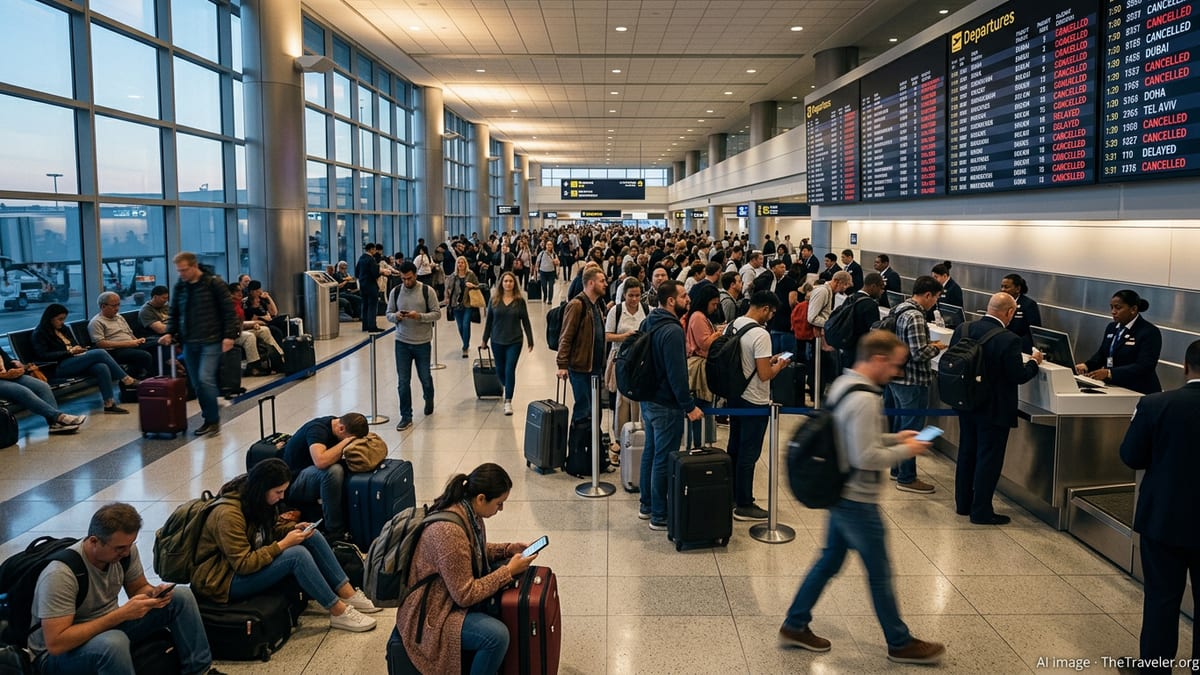
For travelers on the ground, the operational complexity translates into crowded terminals, patchy information and difficult choices. At New York area airports, passengers bound for destinations as varied as Tel Aviv, Dubai, Mumbai and Johannesburg have reported standing in line for hours to rebook itineraries, only to find that alternative routes via Europe or other hubs are sold out for days.
In some cases, travelers departing from or connecting through US and Canadian airports are discovering the full extent of the chaos only at check in, when agents advise that their onward legs through the Middle East have been cancelled or placed on indefinite hold. With limited spare capacity across remaining long haul corridors, families and business travelers alike are being rebooked on multi stop journeys that add a day or more to total travel time.
Consumer advocates are urging passengers to monitor flight status constantly, use airline apps and sign up for text alerts, and to avoid heading to the airport until they have written confirmation that a flight is scheduled to operate. They also recommend that travelers build in generous buffers for any trip involving a connection to or from Europe, Africa or Asia, given the heightened risk of missed connections caused by knock on delays.
Travel insurance and passenger rights frameworks add another layer of complexity. Many standard policies exclude cover for disruptions related to war and government ordered airspace closures, leaving some travelers relying on airlines’ goodwill policies for refunds, credits or fee free rebooking. Experts suggest that anyone whose plans are not urgent consider postponing trips that would normally rely on Middle Eastern hubs until flight schedules stabilize.
Authorities Issue Advisories as Industry Braces for Prolonged Impact
Aviation and government authorities in the United States and Canada are closely monitoring developments, issuing updated advisories on overflight restrictions and destination risk levels. Regulators have restricted US carriers from operating in or over several affected countries, and continue to warn that the situation in and around the Gulf remains volatile and subject to rapid change.
The US State Department has already advised Americans to defer nonessential travel to multiple countries in the region and is working with airlines and partner governments on limited evacuation and repatriation options. While those efforts are primarily focused on citizens currently in the Middle East, they also influence commercial capacity as aircraft are reassigned to special missions and regular routes are thinned out.
Industry groups representing airlines and airports are calling for clear, coordinated communication on when key airspaces might partially reopen and under what conditions. They warn that even a phased return of traffic will require careful management to avoid congestion in the narrow corridors that remain open and to prevent further disruption for flights linking North America with the rest of the world.
For now, travelers in New York, across the United States and in Canada are being advised to prepare for a period of sustained uncertainty. With a major section of global airspace effectively off limits and the conflict that sparked the closures still unfolding, airlines and passengers alike are adjusting to an unpredictable new reality for long haul travel.