

More news on this day
United States and Canadian aviation authorities have ordered Middle East Airlines to ground its widebody jets at North American airports, as widespread airspace closures over the Gulf region sever key transatlantic and transpacific corridors and deepen an already severe global travel disruption.
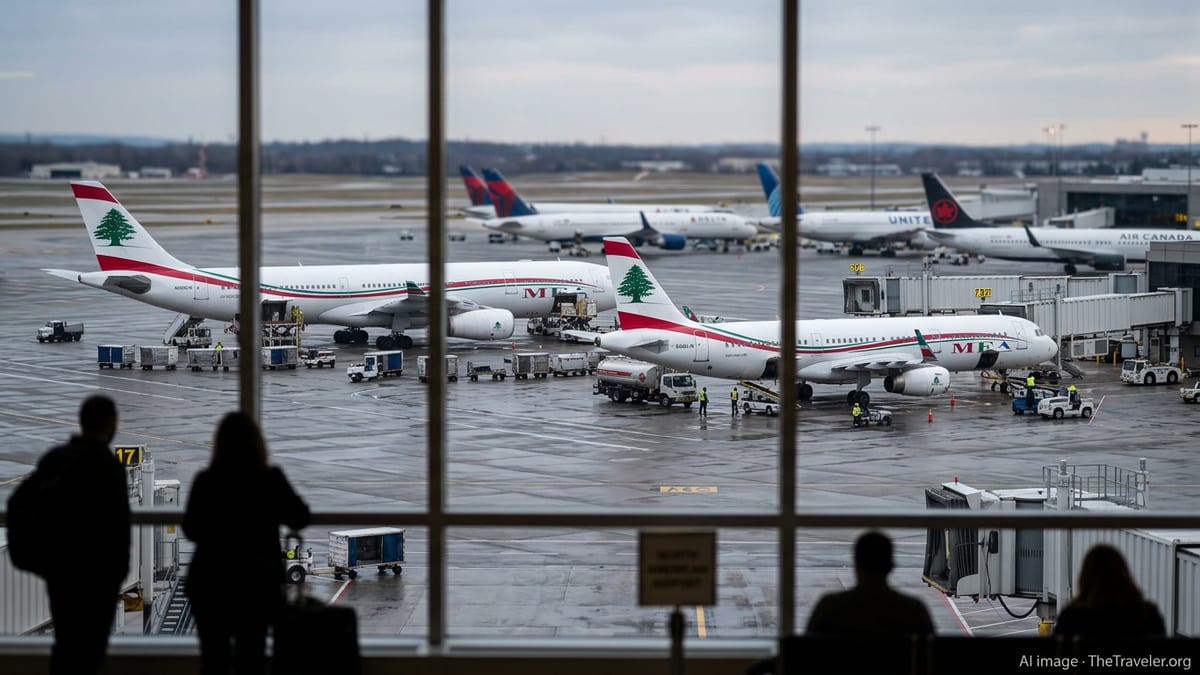
Dozens of Widebody Jets Stranded Across North America
A growing number of Middle East Airlines long haul aircraft have been taken out of circulation at major hubs across the United States and Canada, after regulators moved to keep the jets on the ground while large swaths of Middle Eastern and Gulf airspace remain closed. Aviation data firms report that widebody aircraft including Airbus A330s and Boeing 777s are parked at gates and remote stands from New York and Washington to Toronto, Montreal and Vancouver.
The grounding affects aircraft that would normally shuttle thousands of passengers each day between Beirut and destinations across North America, the Gulf and Asia. With onward routes through the Gulf rendered unusable by airspace shutdowns and missile activity, officials opted to hold the aircraft in place rather than dispatch them on complex and uncertain diversion routings.
Airport operations teams describe an increasingly challenging juggling act, as stranded long haul jets occupy stands needed for other international arrivals. Some airports have begun towing Middle East Airlines aircraft to distant remote parking areas, reminiscent of the parking strategies used during the early months of the Covid 19 pandemic.
While narrowbody aircraft used on shorter regional segments remain primarily positioned in the Middle East, the immobilization of the widebody fleet in North America has sharply reduced the carrier’s global carrying capacity and left thousands of seats out of service at the start of a busy spring travel season.
Regulators React to Escalating Gulf Airspace Closures
The decision by authorities in the United States and Canada comes in response to rapidly evolving security risks following recent US and Israeli strikes on Iranian targets and subsequent missile and drone attacks across the Gulf. Over the weekend, states including Iran, Iraq, Israel, Jordan, Kuwait, Qatar, Saudi Arabia and the United Arab Emirates introduced sweeping or partial airspace closures, effectively shutting some of the world’s busiest long haul corridors.
With major hubs such as Dubai, Abu Dhabi and Doha affected by shutdowns or reduced operations, carriers that rely on these airports as transfer points have been forced to cancel or reroute hundreds of flights. North American regulators, already operating under elevated security postures, moved to restrict operations by Middle East based airlines whose standard routings would cross the most volatile airspace.
Safety analysts note that while commercial aviation regularly adapts to regional conflict by skirting no fly zones, the current pattern of overlapping closures leaves few viable options for safe and efficient routings between North America, the Levant and the broader Middle East. That scarcity of alternatives, combined with the risk of miscalculation in congested skies, has driven a particularly conservative regulatory response.
Industry observers say the coordinated stance between US and Canadian authorities underscores the seriousness with which both countries view the threat environment. Officials have indicated that the grounding orders and routing restrictions will be reviewed on a rolling basis, but have cautioned airlines and passengers not to expect rapid normalization.
Ripple Effects for Passengers and Global Networks
For travelers, the impact is immediate and far reaching. Passengers booked on Middle East Airlines services linking Beirut with North American cities are facing abrupt cancellations, lengthy delays and complex rebookings via Europe or alternative hubs that remain open. Call centers and airport service desks have been overwhelmed as stranded customers seek clarity on new itineraries, refunds or temporary accommodation.
The disruption is also rippling well beyond the airline’s own network. Middle East Airlines codeshare partners in Europe and North America are contending with unexpected demand spikes on remaining routes, even as their own operations are constrained by detours around closed airspace. Longer routings mean higher fuel burn, potential technical stops and tighter crew scheduling margins, increasing the likelihood of knock on delays.
Cargo flows are similarly affected. Widebody passenger jets play a crucial role in belly hold freight movements between North America and the Middle East, carrying everything from e commerce parcels and pharmaceuticals to automotive parts and perishables. With key aircraft now parked, shippers are scrambling to secure limited capacity on freighters and on unaffected routes, driving up spot rates and threatening supply chains that rely on just in time deliveries.
Travel agents and online booking platforms report a surge in itinerary changes as leisure and business travelers attempt to reroute away from the Gulf while still reaching destinations such as India, Southeast Asia and East Africa. Many are finding that alternative options involve longer travel times, additional connections and less predictable schedules.
Comparisons to Past Aviation Crises
Veteran aviation experts are drawing comparisons between the present crisis and previous moments when geopolitics abruptly reshaped global air traffic patterns. The closure of North American airspace after the attacks of September 11, 2001, volcanic ash disruptions over Europe in 2010 and the sudden grounding of international flights at the onset of the Covid 19 pandemic all forced airlines and regulators to improvise in real time.
What distinguishes the current situation, analysts argue, is the combination of sustained military activity, overlapping national security measures and the centrality of Gulf airspace to east west connectivity. For many passengers traveling between North America and destinations in South Asia, East Africa and Australasia, routings through the Gulf have become standard in recent decades. With those corridors suddenly unreliable, the pressure falls back on European, Central Asian and occasionally African transit points.
Airport communities in the United States and Canada are again finding themselves as temporary waystations for travelers caught in a global disruption far from home. Hotels near major gateways report elevated occupancy as airlines arrange accommodations for passengers who cannot immediately be rebooked. Local transport systems and consular services are also adjusting to an influx of stranded visitors seeking assistance and information.
For Middle East Airlines, the logistical puzzle is particularly complex. Decisions about whether to reposition widebody aircraft back toward the Levant via longer northern routes, or to keep them in North America until airspace restrictions ease, involve difficult calculations about crew, maintenance, passenger demand and the evolving security picture.
What Travelers in the United States and Canada Should Expect
Travel authorities in both countries are urging passengers to check the status of their flights frequently and to stay in close contact with airlines before heading to the airport. With schedules shifting hour by hour, even flights that appear confirmed can be subject to last minute cancellations, time changes or equipment swaps as carriers respond to new security advisories.
Travelers booked on itineraries involving the Middle East in the coming days are being advised to build in additional buffer time, carry essential medications and valuables in hand luggage and prepare for the possibility of overnight stays or extended layovers. Those who have not yet departed may wish to explore alternative routings or defer nonessential trips until the extent and duration of the airspace closures becomes clearer.
Insurers and consumer advocates are reminding passengers to review policy terms around trip interruption and war or conflict exclusions, which may affect eligibility for reimbursements. In some cases, airlines are going beyond minimum legal requirements by offering flexible rebooking, travel credits or full refunds, particularly where government advisories discourage travel to affected regions.
For now, the immobilized Middle East Airlines widebody jets at North American airports stand as a visible symbol of the wider aviation shock radiating outward from the Gulf. How quickly those aircraft return to the skies will depend not only on regulatory decisions in Washington, Ottawa and Beirut, but on whether the region’s fragile security situation stabilizes enough to restore confidence in the airways that link East and West.