

More news on this day
Travelers across Mexico’s Pacific coast and several inland states are facing sudden shelter-in-place orders, flight cancellations and highway blockades after the killing of cartel kingpin Nemesio “El Mencho” Oseguera Cervantes triggered a surge of violence, prompting urgent security alerts from both the United States and Canada.
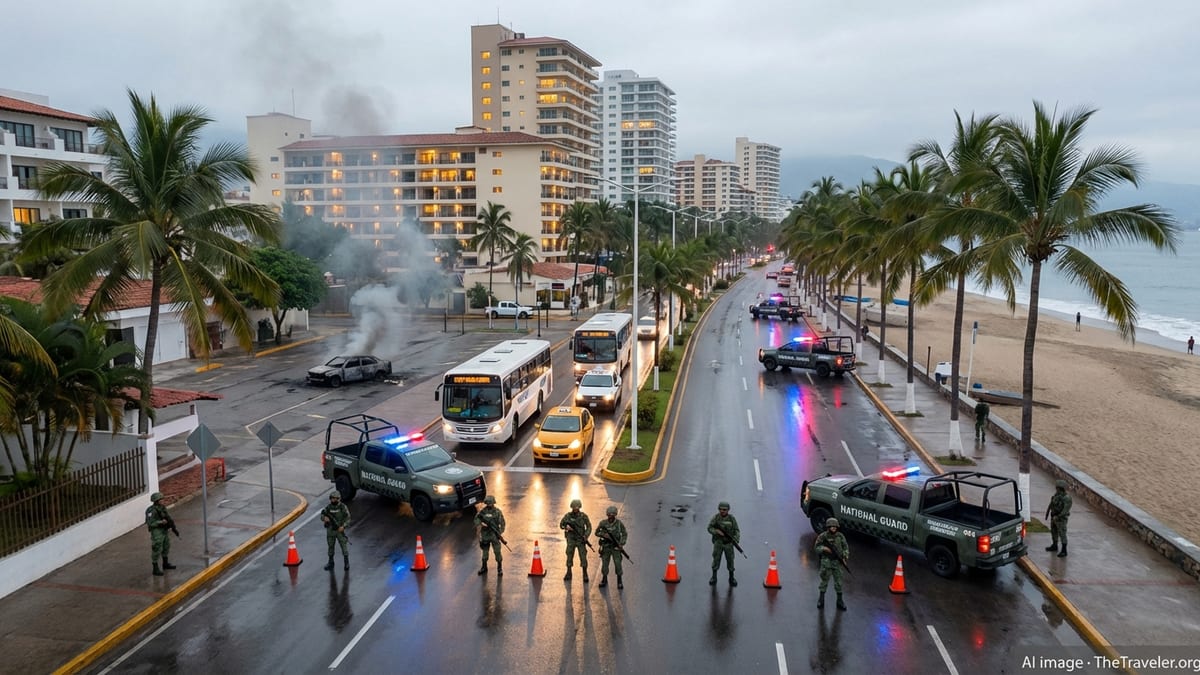
Cartel Kingpin’s Killing Sparks Wave of Unrest
The latest turmoil began on February 22, 2026, when Mexican security forces killed Nemesio Rubén Oseguera Cervantes, widely known as El Mencho, during a military operation near Tapalpa in the western state of Jalisco. Oseguera was the alleged leader of the Jalisco New Generation Cartel, or CJNG, long considered one of Mexico’s most powerful and violent criminal organizations.
Authorities say the operation quickly triggered a violent backlash. Armed groups set vehicles ablaze and erected roadblocks in multiple states, including Jalisco, Guanajuato, Michoacán and Guerrero. Local media and eyewitness accounts describe gunfire, explosions and burning buses used to seal off key corridors around Guadalajara and along routes leading to coastal resorts.
Images shared by officials and residents show charred vehicles abandoned on highways and heavily armed security forces deployed to keep roads open. Analysts warn that the death of such a high-profile cartel figure is likely to unleash an unpredictable power struggle inside CJNG and a test of strength with rival groups, raising the risk of further flare-ups in the coming days.
US Issues Shelter-in-Place Alert for Multiple Mexican States
Within hours of the operation, the US Embassy and Consulates in Mexico issued a rare, sweeping security alert ordering American citizens in several regions to shelter in place “until further notice.” The alert covers Jalisco State, home to the popular resort city of Puerto Vallarta and the metropolitan hub of Guadalajara, as well as parts of Tamaulipas, Michoacán, Guerrero and Nuevo León.
Officials cited “ongoing security operations and related road blockages and criminal activity” as the reason for the heightened warning. Americans in the affected areas were instructed to avoid crowds and areas with active law enforcement or military operations, stay indoors as much as possible, monitor local news and social media, and keep family and friends informed of their whereabouts.
The State Department emphasized that the alert is separate from its longstanding countrywide travel advisory for Mexico, which already warns about elevated risks in many states. This new directive is more immediate and situational, aimed at people already on the ground who may suddenly find themselves unable to move freely because of blockades or clashes.
US officials also underscored that the security environment could change rapidly, urging travelers to be prepared for extended shelter-in-place periods, disruptions to mobile service, and difficulty reaching airports or bus terminals if violence spreads or intensifies.
Canada Raises Advisory and Urges Tourists to Stay Indoors
Ottawa moved quickly in parallel, with Global Affairs Canada updating its guidance for Mexico and issuing pointed warnings for Canadians in several hard-hit states. The department advised travelers in Jalisco, Michoacán and Guerrero to shelter in place, keep a low profile and follow the instructions of local authorities amid reports of shootouts and explosions.
Canadian officials expressed particular concern about the situation in Puerto Vallarta and the surrounding Bay of Banderas, a magnet for Canadian snowbirds and winter vacationers. Localized violence and roadblocks in and around the city have raised questions about access to the airport and the ability of tourists to move between resorts and residential zones.
Canada also cautioned that the security situation is fluid and that official consular assistance could be complicated by blocked roads or ongoing operations. Travelers have been urged to register their presence in Mexico, review their insurance coverage and remain in close contact with airlines and tour operators regarding evacuation or rebooking options.
Flights Canceled as Airports and Highways Become Flashpoints
The unrest has quickly rippled through Mexico’s transportation network, stranding travelers and forcing airlines to suspend or reroute flights. United Airlines canceled its operations to and from Puerto Vallarta and Guadalajara, while other US carriers, including Southwest and Alaska, reduced or halted service to affected airports as reports of roadblocks and burning vehicles intensified.
Canadian carriers, including Air Canada and WestJet, also suspended flights into Puerto Vallarta and other Pacific gateways, citing the “ongoing security situation” and uncertainty over safe ground access to terminals. Inbound flights have been diverted or scrubbed entirely, leaving some passengers stuck at their points of origin and others unable to depart Mexican resorts as scheduled.
Local authorities report that roadblocks and vehicle fires near Guadalajara and along key approach routes to Puerto Vallarta have complicated airport access, prompting security forces to escort some convoys and temporarily close sections of highway. Videos shared by travelers show long lines of tourists waiting in terminals as departures boards fill with delays and cancellations.
Travel industry analysts say the sudden wave of disruptions highlights how quickly cartel violence can impact even heavily touristed corridors that are usually insulated from the worst of Mexico’s organized crime conflicts. For now, airlines are making decisions on a rolling basis, reassessing schedules day by day as information from local authorities and airport operators comes in.
Tourism Hotspots Grapple With Security Fears
Few places illustrate the tension between Mexico’s booming visitor economy and persistent security challenges as starkly as Puerto Vallarta and the broader state of Jalisco. The Pacific resort region, known for its beaches, all-inclusive hotels and growing expatriate communities, is a crucial pillar of Mexico’s tourism industry and a major draw for US and Canadian travelers.
Local business owners and tourism officials are now scrambling to reassure visitors while responding to the immediate crisis. Some hotels have implemented contingency plans that include advising guests to remain on property, limiting nonessential excursions and coordinating with local authorities for updates on road conditions and potential curfews.
In Guadalajara, a key host city for the 2026 World Cup, the scenes of burned-out buses and armored vehicles on urban streets have raised concerns about how future international events might be affected if cartel violence remains volatile. While officials stress that the current violence is tied directly to the operation against El Mencho, they acknowledge that restoring a sense of security will be vital for maintaining traveler confidence in the months ahead.
Elsewhere on the Pacific coast and beyond, including parts of Guerrero and Michoacán that already carried strong security warnings before this week’s events, residents and tourism operators fear that any renewed fighting between criminal groups and the state could further damage local economies that depend heavily on foreign visitors.
What Travelers on the Ground Are Being Told to Do
For tourists currently in the affected regions, both US and Canadian authorities are emphasizing a simple message: stay put, stay informed and avoid unnecessary movement until the situation stabilizes. Travelers are advised to follow directions from hotel management and local officials, as many properties are in direct contact with police and civil protection agencies.
Standard guidance includes remaining indoors during periods of active violence or roadblocks, avoiding attempts to drive through barricades, and steering clear of demonstrations, checkpoints or any gathering of armed individuals. Governments are urging citizens to keep their phones charged, maintain a supply of essential medications and drinking water, and have a plan to communicate if mobile networks are disrupted.
Consular officials recommend that travelers confirm that their travel insurance covers security-related disruptions and changes, and that they keep copies of travel documents in both digital and physical form. For those with imminent flights, airlines and tour operators remain the primary source of information about whether it is safe and practical to travel to the airport.
While there have been no widespread reports of tourists being specifically targeted in the wake of El Mencho’s killing, experts warn that being in the wrong place at the wrong time can be dangerous, particularly in areas where criminal groups use road closures and vehicle fires to slow the advance of security forces.
Impact on Future Travel Plans to Mexico
The immediate question for many would-be visitors is whether to postpone or cancel upcoming trips to Mexico’s Pacific coast and other affected states. Travel advisers say that decisions should be guided by official government advisories, the specific destination involved and the traveler’s own risk tolerance.
Some tour operators are already offering free changes or credits for itineraries that include Puerto Vallarta, Guadalajara or parts of Jalisco, Michoacán and Guerrero. Airlines, meanwhile, have begun issuing flexible rebooking policies for passengers booked on flights to suspended or high-risk destinations, although options vary by carrier and fare type.
Travel experts note that Mexico is a vast country and that the current alerts are concentrated in particular regions linked to the CJNG operation. Popular destinations in other parts of the country may remain relatively unaffected in terms of day-to-day security, even as national authorities remain on high alert and international governments adjust their travel guidance.
Still, the killing of such a prominent cartel leader raises the prospect of a prolonged period of instability in western and central Mexico, which could weigh on traveler confidence well beyond the immediate crisis. Industry stakeholders say transparency from both Mexican officials and foreign governments will be crucial in helping visitors make informed decisions.
Balancing Security Concerns With Mexico’s Tourism Economy
Mexico’s government now faces the delicate task of maintaining pressure on organized crime while reassuring millions of international visitors that the country remains open and welcoming. Tourism is a cornerstone of the national economy, and destinations such as Puerto Vallarta, Guadalajara and coastal communities in Jalisco and Guerrero rely heavily on spending from US and Canadian travelers.
In response to the violence, Jalisco’s governor activated a Code Red security protocol, deploying additional troops and police to key intersections, airports and tourist zones. Federal officials have promised to restore order quickly, arguing that the operation against El Mencho represents a critical blow against one of the most feared cartels in the country.
Security experts caution, however, that the removal of a powerful cartel boss does not automatically translate into safer streets. Short-term spikes in violence are common as criminal factions vie for control, and there is often a lag before any potential long-term security gains are felt by residents or visitors. For travelers, that means closely monitoring advisories in the coming weeks and being prepared for rapid changes in conditions.
For now, the message from both Washington and Ottawa is unequivocal: those already in the most affected parts of Mexico should stay indoors and minimize movement, while those planning trips should watch developments closely. How swiftly Mexico can contain the fallout from El Mencho’s killing will determine whether this crisis becomes a brief disruption or a more lasting turning point for travel across some of its most visited regions.