

More news on this day
Delta Air Lines is facing mounting criticism after the custom motorized wheelchair of Ms. Wheelchair America 2026 was severely damaged on a recent flight, an incident that has turned the spotlight on airline treatment of disabled travelers just as regulators in the United States and United Kingdom move to tighten accessibility rules.
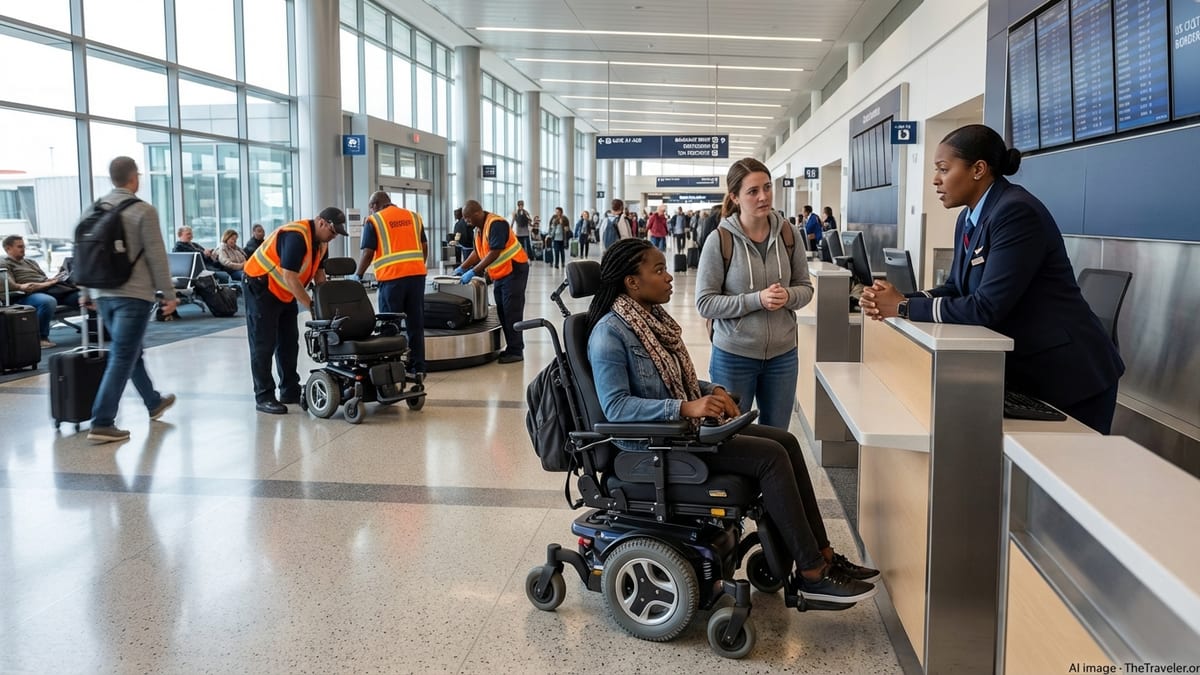
Delta Incident With Ms. Wheelchair America Sparks Outcry
The latest controversy centers on Latavia Sturdivant, the reigning Ms. Wheelchair America 2026, whose customized power chair was damaged on a Delta flight returning to New York from an adaptive ski event in South Dakota. The chair, tailored to support her posture and prevent painful muscle contractions, arrived in pieces, with a broken joystick, cracked components, and bent foot plates, leaving her largely confined to her home.
Sturdivant has described the damage as devastating, saying the chair is not a simple piece of luggage but an extension of her body and independence. Obtaining replacement parts for such a bespoke device can take weeks or months, disrupting her advocacy schedule and daily life. She reported being told that a family member could simply push the heavy chair, a suggestion that disability advocates say reflects a fundamental misunderstanding of complex mobility aids.
Delta has issued a public apology and said it is working directly with Sturdivant to assess the damage and cover repair costs, while reiterating that the airline understands the impact of mishandled mobility devices. The case, however, has quickly moved beyond a single passenger’s claim, becoming a flashpoint in a much broader debate about how safe and dignified air travel truly is for wheelchair users.
The episode comes at a time when passenger stories about damaged wheelchairs and inadequate assistance are increasingly visible in mainstream and social media. For many travelers with disabilities, Sturdivant’s experience has become a powerful symbol of systemic shortcomings that have persisted for years despite repeated promises of reform.
Rising Pressure on Airlines Over Wheelchair Mishandling
The scrutiny on Delta follows a series of high-profile incidents and enforcement actions that have exposed persistent failures across the airline industry. U.S. Department of Transportation data show that wheelchairs and scooters are damaged, delayed, or lost at a rate of roughly one for every hundred devices transported on domestic flights, a ratio that can translate into thousands of passengers affected every year.
For travelers who depend on their equipment for mobility, posture, circulation, and pain management, such mishandling is far more serious than a delayed suitcase. Many describe being effectively stranded at their destination, forced into ill-fitting loaner chairs that can cause injuries, pressure sores, or long-term health complications. Others recount trips cut short or canceled entirely over fears that their chairs might not survive the cargo hold.
Airlines have repeatedly pledged improvements, investing in training and new tracking systems, yet lawsuits and complaints continue to emerge. Delta itself has faced separate allegations from passengers with disabilities, including a Marine veteran with prosthetic legs who has sued the airline after being moved from an exit row seat, a case framed by his lawyers as evidence of discriminatory assumptions about who is fit to assist in an emergency.
These incidents are unfolding against a backdrop of heightened regulatory oversight, as governments in both Washington and London seek to turn long-standing guidance into enforceable standards. The clash between airlines’ efficiency-driven operations and the individualized needs of passengers with disabilities is rapidly becoming a defining test of the industry’s commitment to inclusion.
US Tightens Rules Under the Air Carrier Access Act
The United States has moved aggressively in the past two years to reinforce protections under the Air Carrier Access Act, the core federal law governing disability rights in air travel. The Department of Transportation has repeatedly signaled that mishandled wheelchairs are no longer being treated as inevitable operational glitches but as potential civil rights violations.
In a sweeping final rule announced in December 2024, the department established stricter standards for how airlines assist passengers who use wheelchairs and how they handle mobility devices in the cabin and cargo hold. The rule mandates more rigorous, hands-on training for airline employees and contractors who physically assist disabled passengers or move their wheelchairs, aiming to reduce both injuries and damage.
The regulation also clarifies that any wheelchair returned in worse condition than it was received is presumed to have been mishandled in violation of federal law, placing the burden on airlines to prove otherwise. Carriers must coordinate prompt repairs or replacements at no cost to the passenger and provide loaner mobility equipment that is functionally appropriate while the original device is being fixed or replaced.
These measures build on the department’s Airline Passengers with Disabilities Bill of Rights, introduced in 2022 as a plain-language summary of travelers’ entitlements. Together, the guidelines and new rule create a more explicit framework for accountability, empowering passengers to pursue complaints and giving regulators clearer grounds for enforcement when airlines fall short.
Record Fines and Enforcement Signal a New Era
The policy shift in Washington is backed by a willingness to impose record-breaking penalties. In October 2024, the Department of Transportation announced a 50 million dollar fine against American Airlines for a pattern of violations involving passengers with disabilities, including unsafe assistance and mishandling of wheelchairs over a period of several years.
The penalty, described by officials as the largest ever for disability-related infractions in air travel, was structured to force significant reinvestment in accessibility. A substantial portion of the amount must be directed toward system upgrades, staff training, equipment, and compensation initiatives aimed at improving service for passengers who use mobility devices.
American Airlines has responded by highlighting multimillion-dollar investments in wheelchair handling technology, lifts, and dedicated movers across its hubs, along with new tracking tools for mobility devices. The carrier has said that mishandling rates and disability-related complaint levels have declined, even as the number of passengers requesting assistance continues to rise.
Advocates view the American Airlines case as a warning shot to the broader industry. With disability-related complaints still flowing into federal channels, and wheelchair mishandling rates remaining stubbornly high, regulators have signaled that more investigations and potential enforcement actions could follow if systemic problems persist.
UK Intensifies Focus on Training and Dignity in Air Travel
Across the Atlantic, the United Kingdom is grappling with many of the same challenges. A government-backed taskforce led by crossbench peer and former Paralympian Tanni Grey-Thompson recently called for mandatory disability and accessibility training for all airline and airport staff, citing distressing evidence of inconsistent and sometimes harmful treatment.
The taskforce’s report catalogues a range of failures, from poor handling of wheelchairs and mobility devices to inadequate support for passengers traveling with assistance dogs or medical equipment. Accounts of travelers left stranded in terminals, separated from their chairs, or subjected to undignified boarding and deplaning processes have amplified calls for reform.
Demand for accessible air travel in the UK is growing. Millions of passengers now request assistance each year, a figure that transport authorities expect to increase as populations age and more disabled travelers assert their right to fly. Yet the taskforce found that training remains patchy, often reliant on voluntary schemes rather than binding standards.
UK ministers and aviation leaders have broadly welcomed the recommendations, acknowledging that high-profile failures risk undermining public confidence. While some reforms will require cooperation at the international level, particularly where global aviation rules are involved, campaigners argue that national regulators still have significant levers to raise expectations for airlines and ground handlers operating in and out of British airports.
Inside the Experience of Traveling Without a Reliable Wheelchair
Behind the policy announcements and corporate statements are the lived experiences of travelers like Latavia Sturdivant and thousands of others whose journeys have been upended by damaged or delayed mobility aids. For many wheelchair users, the prospect of surrendering their chair at the aircraft door is fraught with anxiety long before they reach the gate.
Once checked into the system, power chairs and scooters can be exposed to multiple transfer points, tight cargo holds, and rushed turnaround times. Even minor mishandling can bend frames, crack custom-molded seating, or damage electronics. Because many chairs are highly individualized medical devices, quick replacements are rarely possible, and off-the-shelf loaners seldom provide adequate support.
Travelers report physical repercussions ranging from back pain and muscle spasms to skin breakdown and long-term posture issues when forced into unsuitable temporary chairs. The psychological impact can be just as severe, with many describing humiliation, loss of autonomy, and a reluctance to fly again. Surveys suggest that a significant number of disabled people avoid air travel altogether because of these fears.
Advocates stress that mishandling a wheelchair is akin to breaking a passenger’s legs or taking away their ability to move independently. That framing has gained traction in the public conversation, reinforcing calls for airlines and regulators to treat these incidents not as routine baggage problems but as serious accessibility and human rights concerns.
Airlines Promote Safety Policies While Facing Accessibility Tests
As regulators clamp down on mishandling and inadequate assistance, airlines are seeking to balance enhanced accessibility with emerging safety requirements, particularly around the lithium batteries that power many modern mobility devices. Carriers point to a small but rising number of battery-related incidents as a reason for tighter controls, even as they acknowledge the need to keep barriers as low as possible for disabled passengers.
Some airlines have begun requiring passengers using electric wheelchairs and scooters to remove lithium batteries for carriage in the cabin, aligning with evolving safety recommendations. The batteries are treated as essential assistive equipment rather than standard personal items, a distinction that aims to minimize disruption while reducing fire risks in the cargo hold.
Industry representatives argue that safety-driven policies and accessibility improvements can coexist, but disability groups warn that new rules must be implemented with clear communication, practical assistance, and flexibility. Without that, they say, well-intentioned changes could add new layers of stress to an already challenging travel experience for people who rely on powered mobility devices.
For now, the Sturdivant case has become a litmus test of how airlines handle the tension between operational demands, safety protocols, and their duty of care to passengers with disabilities. Many will be watching to see not only how quickly her wheelchair is repaired, but also what broader steps carriers take to prevent similar damage in the future.
What Stronger Accessibility Standards Could Mean for Travelers
For passengers with disabilities in both the United States and United Kingdom, the new rules and recommendations promise a more structured and responsive system, though meaningful change will depend heavily on implementation. In the U.S., clearer liability standards and mandated training could lead to more careful loading procedures, better coordination between gate staff and ramp crews, and faster resolution when things go wrong.
Travelers may also see increased availability of appropriate loaner equipment, more transparent processes for filing claims, and greater use of technology to track mobility devices from check-in to arrival. Over time, advocates hope that improved performance metrics and enforcement will make air travel sufficiently reliable that wheelchair users no longer feel they are gambling with their essential equipment whenever they board a flight.
In the UK, a stronger emphasis on universal disability training could improve consistency from one airport or airline to another, reducing the current patchwork of experiences reported by travelers. Better awareness among frontline staff of the importance and complexity of mobility devices may help prevent incidents like those now drawing international attention.
As stories like Sturdivant’s circulate globally, pressure is building on airlines to demonstrate that accessibility is central to their operations rather than an afterthought. For many disabled travelers, the hope is that this moment of scrutiny will translate into a lasting shift, where flying with a wheelchair is treated as routine and safe, instead of extraordinary and risky.